Book Review: The Wrong Lady Meets Lord Right by Suzanne Allain

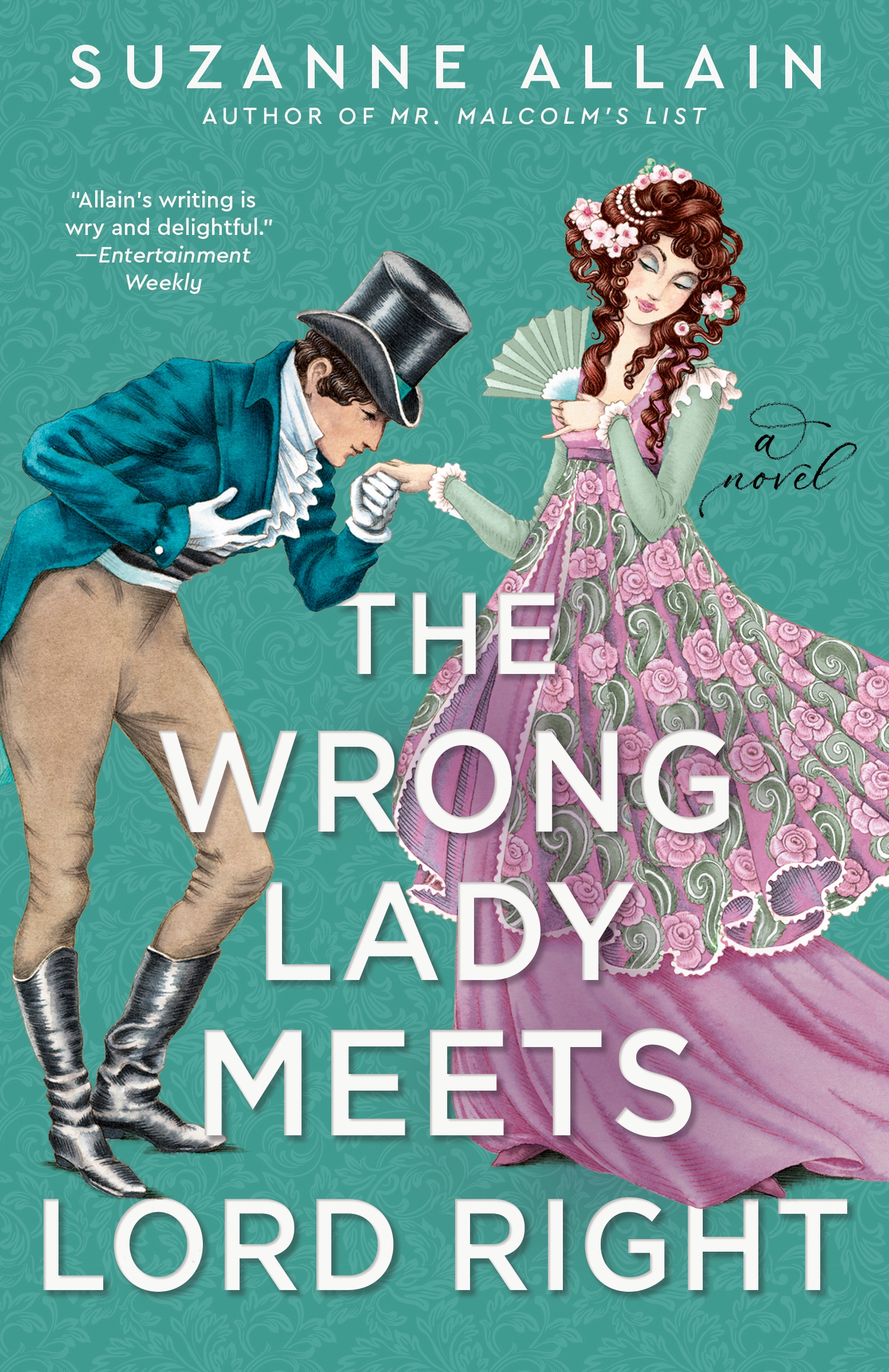
Title: The Wrong Lady Meets Lord Right
Author: Suzanne Allain
Publisher: Berkley
Publication date: December 3, 2024
Length: 271 pages
Genre: Historical fiction
Source: Review copy courtesy of the publisher via NetGalley
Rating:

Rating: 4.5 out of 5.

When a young woman trades places with her noble cousin, their innocent ruse leads to true love in this sparkling new Regency-era romantic comedy of manners from the author of Mr. Malcolm’s List.

When Arabella Grant’s wicked aunt dies suddenly, both Arabella and her cousin Lady Isabelle cannot help but feel relieved. She’d made their lives miserable, and now Lady Issie is free to read to her heart’s content, and Bella is free from taunts about her ignoble birth. 

Their newfound freedom is threatened, however, when Issie’s great-aunt commands her to travel to London for a come-out Issie has never wanted. Issie, who is in poor health, is convinced she’ll drop dead like her mother did if she drops into a curtsy before the queen. So when her great-aunt turns out to be nearsighted and can’t tell the noble Lady Isabelle from her commoner cousin Arabella, Issie convinces Bella to take her place. Bella can attend all the exclusive entertainments that her lower birth would typically exclude her from, and Issie can stay in bed, her nose in a book.

Bella agrees to the scheme for her cousin’s sake, but matters turn complicated when she meets the irresistible Lord Brooke. He begins courting her while under the impression she’s the rich and aristocratic Lady Isabelle, who, unlike Bella, is a suitable bride for an eligible young earl. And Bella, who is convinced that she has met “Lord Right,” worries what will happen when she reveals that he’s actually fallen for…the wrong lady.

Suzanne Allain’s last several books have all been delightfully frothy — yet empowering — reads, and The Wrong Lady Meets Lord Right fits right in!

In this charming new Regency novel, two cousins take on a Prince and the Pauper-esque switcheroo, with silly, laugh-out-loud results. When Lady Strickland — a nasty woman if ever there was one — dies suddenly, her entire fortune is left for her daughter Isabelle. Isabelle was treated terribly by her mother all her life, and only the presence of her beloved cousin Arabella brought joy to Issie during her younger years.

Now, freed from Lady Strickland’s tyranny, Issie and Bella look forward to enjoying their freedom — only to be summoned to London by Issie’s aunt, Lady Dutton, as soon as their year of “mourning” has passed. Lady Dutton insists that Issie’s mother intended for her to have a London season and to be presented at court, and intends to make it happen, with herself as chaperone.

Issie is terrified — she’d rather stay home and read her books. Meanwhile, Bella — always treated by Lady Strickland as the unwanted poor relation — expects more of the same in London. However, Lady Dutton is quite nearsighted and can’t tell the two girls apart. Frantic with nerves and feeling unwell from all their travel, Issie begs Bella to take her place at court — and when that works well, pleads with her to continue the ruse for the full season.

Bella loves Issie and would do anything for her, and agrees to play along if that’s what Issie needs. What Bella doesn’t expect is to encounter the charming Lord Brooke, who seems quite smitten with Bella — although he believes that she’s Isabella, known in society as Lady Belle.

Confused yet? The plot is a merry-go-round of mistaken identities, as Bella pretends to be Issie, Issie pretends to be Bella, each meets the man of her dreams, but each man believes he’s in love with the other cousin. All sorts of near-misses and shenanigans ensue, leading to delightful set pieces, a few touching moments of heartache, and (not exactly a spoiler) a very happy ending, once all the mix-ups are sorted out.

Bella is our point-of-view character, and she’s a treat. Raised alongside Issie but never considered an equal (by anyone but Issie), Bella is good-hearted, devoted to her cousin, and clear-eyed about her own future and prospects. She doesn’t expect to enjoy the game of pretend she ends up playing, and it’s entertaining and touching to see her struggle with herself about doing the right thing, especially once she has to weigh honoring promises to her cousin against deceiving the man she cares for.

The class issues are well-presented, and naturally, society’s contempt and intolerance for the lower classes is not a good look. Still, we do meet some decent members of the nobility, amidst the many pretentious and often cruel snobs, and Bella gets some true surprises about her own connections and origins.

The Wrong Lady Meets Lord Right is a fast, funny read, filled with silly capers but also genuine commitment, loyalty, and love. The relationship between Issie and Bella is the heart of the story and is especially enjoyable, and the romantic elements are quite fun too.

I really enjoyed the author’s previous two books, The Ladies Rewrite the Rules and Miss Lattimore’s Letters. After reading The Wrong Lady Meets Lord Right, I’m definitely counting Suzanne Allain as an auto-buy author, and can’t wait to see what she writes next!
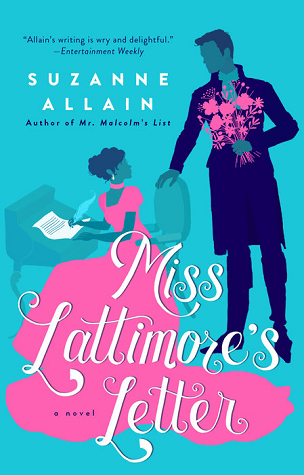
Book Review: Miss Lattimore’s Letter by Suzanne Allain

Title: Miss Lattimore’s Letter
Author: Suzanne Allain
Publisher: Berkley
Publication date: August 10, 2021
Length: 256 pages
Genre: Historical fiction
Source: Library
Rating:

Rating: 4 out of 5.

The woman who never made a match of her own is making matches for everyone else in this hilarious comedy of manners from the author of Mr. Malcolm’s List.

Sophronia Lattimore had her romantic dreams destroyed years ago and is resigned to her role as chaperone for her cousin. Still, she cannot sit idly by when she becomes aware that a gentleman is about to propose to the wrong woman. She sends him an anonymous letter that is soon the talk of the town, particularly when her advice proves to be correct. Her identity is discovered and Sophie, formerly a wallflower, becomes sought after for her “expert” matchmaking skills.

One person who seeks her out is the eligible and attractive Sir Edmund Winslow. As Sophie assists Sir Edmund in his pursuit of a wife, she wishes she could recommend herself as his bride. However, she vows to remain professional and uninvolved while aiding him in his search (especially since the gentleman surely does not return her affections).

Three unexpected arrivals soon show up at Sophie’s door—the man who once broke her heart, a newlywed who is dissatisfied with the match Sophie made for her, and the man madly in love with Sophie’s cousin—all wanting her attention. But when her onetime beau and Sir Edmund both appear to be interested in her, Sophie can’t figure out if she’s headed for another broken heart­­ or for the altar. How can she be expected to help other people sort out their romantic lives when her own is such a disaster?

After thoroughly enjoying The Ladies Rewrite the Rules, released earlier in 2024, I was eager to read more by author Suzanne Allain. I was glad to find Miss Lattimore’s Letter at the library — this 2021 novel is yet another gem of a Regency romance, with an empowered woman steering her own course rather than sitting back and letting life pass her by.

When we meet Sophie — Sophronia — she’s a 28-year-old spinster chaperoning her younger cousin Cecilia through the social season. Sophie once had a chance at marriage, but that fell through — and now she’s fated to sit with the older ladies, wear dull dresses, and watch the pretty young women enjoy their shining moments.

All this changes when Sophie accidentally overhears a private conversation, from which she learns that two impending engagements are between couples who each secretly wish to be with someone else. Sophie thinks that someone should set these people straight before it’s too late… and then decides that that “someone” might as well be her. She writes an anonymous letter, and it works: The couples realign, and the people involved end up with the ones they truly love.

Sophie’s anonymity doesn’t last long, and she’s soon being hailed as a genius matchmaker… even though she didn’t actually do anything but write a letter. Still, she finds herself once again a person generating interest in society, being asked to dance, and suddenly thought of as more than an over-the-hill spinster. When she catches the eye of a kind and witty gentleman, she’s more than a little interested, but the reappearance of the man who broke her heart so many years earlier brings unexpected complications.

Miss Lattimore’s Letter is an utterly engaging read. Yes, making matches and pursuing romances are quite central, but much of the fun is in seeing the friendships and alliances formed between Sophie and the various people in her orbit. It’s delightful to see Sophie take control of her own life, offer advice to women who feel pressured to choose money and titles over true connection, and remain true to herself even while finding a way to allow love back into her life.

The writing is clever and warm-hearted, and there are nods both to Jane Austen and to the joys of being a bookworm, which absolutely appealed to my book-loving little soul.

By the end of the morning, a morning spent in traversing the room back and forth in earnest conversation, the two young ladies were quite pleased at having made the acquaintance of someone who seemed destined to become a friend. They even had that most important characteristic of all in common: they counted the same books among their favorites.

While romance is always at the forefront of the story, I loved that the friendships between the women are treated as relationships that matter, and it’s lovely to see the trust that developments once the women open up to one another and speak honestly.

Sophie’s love triangle is perhaps a bit annoying — clearly, we know who she’s meant to be with, and which of the two men is basically a cad. Still, it’s fun watching it all play out… and we know Sophie is smart enough to make the right choice.

Sophie found it quite astonishing that she had gone eight-and-twenty years without being kissed by even one gentleman and had now been kissed by two different ones in the span of as many days. 

Miss Lattimore’s Letter is a joyful book with a memorable lead character and very clever storytelling. It made me laugh and kept me interested enough to read it straight through in one day. For Regency romance fans, this book is a treat. Don’t miss it!

Book Review: All’s Fair in Love and War by Virginia Heath

Title: All’s Fair in Love and War
Author: Virginia Heath
Publisher: St. Martin’s Griffin
Publication date: May 28. 2024
Length: 384 pages
Genre: Historical romance
Source: Review copy courtesy of the publisher via NetGalley
Rating:

Rating: 3 out of 5.

In the first installment of a Regency romp of a series, a governess who believes in cultivating joy in her charges clashes with the children’s uncle who hired her, only to find herself falling in love.

When the flighty older sister of former naval captain, Henry Kincaid, decides on a whim to accompany her explorer husband on an expedition to Egypt, he finds himself unwittingly left in the lurch with her three unruly children and her giant, mad dog. With no clue how to manage the little rascals, a busy career at the Admiralty that requires all of his attention, and no idea when his sister is coming back, Harry has to hire an emergency governess to ensure that everything in his ordered house continues to run shipshape. In desperation, he goes to Miss Prentice’s School for Girls prepared to pay whatever it takes to get a governess quick sharp to bring order to the chaos.

Thanks to her miserable, strict upbringing, fledgling governess Georgina Rowe does not subscribe to the ethos that children should be seen and not heard. She believes childhood should be everything that hers wasn’t, filled with laughter, adventure, and discovery. Thankfully, the three Pendleton children she has been tasked with looking after are already delightfully bohemian and instantly embrace her unconventional educational ethos. Their staid, stickler-for-the-rules uncle, however, is another matter entirely…

Georgie and Harry continue to butt heads over their differences, but with time it seems that in this case, their attraction is undeniable—and all is indeed fair in love and war.

All’s Fair in Love and War is a cutesy Regency romance with a kinda, sorta enemies-to-lovers vibe going on. The main characters aren’t truly enemies, but they definitely get off on the wrong foot and make terrible impressions on one another.

Harry is an up and coming naval officer run ragged by his duties, working practically around the clock in pursuit of an anticipated promotion (and ultimately, the goal of becoming admiral). When he gets saddled with his young nieces and nephew with no prior warning, he’s in desperate need of help, and is willing to pay any price to get a graduate of Miss Prentice’s School for Girls, reputed to turn out the very best governesses in England.

Who he ends up with is Georgina Rowe, a headstrong protégé of Miss Prentice who, despite years of excellent training, seems incapable of landing a governess job, largely due to her inability to stay quiet and meek when she disagrees or witnesses injustice. Harry’s desperate circumstances are a perfect opportunity for Georgie, and she starts her new job immediately… only to discover that the Captain and she have very different ideas of what constitutes a good learning environment for children.

Harry believes in discipline, serious study, and always following the clock (as evidenced by the two pocket watches he constantly wears). Georgie believes in a more holistic approach to learning, incorporating the children’s interests and getting them out of the classroom and into nature as much as possible. Harry is incensed to see his neatly ordered (dull) classroom transformed into chaos on the very first day of Georgie’s teaching tenure, and it would appear that her employment could be short-lived indeed.

And yet… the children seem to be thriving, and despite their anger and annoyance at one another, Harry and Georgie have both already noticed how very attractive they find one another. Smoldering looks abound, and before long, Harry thinks of Georgie in his more private moments as a siren, whose lure he’s having trouble resisting.

There are some pleasantly diverting scenes of Georgie’s chaotic influence on the household, comedy bits involving the children’s large dog, Harry being horrified by the lack of order, and even some sweeter moments when Harry and Georgie get a chance to recognize how great the other person is, underneath the outer annoying elements.

You can absolutely see where all this is going, but still, it’s fun to get there. Harry and Georgie are each hampered by their upbringings and consequent worldviews, so it takes quite a lot for each to unbend enough to recognize where they’re getting in their own way and what a compromise might look like.

The writing is a bit uneven. A generous view might be that the florid prose is showing the over-the-top thoughts of the characters, rather than just being how these scenes are written. Such as:

After their oddly charged moment on his landing ten days ago, the vixen had infested his mind and inserted herself so deep beneath his dermis that her essence had haunted him ever since.

And…

She was the sort who lured a man willingly onto the treacherous rocks of forever.

I also found some odd phrases here and there that sound much too modern, such as a man explaining that his wife has no boundaries, or a conversation between Harry and Georgie that starts “Well, this is awkward.”

All’s Fair in Love and War is a fun but not especially remarkable read. It’s light entertainment, but I didn’t love the writing style, and found the somewhat explicit sex scenes to be more cringe than steam. Still, it’s a quick book and a nice enough way to pass the time, and upbeat Regency romances in general have a way of boosting my spirits.

I see on Goodreads that this book is listed as first in a new series (Miss Prentice’s Protegees), which I assume will continue by focusing on Georgie’s friends in future books. I’m on the fence about whether I’ll continue, given that the writing didn’t totally suit my tastes. I also have an earlier book by Virginia Heath in my Kindle library (Never Fall for Your Fiancée), so if I do read more by this author, that’s probably where I’d go next. If you’ve read her books and have recommendations, please let me know!

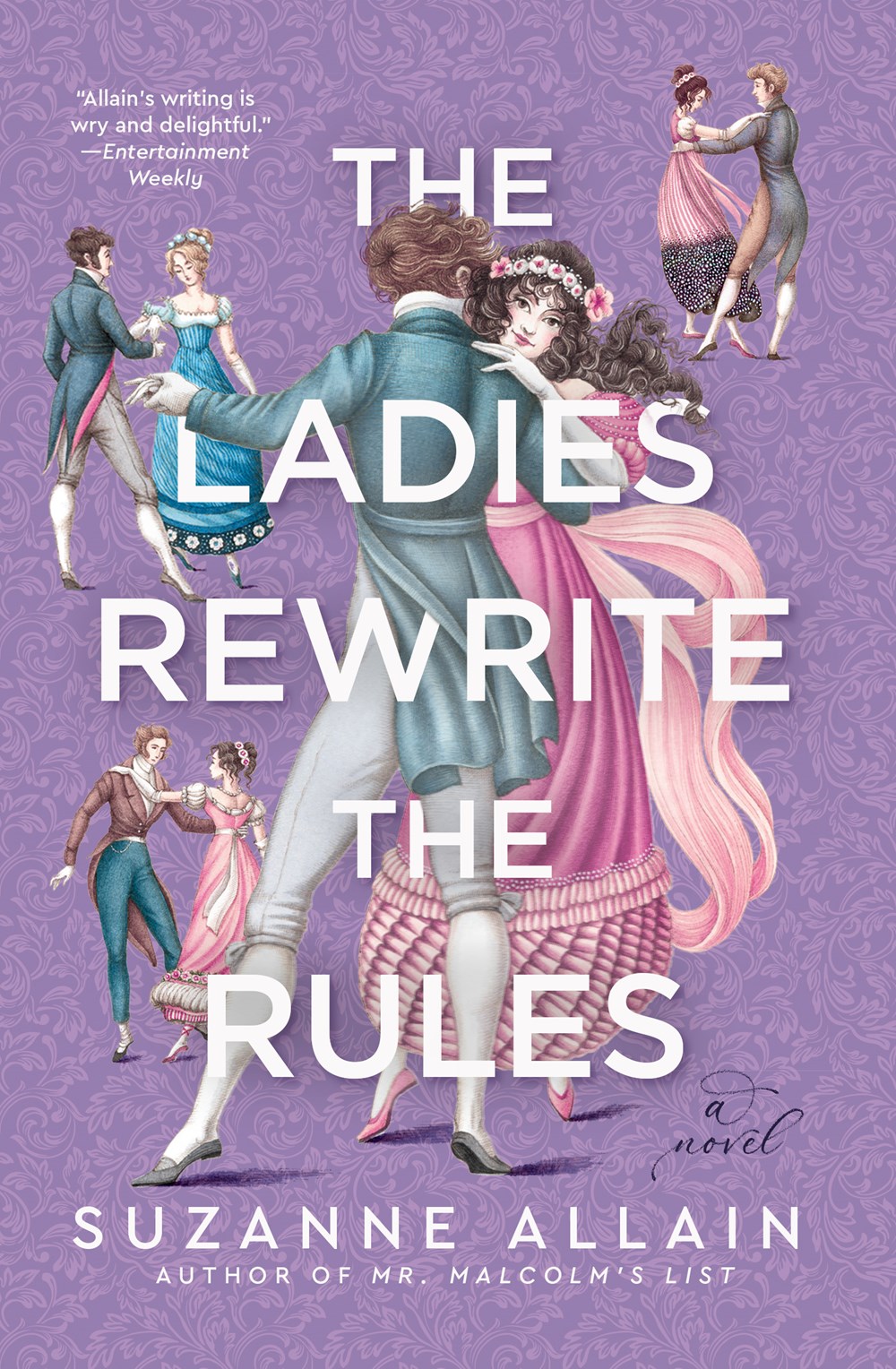
Book Review: The Ladies Rewrite the Rules by Suzanne Allain

Title: The Ladies Rewrite the Rules
Author: Suzanne Allain
Publisher: Berkley
Publication date: January 9, 2024
Length: 272 pages
Genre: Historical fiction
Source: Review copy courtesy of the publisher via NetGalley
Rating:

Rating: 4.5 out of 5.

From the author of Mr. Malcolm’s List comes a delightful romantic comedy set in Regency England about a widow who takes high society by storm.

Diana Boyle, a wealthy young widow, has no desire to ever marry again. Particularly not to someone who merely wants her for her fortune. 

So when she discovers that she’s listed in a directory of rich, single women she is furious, and rightly so. She confronts Maxwell Dean, the man who published the Bachelor’s Directory , and is horrified to find he is far more attractive than his actions have led her to expect. However, Diana is unmoved by Max’s explanation that he authored the list to assist younger sons like himself who cannot afford to marry unless it’s to a woman of means. 

She gathers the ladies in the directory together to inform them of its existence, so they may circumvent fortune hunters’ efforts to trick them into marriage. Though outraged, the women decide to embrace their unique position of power and reverse the usual gender roles by making the men dance to their tune. And together… the ladies rewrite the rules.

What a delightful little gem! This comedy of manners is an utterly fun treat about women taking back control of their destinies at a time when society tells them they’re powerless.

A woman needs a dowry to attract a man, must marry “well”, must remain virtuous at all times, must avoid the thousand and one ways she can be “ruined”, must kowtow to the powerful matrons who control social standing… the restrictions on young women of the Regency era go on and on.

Diana Boyle is lucky, all things considered. She married a much older man at age eighteen to save herself and her mother from poverty. When she finds herself a widow at age twenty-five, she’s finally able to live peacefully in the grand estate left to her by her unpleasant late husband, and for once has no pressure to do what others want. And mainly, Diana just wants to be left alone. She’s not a social butterfly, has no interest in remarrying (her unhappy first marriage was plenty, thank you), and doesn’t need balls and visits and endless society obligations.

All this changes when a pair of gentlemen show up at her estate — uninvited — and proceed to attempt to ingratiate themselves with her. Her observant butler manages to discover the reason — they’re carrying a copy of a directory that lists the wealthiest widows and unmarried women of London, and Diana is listed! She’s outraged, enough so that she overcomes her normal shyness to seek out the author of the directory and give him a piece of her mind.

Maxwell Dean is not quite the villain she’d expected. Rather than a fortune hunter, he’s a man who’s seen more than one friend fall in love, only to have it come to naught when the couple realize that neither has any money whatsoever. For a younger son, the only hope is to marry a woman of means — so why not provide some guidance in advance? Maxwell doesn’t realize how mercenary his guide might set men up to be — he honestly just thinks he’s helping people find love in a more practical way. (He’s a very special — and sweet — snowflake, to be honest).

The fun takes off when Diana makes it her mission to inform other ladies of their inclusion in the directory. While initially upset and offended, the women soon discover more than one silver lining. They band together, forming strong friendships and allyships, and realize that given the situation, they’re actually the ones with the power.

Somehow the very thing that had been the symbol of their helplessness, that directory which listed them as no more than a commodity, had now become a way for them to exert their independence, to rewrite the rules in their favor.

With all these men seeking them as marriage partners, they have a freedom never before experienced — to waltz with abandon, to decline a dance if they don’t feel like dancing with the man asking (and still dance with others!), to say no if they’re so inclined in any situation. The women of the directory find a new sense of liberty and strength, and they intend to enjoy it to the hilt.

For it’s an indisputable fact that when a person no longer seeks acceptance, they immediately become irresistible.

Of course, there’s also a budding romance between Diana and Max, and it’s quite sweet to see the two of them come together, tentatively at first, as they discover friendship, trust, and attraction. As Diana’s connections to the other women grow, and her fondness for Max strengthens too, she’s able to rethink her position in life and for once, make her own decisions about who she wants to be and how she wants to live.

The writing in The Ladies Rewrite the Rules is oodles of fun. There are plenty of funny and silly moments, but the women also share stories that are more painful and illustrate how strongly the odds are stacked against them. I especially loved seeing Diana’s friendship with Lady Regina, a wealthy heiress whose reputation had been tarnished as a much younger woman. Through their new sense of confidence and empowerment, Regina is able to right some old wrongs and realize that she is in fact as entitled to happiness as anyone else.

I picked up this book with a little bit of hesitation, as I didn’t love Mr. Malcolm’s List quite as much as I’d hoped to… and so I was incredibly happy to discover how much I enjoyed spending time with Diana, Regina, and the Ladies of the Registry.

I tore through The Ladies Rewrite the Rules in a little more than a day, and found myself smiling and laughing throughout. If you enjoy a good Regency tale with a slightly unconventional twist, be sure to check this book out!

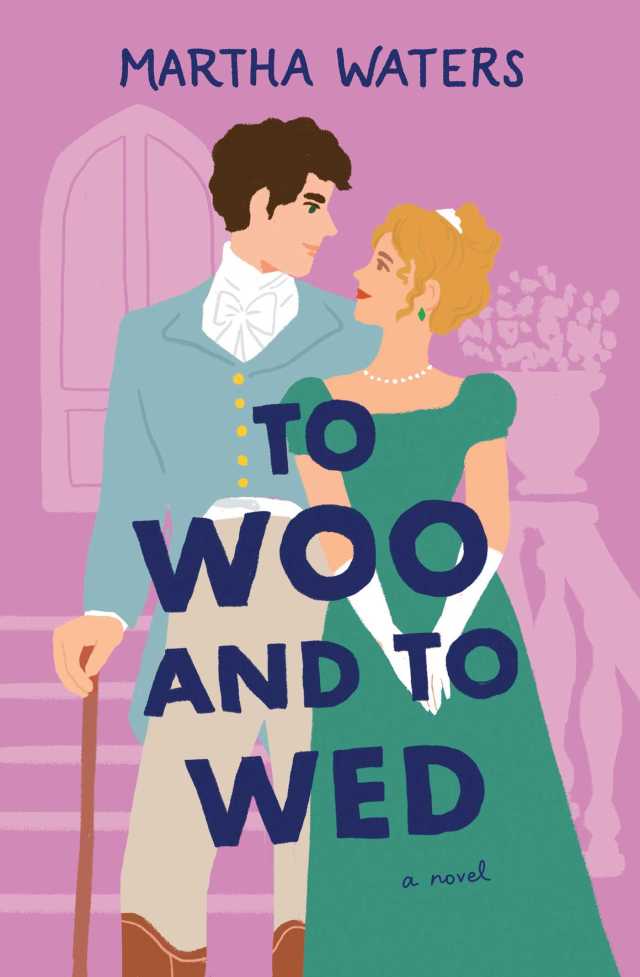
Book Review: To Woo and To Wed (The Regency Vows, #5) by Martha Waters

Title: To Swoon and To Spar
Series: The Regency Vows, #5
Author: Martha Waters
Publisher: Atria
Publication date: February 6, 2024
Length: 336 pages
Genre: Historical fiction/romance
Source: Review copy courtesy of the publisher via NetGalley
Rating:

Rating: 4 out of 5.

The final installment in the Regency Vows series follows the heir to a dukedom and a young widow, once very much in love, as they reunite years later to fake an engagement for the benefit of her sister.

West, the Marquess of Weston, and Sophie, Lady Fitzwilliam Bridewell, have lately been spending a considerable amount of time together. But West and Sophie are not new acquaintances. In fact, years ago, they had once been nearly engaged until West’s almost fatal curricle accident and his meddling father threw them off course.

Now recently widowed, Sophie has put aside all thoughts of romance. But when her widowed sister, Alexandra, mentions a fondness for an earl, Sophie realizes that she may be holding her sister back. Alexandra won’t move forward with an engagement until Sophie, too, settles down again, and so Sophie approaches West with a plan. They will announce their engagement and break things off once Alexandra is happily married. It’ll be simple. After all, it’s not like she is going to fall for West a second time, not when Sophie has sworn not to risk her heart again.

To Woo and To Wed is a fitting, satisfying wrap-up to a consistently entertaining series about love, friendship, and offbeat relationships. The series as a whole balances light-hearted romps and banter with some serious (but not too heavy) themes about family obligations and expectations. Book #5 ties the entire series together in a way that’s sure to please its faithful readers.

Throughout the series, West (Marquess of Weston, and future Duke) and Sophie (a lovely young widow) have been in the background — not driving the previous books’ plots, but factoring into the overarching storylines nonetheless. Over the course of these books, we’ve learned bits and pieces of their (mostly sad) history: At one point madly in love and on the verge of betrothal, West was in a tragic accident that killed his closest friend and left him severely injured, and upon his recovery, he discovered that Sophie had married another man. Widowed after three years of marriage, Sophie has carried an air of sadness with her, and she and West have kept their distance. More recently, however, West and Sophie have been thrown together much more frequently as their circle of friends and relatives have overlapped (in the four books of the Regency Vows series). Here in book #5, West and Sophie finally take center stage, and we learn much more about their backstory and how their lives continue to intersect.

In To Woo and To Wed, Sophie finds herself in a bind when her younger sister, also a widow, hints at being in love and ready to marry, but seems to be holding off out of concern for Sophie’s well-being. Sophie is perfectly fine on her own, yet doesn’t want to be responsible for delaying her sister’s happiness. Thrown together with West yet again due to their mutual social connections, she makes a startling proposal: She and West will announce their betrothal, ensuring her sister’s comfort in getting married. Once Alexandra is safely wed, she and West can break things off and go their separate ways.

West is amenable — he still loves Sophie, for one thing, and he’s also getting pressure from his awful, domineering father to marry and produce heirs. In fact, his father is now using outright extortion — if West doesn’t get married (and soon), his father will sell the property that once belonged to his late mother, the place that West most considers home.

Of course, a fake betrothal is bound to get complicated. First of all, their friends are rightfully skeptical, and even Alexandra seems suspicious, forcing ridiculous wedding plans (such as overly ruffled matching gowns, a double ceremony, and departure on horseback) on Sophie… in hopes of making her confess the truth?

And then there’s the undeniable fact that neither Sophie nor West has ever gotten over one another. All this forced proximity and pretend intimacy gets harder and harder to endure while denying feelings… and those feeling keep bubbling up each time they meet.

It’s quite lovely to see West and Sophie together at long last, and very satisfying to finally get their full backstory and understand just went wrong seven years earlier. They’re both great characters — smart, caring, and sensitive — and they deserve happiness. Getting there isn’t easy, but their ups and downs give us readers plenty of time to cheer them on.

All of the characters from the previous books participate in the events of To Woo and To Wed, and it’s extremely enjoyable to see them all come together, in various combinations to move the plot forward (and to meddle in Sophie and West’s romance).

The Regency Vows series is a lot of fun, and this 5th book is a terrific conclusion to the characters’ romantic adventures. Many romance series are only loosely connected, so a reader can jump in at any point. Here, there is so much involvement of other characters and winking references to past events that I can’t see the reading experience being nearly as enjoyable if someone started anywhere but with book #1, To Have and To Hoax. My recommendation? Start at the beginning, and enjoy the ride all the way through to the end!

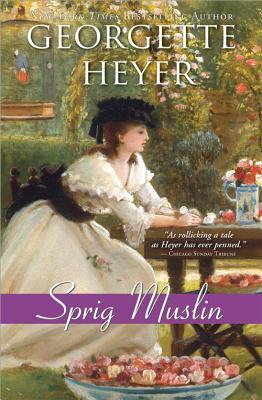
Book Review: Sprig Muslin by Georgette Heyer

Title: Sprig Muslin
Author: Georgette Heyer
Publisher: Sourcebooks Casablanca
Publication date: 1956
Length: 298 pages
Genre: Historical fiction/romance
Source: Purchased
Rating:

Rating: 4.5 out of 5.

A dashing man of honor…

En route to propose to his sensible acquaintance Lady Hester, Sir Gareth Ludlow finds young, pretty Amanda wandering unattended and knows it is his duty to bring her back to her family. This turns out to be a challenge as Amanda seems to possess an imagination as intriguing as it is dangerous.

A shocking refusal…

Lady Hester stuns both him and her family when she refuses him. At her age, no one would expect her to turn down such an eligible suitor. But Lady Hester has met the indomitable Amanda. How can the quiet, intelligent Hester hope to compete with such a lively young lady?

After finishing Georgette Heyer’s Cotillion, I felt like my appetite for her books was reignited, and turned to Sprig Muslin, a paperback I’d picked up a few years ago. I’m so happy I did! Sprig Muslin is silly, sweet-natured, fun — and a refreshing contrast to some of Heyer’s more dramatic books about rakes and rogues and dashing men with terrible reputations.

In Sprig Muslin, the two anchors of the story are good-natured, respectable adults who nonetheless find themselves caught up in a whirlwind of shenanigans. Sir Gareth Ludlow, at age 35, is fashionable, well-off, and after losing his fiancée in a tragic accident many years earlier, still single. It’s time for him to take a wife and start producing heirs.

Sir Gareth decides to propose to Lady Hester Theale, a kind, intelligent woman he’s been friends with all his life. Lady Hester, at age 29, is on the shelf and seemingly content with her lot, although she does seem to get bossed around by her overbearing brother and sister-in-law quite a bit. Hester is appalled to learn that Sir Gareth has declared his intentions to her father and is en route to propose to her; although she won’t give a reason, she definitely does not want this proposal.

Sir Gareth’s plans are interrupted when he stops for refreshment along the way and discovers a young girl on the verge of trouble. Amanda, not quite 17, has apparently run away and is determined to remain at large. Clearly belonging to an upper class family, she states that she intends to marry an up-and-coming soldier, and by running away, she intends to force her grandfather to give his consent. Amanda is headstrong and passionate, and Gareth realizes that his duty is to see her safely returned to her family rather than leaving her to make her way unchaperoned and without an actual plan.

There’s a hitch, however: Amanda refuses to name her family, where they live, or even who her soldier fiancé is. She spins story upon story, and while initially thankful that Gareth seems willing to help her, she soon realizes that he’s going to keep her from her schemes, and attempts to get away from him too.

Thus begins a madcap series of escapades, as Amanda creates one fabulous story after another to explain her situation, drawing in Gareth and then others met along the way. Each tale leads to further complications, and before too long even Hester is drawn into Amanda’s web of stories and fake identities.

Sprig Muslin is utterly delightful. As Amanda’s stories get more and more inventive, various bystanders take on roles, and her tales result in all sorts of rescue attempts, misguided escapes, and even a daring kidnap attempt that goes disastrously wrong. It’s all quite ludicrous, and so very, very enjoyable.

As with all Georgette Heyer books, the unusual words and expressions make the reading experience extra entertaining — here are a few from Sprig Muslin that I highlighted:

  • nodcock (fool or idiot)
  • marplot (one who ruins a plan through meddling)
  • bosky (drunk)
  • daffish (stupid, silly)
  • spinney (small area of trees and bushes)
  • gammon (trick)
  • nonesuch (a person or thing unrivaled or unequaled)
  • gaby (a foolish person)
  • elbow-crooker (drinker)
  • bobbery (a squabble, a noisy disturbance)
  • humdudgeon (loud complaint or noise)
  • flat (as in, “A flat, my child, is one who is easily duped”)

And as for phrases, can’t beat:

  • a fashionable fribble
  • a real top-of-the-trees, slap up to the echo (top-of-the-trees = someone of high esteem)
  • chuffy thing to do
  • in the petticoat line (associating with women of “easy virtue)

While I always enjoy Georgette Heyer’s books, Sprig Muslin may have just become my new favorite. It’s so good-natured, and the sense of fondness for Kitty’s exploits makes this a sweet read. I came away from it really appreciating all the main characters, and had plenty of giggles along the way. If you’re looking for a GH book but aren’t crazy about rakish men being cast as heroes, Sprig Muslin is a great choice!

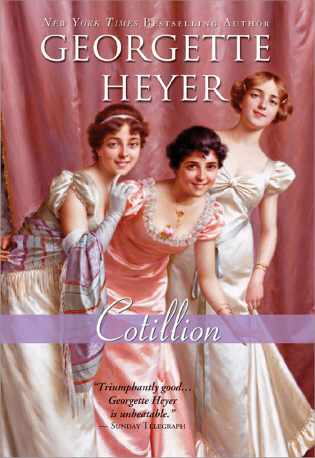
Book Review: Cotillion by Georgette Heyer

Title: Cotillion
Author: Georgette Heyer
Publisher: Sourcebooks Casablanca
Publication date: 1953
Length: 355 pages
Genre: Historical fiction/romance
Source: Purchased
Rating:

Rating: 4 out of 5.

Almost an heiress
Country-bred, spirited Kitty Charings is on the brink of inheriting a fortune from her eccentric guardian — provided that she marries one of his grand-nephews. Kitty has spent her secluded life pining for the handsome, rakish Jack, who is well aware of her attachment.

A plan of her own
But when Jack fails to respond to his great-uncle’s ultimatum, Kitty hatches a strategy of her own — a counterfeit betrothal to mild-mannered Freddy Standen (who neither needs nor wants the money).

A most unlikely hero
And when Kitty’s generous heart leads to all sorts of unintended troubles, there is only one man who can rescue her from more than one dreadful fix, pick up the pieces of her plotting and in the process, win her heart…

Cotillion is a light-hearted addition to Georgette Heyer’s huge collection of Regency romances, and it’s a silly read that still manages to surprise.

Main character Kitty is the ward of a grumpy, gouty, rich old man who has named her his heiress — but only if she marries one of her many eligible cousins-by-adoption. Great-uncle Matthew summons the lot of them to his gloomy estate, but not all show up: Jack, the dashing rake whom Kitty has loved since girlhood, has declined the invitation.

Several others do arrive as ordered — Lord Biddenden, the oldest cousin — already married and there to keep an eye on things; Lord Dolphinton, the sweet but slow-witted Earl of an Irish estate (and apparently Irish nobility isn’t considered nearly as impressive as English nobility); Hugh, a rector who’s entirely too upright and stodgy to suit Kitty… and then there’s Freddy, a “Pink” of the ton, a nice guy who likes Kitty well enough but has no interest in Great-uncle Matthew’s schemes (and as an eldest son, doesn’t need the money that comes with marrying Kitty).

Kitty is stuck — she’ll get nothing if she doesn’t marry one of the cousins, and she’s more than a little heart-broken that Jack hasn’t come to her rescue. She’s been raised in this boring home with no opportunity for society, and is desperate for at least a taste of what’s she’s missing before resigning herself to a life working as a governess or a chambermaid. What Kitty wants above all else is the chance to spend time in London — even just a month would be a treat! And so she comes up with a scheme — she asks Freddy to “offer” for her and enter into a fake betrothal. If they were betrothed, it would be proper for him to take her to London to stay with his family and introduce her to society. If they don’t publicly announce the betrothal, there will be no harm in calling it off after a month. Kitty feels quite sure that after that small taste of fun and freedom, she’ll be ready to face the rest of her life.

Freddy is a friendly, affable sort and agrees to the plan, which soon gets even more complicated. Freddy’s mother is unavailable to chaperone, so he installs her with his married sister, who’s quite a lot of fun, and soon Kitty is enjoying fashion, parties and outings. She also can’t refrain from befriending unusual people and wanting to help them, and before long, she’s caught up in the affairs of two different couples who seem to have all the odds stacked against them — but Kitty is determined to sort out their challenges and get them all a happy ending.

A note on the title: According to an essay on Tor.com:

A cotillion is a Regency dance where you change partners, and Georgette Heyer’s Cotillion is a Regency Romance where everybody twirls and faces their partners and ends up in a happy set of not-entirely predictable couples. 

What’s more, a cotillion is a dance for four couples, and that’s pretty apt for this book.

Cotillion is quite a fun read. Sure, I could quibble with the terribly sexist attitudes portrayed here, but they’re a product of their time — so I can despise the seemingly admirable rake who’s known for his string of mistresses without despising the book itself.

Reading Georgette Heyer’s Regency books is a lesson in idioms, slang, and speech patterns. Freddy in particular speaks without including subjects in his sentences:

“Thing is,” said Freddy, recognizing his cue, “never thought my uncle would permit it. Thought it was useless to approach him. As soon as I read his letter — bespoke a chaise and came at once! Trust you’ll allow me to speak to him in the morning.”

And here are just a few of the words or phrases I had to stop, highlight, and look up:

  • objurgations (harsh reprimands or criticisms)
  • retroussé (a nose that turns up at the tip)
  • wear the willow (to grieve a death)
  • fustian (pompous or pretentious speech)
  • out-and-outer (possessing a particular quality to an extreme degree)
  • bamming (hoaxing, tricking, cheating)
  • percipience (perceptiveness)
  • gudgeon (a credulous or easily fooled person)
  • Joliffe-shallow (type of hat)
  • cognomen (nickname)
  • cicisbeo (the professed gallant or lover of a woman)
  • havey-cavey (dubious, shady)

And as for dialogue, here are a few choice selections:

“Dashed bacon-brained notion to take into your to your cockloft!”

Jack’s too downy to play cards with a leg. But he ain’t a flat either.

When I go into wedded shackles in will be in my own time, and in my own fashion.

Kitty’s adventures are not to be taken terribly seriously. Having read a bunch of GH’s Regency romances already, I was sure from the start that I knew where the story was going, but — surprise!! — about midway through I realized that my expectations were way off base, and the way it all worked out really charmed me. (I’ve seen a few Goodreads reviews say that the surprise is most effective if you’ve read at least a few other Heyer romances first — and that makes sense to me!)

I can’t say that Cotillion is my favorite of Georgette Heyer’s books, but I’m certainly glad to have read it, and found it really entertaining the whole way through.

Any Georgette Heyer fans out there? Which of her books do you recommend? This is #8 for me, and I’ll happily read more (although I think about 1 or 2 per year is probably the most I can handle).

Book Review: To Swoon and To Spar (The Regency Vows, #4) by Martha Waters

Title: To Swoon and To Spar
Series: The Regency Vows, #4
Author: Martha Waters
Publisher: Atria
Publication date: April 11, 2023
Length: 336 pages
Genre: Historical fiction/romance
Source: Review copy courtesy of the publisher via NetGalley
Rating:

Rating: 4 out of 5.

The Regency Vows series returns with this story about a viscount and his irascible new wife who hopes to chase her husband from their shared home so that she can finally get some peace and quiet—only to find that his company is not as onerous as she thought.

Viscount Penvale has been working for years to buy back his ancestral home, Trethwick Abbey, from his estranged uncle. And so he’s thrilled when his uncle announces that he is ready to sell but with one major caveat—Penvale must marry his uncle’s ward, Jane Spencer.

When the two meet in London, neither is terribly impressed. Penvale finds Jane headstrong and sharp-tongued. Jane finds him cold and aloof. Nevertheless, they agree to a marriage in name only and return to the estate. There, Jane enlists her housekeeper for a scheme: to stage a haunting so that Penvale will return to London, leaving her to do as she pleases at Trethwick Abbey. But Penvale is not as easily scared as his uncle and as their time together increases, Jane realizes that she might not mind her husband’s company all that much.

The Regency Vows series is a fun, upbeat set of stories centered around a circle of friends who have decidedly non-traditional love stories in a time when social rules are everything. Four books in, the series continues in its lively approach, this time focusing on a marriage of convenience that (surprise, surprise) turns into a true romantic match.

The first three books focused on three close friends — Violet, Diana, and Emily — each getting their own story of love, bickering, bargains, sexytimes, and total devotion, plus healthy doses of their friendship, which really makes the books stand out. Yes, they’re romances, but the women’s relationships with one another are just as important as the love stories.

Here in book #4, To Swoon and To Spar, the story shifts to Diana’s brother, Lord Penvale — close to his sister, very good friends with all of his sister’s friends’ husbands, but not particularly looking for love or marriage. Since childhood, his one goal (or should we say, obsession?) has been to buy back his family’s estate from his greedy uncle.

At long last, the uncle is ready to sell, but there’s a catch: He wants to be rid not only of the Cornwall estate, but also his ward, a serious young woman named Jane whose late father served with him in the Navy. If Penvale wants Trethwick, he’ll have to marry Jane. Penvale wants the estate, and Jane wants to be rid of her guardian. The match seems to offer both what they want, and after a very sensible discussion, they agree to move forward.

Penvale does not know that Jane is secretly plotting to drive him away from Trethwick. She doesn’t hate Penvale and has no malicious motivation — she’s simply very shy and introverted, and would rather be left alone at the beloved mansion in Cornwall to enjoy the huge library and the gorgeous views, without a pesky husband to contend with.

Needless to say, all does not go according to plan, and Penvale is not nearly as gullible as Jane had hoped. And as is true with all of the pairings in this series, sparks fly, and before long, the dry, sensible all-business marriage threatens to turn into a true meeting of hearts and minds.

While the ghost story aspect is very silly (maybe even ridiculous), it’s still cute to read, and I liked both Penvale and Jane as characters. Early on, I missed the rest of the friend circle and their banter and antics, but eventually they do show up, and dial up the fun to eleven.

Jane is quite prickly, and at first I thought she was one of these typical strong-willed heroines that we’ve seen so many times, where unpleasantness is meant to be a sign of her independence and proto-feminism. But in actuality, so much of Jane’s unfriendliness can be attributed to her social awkwardness and intense shyness, and it makes her so relatable and lovable.

The writing is jaunty and witty, and made me giggle throughout the book, such as…

Jane meant to make an elegant, stately departure at this juncture, but at that moment, she came to learn a truth — perhaps not universally acknowledged but undeniable all the same: It is impossible for a lady to extract herself from straddling a gentleman’s lap with anything approaching grace.

Of course, I knew for sure that Jane was a woman after my own heart when she (irritably) explains to a visitor:

“I like to reread books from time to time,” Jane added. “I wouldn’t expect you to understand.”

Since this is a romance, I suppose it’s a requirement that there’s a major falling out between Penvale and Jane that drives them apart prior to the inevitable happy ending. The misunderstanding and separation felt like the weakest links in the story to me, as both seemingly smart characters jumped to miserably unfounded conclusions — but fortunately, this unhappy phase wasn’t dragged out for too long.

To Swoon and To Spar is an entertaining, silly, joyful addition to a sweet series, and I look forward to seeing which couple will take center stage next time around. I have my guesses… but we’ll have to wait and see!

Book Review: Mr. Malcolm’s List by Suzanne Allain

Title: Mr. Malcolm’s List
Author: Suzanne Allain
Publisher: Berkley
Publication date: June 21, 2022 (reissue — originally published 2009)
Print length: 256 pages
Genre: Regency romance
Source: Purchased
Rating:

Rating: 3 out of 5.

It is a truth universally acknowledged that an arrogant bachelor insistent on a wife who meets the strictest of requirements–deserves his comeuppance.

The Honourable Mr. Jeremy Malcolm is searching for a wife, but not just any wife. As the target of matchmaking mothers and desperate debutantes, he’s determined to avoid the fortune hunters and find a near-perfect woman, one who will meet the qualifications on his well-crafted list. But after years of searching, he’s beginning to despair of ever finding this paragon. Until Selina Dalton arrives in town.

Selina, a vicar’s daughter of limited means and a stranger to high society, is thrilled when her friend Julia Thistlewaite invites her to London, until she learns it’s all part of a plot to exact revenge on Mr. Malcolm. Selina is reluctant to participate in Julia’s scheme, especially after meeting the irresistible Mr. Malcolm, who appears to be very different from the arrogant scoundrel of Julia’s description.

But when Mr. Malcolm begins judging Selina against his unattainable standards, Selina decides that she has some qualifications of her own. And if he is to meet them he must reveal the real man behind…Mr. Malcolm’s List.

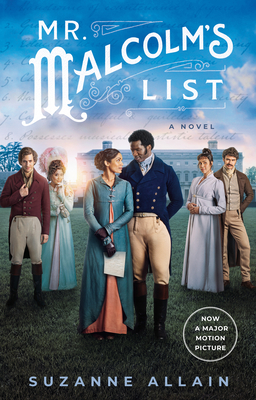
I feel like I’ve been bombarded by promos for the movie Mr. Malcolm’s List — and before deciding if I wanted to see it, I decided to give the book a try.

In this Regency romance, Mr. Malcolm is a prime catch, but catching him seems unachievable. He has a list, you see, of what he wants in a wife, and one deficiency in a prospective bride is enough to have her dropped from consideration. When one young woman, Julia, takes offense at being jilted for seemingly inconsequential reasons, she decides to take revenge.

Her great plan? Invite a school friend to London, have her captivate Mr. Malcolm, make him fall madly in love with her, and then, when he finally proposes, have his beloved inform him that he does not meet the qualifications of her list. What could possibly go wrong?

Julia’s pawn in this scheme is Selena, a vicar’s daughter who has spent the past three years in service as a companion to an elderly woman. As this woman has recently died, Selena is at loose ends, and is delighted to receive Julia’s invitation to stay with her… until she arrives and learns about Julia’s scheme. Selena is horrified, but also has nowhere else to go. Reluctantly, she agrees to play along, at least for a little while.

When she meets Mr. Malcolm, things become infinitely more complicated, because he’s the most beautiful man she’s ever seen and they seem to connect instantaneously. As they begin to develop feelings, Selena yearns to be free of Julia’s plans, but more and more obstacles crop up to keep her from being honest with Mr. Malcolm. When he does finally learn the truth, it may be too late to salvage the romance that’s sparking between them.

Mr. Malcolm’s List is a quick, light read. I was entertained, but not enthralled. Perhaps I’ve just read too many Regency-set books, but there doesn’t feel that there’s much all that new or different here. Selena is the intelligent, lovely, good heroine; Mr. Malcolm is the dashing ladies’-man with a heart of gold, who just needs the right woman to reform him.

There are house parties and balls and horse-back riding, as well as scandalous moments and worries about reputations and vulgar relations. There’s talk of the season and matches and titles, and impending spinsterhood is always a concern. All pretty much staples of this type of romance, and all present and accounted for.

The story did hold my interest enough for me to want to see it through and find out how it all turns out. The pacing is a little odd at times — moments that seem like they’ll be big overaching secrets looming in the background get resolved or revealed within a paragraph. Julia’s schemes are all very obvious, and the secondary love story lacks any sort of believability or chemistry.

Still, I finished, and did find some scenes and characters amusing. As for the movie… well, it looks like the plot is fairly faithful to the book — but based on the trailer, it also appears that the movie is trying to jump on the Bridgerton bandwagon. Bridgerton‘s diverse casting was new and refreshing and innovative in so many ways. Based solely on the trailer, it would appear that the Mr. Malcolm’s List movie is trying to ride the waves of Bridgerton‘s success by copying their approach to shaking up a Regency setting through diverse casting — and while I’m absolutely in favor of diverse casting, it just seems a little… too duplicative?

Check out the movie trailer:

What do you think? Would you go see Mr. Malcolm’s List? Or does this seem too much like a Bridgerton wannabe?

Book Review: To Marry and To Meddle by Martha Waters

Title: To Marry and To Meddle (The Regency Vows, #3)
Author: Martha Waters
Publisher: Atria
Publication date: April 5, 2022
Length: 336 pages
Genre: Historical fiction/romance
Source: Review copy courtesy of the publisher via NetGalley
Rating:

Rating: 3.5 out of 5.

The “sweet, sexy, and utterly fun” (Emily Henry, author of The People We Meet on Vacation) Regency Vows series continues with a witty, charming, and joyful novel following a seasoned debutante and a rakish theater owner as they navigate a complicated marriage of convenience.

Lady Emily Turner has been a debutante for six seasons now and should have long settled into a suitable marriage. However, due to her father’s large debts, her only suitor is the persistent and odious owner of her father’s favorite gambling house. Meanwhile, Lord Julian Belfry, the second son of a marquess, has scandalized society as an actor and owner of a theater—the kind of establishment where men take their mistresses, but not their wives. When their lives intersect at a house party, Lord Julian hatches a plan to benefit them both.

With a marriage of convenience, Emily will use her society connections to promote the theater to a more respectable clientele and Julian will take her out from under the shadows of her father’s unsavory associates. But they soon realize they have very different plans for their marriage—Julian wants Emily to remain a society wife, while Emily discovers an interest in the theater. But when a fleeing actress, murderous kitten, and meddlesome friends enter the fray, Emily and Julian will have to confront the fact that their marriage of convenience comes with rather inconvenient feelings.

The Regency Vows series is a fun, fresh look at love and friendship in (obviously) the Regency era. The books focus on a trio of friends, Violet (lead character of the first book, To Have and To Hoax), Diana (starring in To Love and To Loathe), and Emily, the main character of this 3rd book, To Marry and To Meddle.

Lady Emily Turner is the perfectly mannered daughter of a respectable society family. At age 23, she is unmarried, largely because her parents have promised her to an awful man to whom the family is ruinously in debt. She’s desperately unhappy, but would never dream of disobeying her parents… until Julian comes along.

Lord Julian Belfry is the younger son of a titled family. No one expects much of a younger son, but they certainly don’t expect and can’t tolerate his ownership of a (gasp!) theater — especially a theater that has the reputation of being a place for gentleman to spend a night out with their mistresses.

In Emily, Julian sees a way to attain respectability for his theater. In Julian, Emily sees a path to freedom. At a country party (the setting of much of the previous book), Julian comes up with a plan that might solve both of their problems: He proposed marriage. With Emily’s good social standing, he hopes to repair the theater’s reputation and draw in the right crowd. And with Julian’s money, Emily’s family can be freed from their debts, saving Emily from being forced into a terrible marriage.

The arrangement would clearly be a win-win situation, and the fact that they enjoy one another’s company is an added bonus. Emily accepts, and the two are married right away. Emily soon learns that there’s one more unexpected benefit to the marriage — she and Julian are very compatible, and they enjoy a steamy start to their married life (interrupted only by the appearance of a homeless kitten, whom Julian christens Cecil Lucifer Beelzebub).

While quite enjoyable, I found TM&TM a little… flat. There just isn’t much dramatic conflict in the plot. The key tension is around whether Emily spends her time wooing society ladies by paying calls, when what she really wants is to spend more time with Julian and participate in running the theater. Julian’s conflict has to do with running the theater in a way that will prove it’s respectable, when what he really and truly wants is his own father’s approval. And, as expected, they each must reluctantly face the fact that they’ve fallen in love — how to admit to one’s spouse that a mutually beneficial arrangement now involves one’s feelings?

Because of course she loved him — how could she not? But, more importantly, how could she ensure that he did not know, did not ever discover her secret? Because, after all, in a marriage of convenience, love would the most inconvenient surprise of all.

It’s all very pleasant and often quite funny, but there just isn’t much there there when it comes to the plot. The stakes are fairly low, after all, when it comes to the plotlines related to the theater. The book is at its best when it focuses on relationships, and it was touching to see how both Emily and Julian stand up to their families and repair their damaged connections.

To Marry and To Meddle has the fun, light tone of the previous books, and as Emily continues her close friendship with Violet and Diana, we get to spend more time with these entertaining characters, which is lovely. One of the things I really appreciate about these books is how the women’s friendship is so central to the stories. Even though each book focuses on a different romantic relationship, the time spent with the trio of women is what connects them all, and their support and affection for one another feels very special.

The dialogue and overall writing can be a real hoot:

Predictably, she blushed. Perversely, he was delighted.

Julian clearly know the way to a woman’s heart:

[…] After Julian had rung for tea and crossed to the sideboard to busy himself with the decanter stored there, he said, almost casually, “You must buy any books you wish to add to our collection.”

Something within Emily warmed at these words. She’d always been faintly envious of Violet’s library at the house she shared with Lord James, and felt a small thrill run through her at the thought that she, too, could have a room full of books to call her own.

Amidst the funnier moments…

“You’re not…” Violet trailed off, a look of dawning horror on her face. “Sick of tea?” She uttered the words in a hushed whisper, as though afraid to speak them into truth.

… there are also scenes of coming into one’s own power and strength:

Here, a woman could take up space, speak loudly, draw the eyes of a crowd — or, alternatively, could slip into a role behind the scenes, quietly doing her work just as well as the men who surrounded her — and Emily found both prospects not shocking but… exhilarating.

I do recommend this book, but suggest starting at the beginning of the series, or you’ll miss the backstories of the characters and their social circle. I don’t know if there will be a 4th book, but I can guess which side character might get her own book next, and I hope my prediction comes true!