
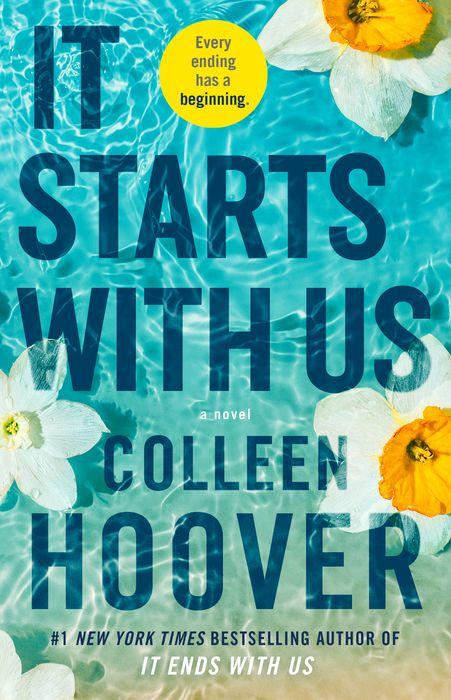
Title: It Starts with Us
Author: Colleen Hoover
Publisher: Atria
Publication date: October 18, 2022
Length: 323 pages
Genre: Contemporary fiction
Source: Library
Rating:
Before It Ends with Us, it started with Atlas. Colleen Hoover tells fan favorite Atlas’s side of the story and shares what comes next in this long-anticipated sequel to the “glorious and touching” (USA TODAY) #1 New York Times bestseller It Ends with Us.
Lily and her ex-husband, Ryle, have just settled into a civil coparenting rhythm when she suddenly bumps into her first love, Atlas, again. After nearly two years separated, she is elated that for once, time is on their side, and she immediately says yes when Atlas asks her on a date.
But her excitement is quickly hampered by the knowledge that, though they are no longer married, Ryle is still very much a part of her life—and Atlas Corrigan is the one man he will hate being in his ex-wife and daughter’s life.
Switching between the perspectives of Lily and Atlas, It Starts with Us picks up right where the epilogue for the “gripping, pulse-pounding” (Sarah Pekkanen, author of Perfect Neighbors) bestselling phenomenon It Ends with Us left off. Revealing more about Atlas’s past and following Lily as she embraces a second chance at true love while navigating a jealous ex-husband, it proves that “no one delivers an emotional read like Colleen Hoover” (Anna Todd, New York Times bestselling author).
OK, I’ve paid my dues! I’ve read TWO Colleen Hoover books, and that’s enough for me.
It Starts with Us is the follow up to the author’s 2016 bestseller It Ends with Us, recently made into a movie and generating quite a bit of online chatter. It Starts with Us picks up immediately after the epilogue of the previous book. Read on to learn more… but note that there will be spoilers for both books.
Let’s start with the most important bit: The synopsis above refers to Ryle as a “jealous ex-husband”. Why doesn’t the promotional material for these books come right out and say what’s really going on? Ryle is abusive, physically and emotionally. In the first book, Lily eventually leaves Ryle after he bites her, pushes her down a flight of stairs, leaves her with a concussion and in need of stitches, and attempts to rape her. There’s no sugar-coating this… so no, “jealous” doesn’t even begin to cut it.
In It Starts with Us, Lily is navigating co-parenting with Ryle. While she retains full custody of their toddler daughter, Ryle has visitation rights. Further complicating matters is the fact that Lily’s best friend Allysa is Ryle’s sister, and she lives in the same building as Ryle.
When Lily runs into her first love Atlas (yes, that’s actually his name), they both know that their connection has never gone away, despite all the years apart. Lily is worried about how Ryle will react to her dating anyone post-divorce, but especially Atlas, the man who seems to trigger all of Ryle’s worst impulses just by existing.
Atlas’s life is also complicated by the introduction of a 12-year-old brother whom he never knew about, thanks to his estranged mother’s manipulations and emotional cruelty. Once Atlas meets Josh, he’s determined to get custody and give him a better life than Atlas had at that age.
And meanwhile, Atlas and Lily begin dating, and reignite all the sparks that ever existed between them.
It Starts with Us goes pretty much as you’d expect it to go. The main storyline is about Lily and Atlas’s romance, with chapters alternating between each of their perspectives. Atlas is, of course, simply too good to be true, patient and devoted and kind, refusing to be angered or driven to violence even when Ryle throws the first punch. He’s gentle, yet fiercely protective of Lily.
Lily is a puzzle, to be honest, and she seems to have gotten poor legal advice, among other problems. She never filed charges against Ryle and did not document his abuse as part of their divorce and custody agreements, so when he lashes out again, there’s no pattern to point to. Sure, she can file new charges, but there’s no documented history, and everyone seems to feel that she would have a hard time proving her case.
She also seems to worry a lot about Ryle’s reactions, how to talk to him about her dating life, and how he’ll feel about Atlas being back in her life. And why exactly is this his business? Since when does an ex get to have an opinion on who someone dates?
I’m stuck dealing with Ryle’s feelings forever, and frankly, I’m growing tired of always feeling sorry for him, worried for him, fearful of him, considerate of his feelings.
Lily can’t avoid Ryle, because she’s constantly over at Allysa’s house… but why continue to go there when confrontations seem inevitable? And why on earth would she agree to closed-door, isolated conversations with Ryle when she is fully aware of who he is and how easily his anger erupts?
Late in the book, she insists that he starts working on anger management… but why did no one push him in that direction years earlier?
Lily’s overall take on abuse is really concerning:
I realize in this moment that the hardest part about ending an abusive relationship is that you aren’t necessarily putting an end to the bad moments. The bad moments still rear their ugly heads every now and then. When you end an abusive relationship, it’s the good moments you put an end to.
In the world of these books, the abuse seems to be portrayed as especially awful because there’s so much love in the relationship. So if he was just nasty all the time, it would be easier? I’m not sure what message the author is trying to send here, but I don’t feel it’s a healthy one.
I could go on. There’s so much about this plot that bothers or frustrates me, and it’s not helped by shoddy writing and poor grammar. I suppose you could argue that the first-person narratives are reflecting how Lily and Atlas speak, rather than following grammar rules, but really, is it that hard to say “between Ryle and me”, rather than “between Ryle and I”, which is what actually appears in the book?
There are so many ridiculous elements — here are just a few more:
- Lily gives Atlas her teen journals to read, to let him see what she felt and experienced when they were together all those years ago. Who on earth would actually do this?
- Ryle’s sister, brother-in-law, and mother all seem to love and support him, are sad that his marriage failed, but place no restrictions on his role in their lives. His violence seems to be a feature, not a bug.
- It takes Lily over a year post-divorce to get her house key back from Ryle.
- Atlas talks to his friend’s 13-year-old son about his personal life and jokingly refers to him as his “therapist”.
- Ryle continues in his work as a super-successful neurosurgeon… and I still think it strains credulity that he would work in such a high-stress profession and not have his anger issues leak out into his work life.
By the end of the book, Lily at least places restrictions on Ryle’s interactions with their daughter, pending his participation in anger management sessions… but the fact that it took her that long to do so also seems incredible. How does she know that his violence will only affect Lily herself and not their child? She places a degree of trust in him that’s unwarranted, to say the least.
That’s it for my rambles. Both of these books, while highly readable, are also problematic in so many ways. They’re fast reads, and I stuck with them — I did want to see where the author takes the characters and how I’d feel about the wrap-up.
However, I can now safely say that my curiosity about Colleen Hoover’s books has been more than satisfied, and I feel no need to explore further. I know her books are wildly popular… but she just isn’t an author for me.

 Bookshelf Fantasies