
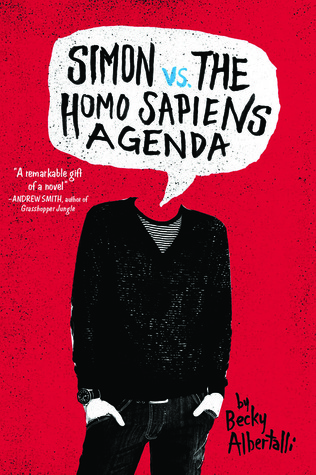
Book Review: Simon vs. the Homo Sapiens Agenda by Becky Albertalli

SimonI dare anyone to read this book and not fall at least a little bit in love with Simon, the main character of this sweet, funny, touching young adult novel.

Simon is a 17-year-old high school junior, a good student, in the school musical (Oliver!), and with a reliable circle of friends, among them his life-long besties Nick and Leah and his new BFF Abby. What Simon hasn’t shared with anyone is that he’s gay. It’s not that he’s unsure — he’s quite, quite certain about his identity. He’s just not quite ready to stop being private and have to deal with the reactions he’s sure to face.

But life gets complicated. On the Tumblr where students from his school share secrets, he’s found a kindred spirit — a kind, smart boy going by the name of Blue, who is also a junior at the same school. Simon and Blue start an intense email correspondence, each using his “secret” gmail account to maintain anonymity. Over the course of the weeks and then months since they began emailing, they’ve opened up to one another to  a remarkable degree. Simon wants to meet; Blue isn’t sure that it’s a good idea.

And then Simon makes the ultimate online error — he checks his email using the computers in the school library and forgets to log back out. Before long, he’s facing a geeky, awkward student named Martin who lets Simon know that he has screenshots of his emails and will let the entire school know that Simon’s gay unless Simon helps him get Abby to go out with him. It’s blackmail, but carried out with a smile. Martin refuses to see that he’s doing something evil, and apart from this unforgivable act, Martin isn’t a terrible person or a bully, which makes it all the more confusing for Simon.

Simon himself is a sweetheart. He’s funny and smart, tries to do the right thing, and has good intentions, although he still manages to hurt some of his friends along the way. Above all, he’s a boy who’s falling in love with someone from the inside out, learning everything about Blue but still not knowing which of the boys he sees at school everyday is the actual man of his dreams.

Simon’s voice in the novel is engaging and full of humor. Even in his moments of doubt or discouragement, he’s funny as hell.

I take a sip of my beer, and it’s — I mean, it’s just astonishingly disgusting. I don’t think I was expecting it to taste like ice cream, but holy fucking hell. People lie and get fake IDs and sneak into bars, and for this? […] Anyway, it really makes you worry about all the hype surrounding sex.

Simon’s email flirtation with Blue is incredibly adorable:

I’m glad I was cute and grammatical. I think you’re cute and grammatical, too.

The truth eventually comes out, and Simon comes out, and all is finally revealed. I don’t want to say more, because seeing it unfold is a big part of the fun.

Beneath all the humor and cute teen escapades are real feelings, beautifully expressed, about family, identity, safety, trust, and friendship. Simon’s journey in Simon vs. the Homo Sapiens Agenda involves sharing himself, really and truly, with the people in his life, and pursuing his truth even when it means taking risks.

It’s a lovely and engaging story, full of flirting and happy moments as well as heartache, and I loved every bit of it. Highly recommended — check it out!

_________________________________________

The details:

Title: Simon vs. the Homo Sapiens Agenda
Author: Becky Albertalli
Publisher: Balzer + Bray
Publication date: April 7, 2015
Length: 303 pages
Genre: Young adult fiction
Source: Purchased


Wishing & Waiting on Wednesday: The Porcupine of Truth

There’s nothing like a Wednesday for thinking about the books we want to read! My Wishing & Waiting on Wednesday post is linking up with two fabulous book memes, Wishlist Wednesday (hosted by Pen to Paper) and Waiting on Wednesday (hosted by Breaking the Spine).

This week’s pick:

The Porcupine of Truth

The Porcupine of Truth by Bill Konigsberg
(to be released May 26, 2015)

The author of OPENLY STRAIGHT returns with an epic road trip involving family history, gay history, the girlfriend our hero can’t have, the grandfather he never knew, and the Porcupine of Truth.

Carson Smith is resigned to spending his summer in Billings, Montana, helping his mom take care of his father, a dying alcoholic he doesn’t really know. Then he meets Aisha Stinson, a beautiful girl who has run away from her difficult family, and Pastor John Logan, who’s long held a secret regarding Carson’s grandfather, who disappeared without warning or explanation thirty years before. Together, Carson and Aisha embark on an epic road trip to find the answers that might save Carson’s dad, restore his fragmented family, and discover the “Porcupine of Truth” in all of their lives.

Openly Straight was one of my very favorite books of 2013, and I am so excited that this talented author has a new book coming out in 2015! Sign me up!

PS – If you’re interested, check out my review of Openly Straight, here.

What are you wishing for this Wednesday?

Looking for some bookish fun on Thursdays? Come join me for my regular weekly feature, Thursday Quotables. You can find out more here — come play!

♥♥♥♥♥♥♥♥

Do you host a book blog meme? Do you participate in a meme that you really, really love? I’m building a Book Blog Meme Directory, and need your help! If you know of a great meme to include — or if you host one yourself — please drop me a note on my Contact page and I’ll be sure to add your info!

Book Review: Lies We Tell Ourselves by Robin Talley

LiesAuthor Robin Talley gives us a stunning look at the school integration wars of the 1950s in her debut novel, Lies We Tell Ourselves. Seen through the eyes of two high school girls — one black, one white — caught up in the terror and day-to-day struggles of the early days of a Virginia high school’s forced integration, Lies takes us behind the historical record into the hearts and minds of the young people who had to actually live it all.

We’ve all read about integration in our history books and seen the photos of the Little Rock Nine being escorted into school by police through a jeering crowd. But what must it have been like for the students themselves? What did they feel, and what did they want?

In Lies We Tell Ourselves, we see both sides of the struggle through the two main characters, Sarah and Linda. Sarah is an honors student at the black high school in town; Linda is the white daughter of the town’s virulently anti-integration newspaper editor. When the court ruling comes down which forces the local white school to open its doors to black students, Sarah, her younger sister Ruth, and eight other students become the living symbols of integration. Once the NAACP wins its case, it’s the children who have to walk the path laid out for them by their parents and other adults. Everyone is just looking for an excuse to call integration a failure, so the pro-integration side lays out strict rules for the children: No fighting, no arguing, no answering back, no defending oneself, no extracurricular activities. Go along, get along — just walking the halls is an achievement, so don’t do anything that’ll hand the other side an excuse to say it doesn’t work.

The experiences of Sarah and the others are horrifying. Yelled at, spit upon, assaulted, impeded, harrassed, and threatened, entering the school and walking to their classrooms each day is like walking through a minefield. When someone spits on Sarah or dumps milk over her head, she can’t react, but must simply move on through the day. If she gives any hint that she’s upset, it’ll give the segregationists fuel for their argument that no one is ready for mixing of the races.

I wipe the tears away and stare at my reflection until my face smooths out and my eyes go empty. This is how they have to see me. If they know I feel things, they’ll only try to make me feel worse. Maybe if I keep trying, I really won’t feel anything.

From Linda’s perspective, the “agitators” — the black students — are just ruining her senior year. Why couldn’t they stay in their own schools? Why do they need to come and cause such chaos in her own perfect little world? Even worse for Linda is her internal conflict — is it possible that the “Southern values” she’s been raised with are wrong? Is it possible that the behavior she witnesses on a daily basis isn’t about preserving tradition, but is simply ugliness and hatred?

For eighteen years, I’ve believed what other people told me about what was right and what was wrong. From now on, I’m deciding.

The day to day realities of 1959 in Virginia are simply awful to read about through the lens of our 21st century, post-Civil Rights sensibilities. The actions within the school are revolting. The verbal harassment, including the most disgusting racial epithets, are constant. The teachers and administration routinely turn a blind eye. In home ec class, Sarah is given her own sets of pots and pans to use, so that white kids don’t have to handle implements dirtied by black hands. It goes on and on, and reading about it through the words of students living it is incredibly painful.

Complicating matters even further for Sarah and Linda is that they’re thrown together as partners on a project for French class, and as they begin to know one another, each is reluctantly aware of a growing attraction toward the other. The girls spend much of their time together arguing, but beneath the racial divide, there’s a simmering interest that has nothing to do with skin color. As each girl realizes that dating boys and pretending to fit in doesn’t really work for her, entirely different questions about shame, sin, and what’s “natural” and “normal” surface.

I almost felt like telling Sarah and Linda, “don’t you have enough on your plates right now?” Just attempting a friendship is enough to get Linda ostracized and ridiculed and for Sarah to become even more of a target for the thuglike white boys from school. To pursue a same-sex relationship in the South of the 1950s seems foolhardy in the extreme, and while it was moving to see what the girls go through and how caught in a web of hatred they each find themselves, I’m not sure that the story needed one more element to put the characters at risk.

That said, I found Lies We Tell Ourselves to be a moving, important, and brave book. It’s eye-opening to take a well-known chapter of history and revisit it through the perspectives of people who lived through it. I’d thought I could imagine what it must have been like to live through those days, based on reading history books and watching documentaries. But sometimes, it takes fiction to make facts come alive, and that’s what the author achieves here. By giving us a personal point of entry to the experience, we walk the halls of the high school with Sarah and Linda and experience the fear, the hate, the humiliation, and the absolutely insane level of courage it must have required simply to take the few steps from one classroom to another.

Sarah and Linda are remarkable, unforgettable characters, and while the book ends at the conclusion of their high school careers, I can’t help thinking about how much better their lives will be from this point forward. They’ve each changed dramatically, and they’ve stood at the center of social change and survived.

Lies We Tell Ourselves would make a fantastic addition to any US History class curriculum, but more than that, its story of two brave girls trying to find their way and do what’s right should be widely read by teens and adults, in school or out. Robin Talley’s fine writing gives us a front-row seat to a difficult and important chapter of our nation’s recent history — but beyond the social value, she’s also written just a really good novel that conveys true emotion and personal growth.

_________________________________________

The details:

Title: Lies We Tell Ourselves
Author: Robin Talley
Publisher: Harlequin Teen
Publication date: September 30, 2014
Length: 304 pages
Genre: Young adult historical fiction
Source: Review copy courtesy of Harlequin Teen via NetGalley