
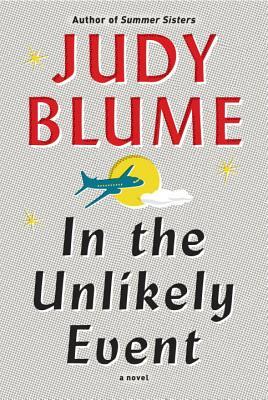
 When you think of historical fiction, if you’re like me, images of petticoats, palaces and kilts might fill your head. But how about fiction that tells a story of a more recent history? In Judy Blume’s new novel, In the Unlikely Event, the plot revolves around real events from the 1950s, and the effect is stunning.
If you didn’t grow up in New Jersey and weren’t around in the 1950s, you might be as shocked as I was to realize that the plane crashes that serve as a catalyst for the drama of this book actually happened. If these events weren’t actual documented history but rather a fictional invention, we’d all be shaking our heads and saying that’s it’s just too unbelievable.
The facts are these: In the winter of 1951 – 1952 in Elizabeth, New Jersey, three different planes crashed into the town within a span of three months. How is this even possible?
In the Unlikely Event shows us the horrifying plane crashes and the devastating effect on the residents of Elizabeth through the eyes of a large cast of characters, all of whom bear witness in one way or another.
The main character is 15-year-old Miri Ammerman, who lives with her mother Rusty, uncle Henry, and grandmother Irene. Miri’s best friend is Natalie Osner, daughter of the town’s very successful dentist. Each person is connected to other people, so that we meet the best friend of Natalie’s brother, the high school senior who assists in Dr. O’s office, the orphan boy who falls for Miri, the girlfriend of Miri’s uncle, and on and on in interlocking, expanding circles.
The time itself is exquisitely drawn in loving details, from the cashmere sweaters of the rich girls to the Lanz nightgowns that Miri’s friends all wear to sleep-overs, from 17-inch TVs to telephones with long cords — in all sorts of little ways, the author paints a picture of a particular era in American life. World War II is in the past, but not so distant as to be forgotten. American boys are serving in Korea. And air travel is new and fresh and glamorous. Airline stewardesses must be pretty, perky, flirty, and single. Traveling by air is a luxury, and going on an airplane is all part of the excitement.
And then the crashes start. As each plane crash occurs, the impact is felt more and more deeply by Miri and her circle of friends, family, and acquaintances. Boys at school claim it’s either UFOs or Commies behind the whole thing. One of Miri’s friends descends into mental illness and anorexia, consumed by thoughts of one of the dead airline passengers. People on the ground lose their lives as well as the passengers who fell from the sky, and the loss is random, tragic, and incomprehensible. Miri’s life changes in unpredictable ways, marriages disintegrate, friendships are changed forever, and indeed the entire community seems to lose its heart and its center.
In the midst of all this loss and suffering are some quintessential Judy Blume moments. The scenes of Miri and her friends bring back memories of the author’s classic books about preteen and teen girls, as they deal with their parents’ flaws, differences in economic status, pressure to fit in — and boys. Make-up and clothes, flirting and making out, worrying about going all the way and getting “in trouble”, fretting over missed periods — all of this is told in the voice we’ve trusted to portray young womanhood in so many earlier books, and it’s comforting and familiar here in her newest.
My only minor quibble with In the Unlikely Event is that we’re dropped into the world of Elizabeth and immediately introduced to just about every character in the story, and it’s a lot to track. Eventually, we get to know them all individually and it’s easier to understand who’s who and how they connect, but at the beginning, I found myself doing a lot of flipping backwards to figure out who a particular person was and where I’d seen them before.
Other than the early clutter of characters, the structure and richness of In the Unlikely Event works very, very well. The story is framed at the beginning and end by Miri traveling back to Elizabeth for a commemoration of that awful winter, 35 years later. It’s interesting and touching to see how all the people we followed in the 1950s have turned out, and how each has had his or her life changed and shaped by that one fateful year.
With detailed, evocative writing and characters whom we come to truly know and care for, In the Unlikely Event is a touching, compelling story that really holds a reader’s attention from start to finish. I’m very glad to have read it, and strongly recommend it.
End note: Way back when in my early days of blogging, I wrote a little salute to Judy Blume. Want to read it? You can find it here.
The details:
Title: In the Unlikely Event
Author: Judy Blume
Publisher: Knopf
Publication date: June 2, 2015
Length: 397 pages
Genre: Adult fiction
Source: Library

 Bookshelf Fantasies