The Monday agenda

Not a lofty, ambitious to-be-read list consisting of 100+ book titles. Just a simple plan for the upcoming week — what I’m reading now, what I plan to read next, and what I’m hoping to squeeze in among the nooks and crannies.

So what’s on the reading agenda this week?

From last week:

Ashen Winter by Mike Mullin: Done! My review is here.

The Evolution of Mara Dyer by Michelle Hodkin: Quit after reading 150 pages. I just couldn’t get into it, despite having enjoyed the first book in the series.

Anna and the French Kiss by Stephanie Perkins: Done! My review is here.

Beta by Rachel Cohn: Returning to the library unread. I was about to start this one, then discovered from the dust jacket that this book is first in a new series… and I’m trying to swear off new series for a while.

So far, no new books for my kiddo and me. We haven’t settled on our next read-aloud yet, and had a couple of false starts this week with books that neither of us ended up enjoying. Soldiering on! We still have a few more to try, and I’m hoping that one of the ones that I most want to read will also appeal to this opinionated 10-year-old.

Drums of Autumn by Diana Gabaldon: Done! The group re-read has finally come to an end. We’ll be starting the next in the series, The Fiery Cross, in January. And if you happen to be an Outlander fan and want to join the fun, just let me know and I’ll get you connected.

And this week’s new agenda:

I hereby declare: It’s Graphic Novel Week!

I’ve been accumulating a stack of graphic novels over the past few weeks, and I think I’ll dive in and devote my reading week to catching up. So exciting! On the list are:

Buffy the Vampire Slayer, season 9 volume 2: On Your Own: If you thought Buffy’s story ended when the TV show went off the air, and you’ve been missing her ever since, check out the continuing story in graphic novel form.

Angel and Faith: Daddy Issues: Excellent Buffy spin-off.

Soulless manga, volume 2: The manga version of Changeless by Gail Carriger.

A Wrinkle In Time graphic novel: My Hanukkah gift from my daughter. See me gushing with joy about this here.

Fairest, volume 1: A new spin-off from Bill Willingham’s Fables series, which I love madly and deeply.

Werewolves of the Heartland: A Fables stand-alone, centered on my absolutely favorite character from the Fables world. Can’t wait!

Locke & Key: Clockworks: Volume 5 in the superbly creepy series by horror master Joe Hill.

Other than graphic novels, I plan — quite cautiously and with some trepidation — to add in Fairy Tales from the Brothers Grimm by Philip Pullman. Given the fact that I am just a terrible reader of short stories and find it impossible to maintain interest long enough to get through an entire book of stories, even if they’re by an author whom I love (as is the case here), I’m setting myself the rather mild goal of reading this collection of fairy tales bit by bit. I’ll aim for two stories a week — that should let me enjoy the stories without feeling my usual frustration at not reading a “real” novel.

So many book, so little time…

That’s my agenda. What’s yours? Add your comments to share your bookish agenda for the week.
Fresh Catch: This week’s exciting new book arrivals

Two books I’ve been eagerly awaiting arrived this week, and I’m just pleased as punch. (Can punch be pleased? Is that punch as in Hawaiian? Or like what comes from a closed fist? Or should that be with a capital P, as in the puppet who abuses puppet Judy? I think I don’t understand this expression after all. But I digress).

Book #1:

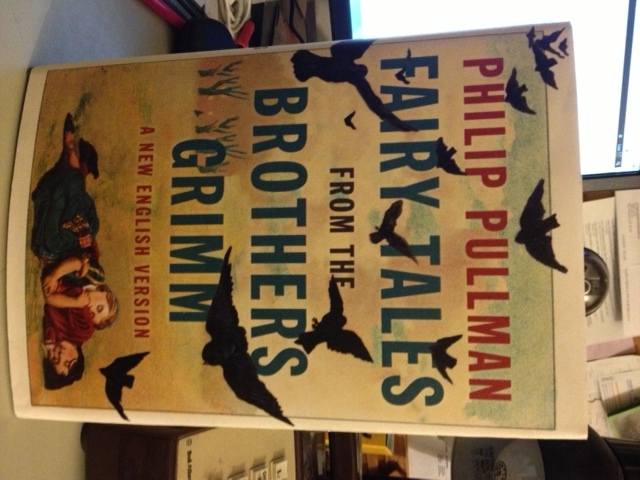
I’ve been waiting for this one since August (I even blogged about it, here, in a fit of intense anticipation), and here it is! Fairy Tales From The Brothers Grimm, by Philip Pullman, is a collection of Pullman’s 50 favorites, including tried-and-true standards such as “Snow White”, “Rumpelstiltskin”, “Little Red Riding Hood”, and “Cinderella”. I can’t wait to read these, but I must confess that I’m even more intrigued by the titles of some of the lesser-known stories in the collection. Has anyone ever heard of “Thousandfurs” or “The Donkey Cabbage”? How about “The Devil with the Three Golden Hairs”, “The Girl with No Hands”, or “The Nixie of the Millpond”? Listen, I adored Pullman’s His Dark Materials trilogy and I’d be willing to read just about anything he sets his pen to… add to that my love of fairy tales, and this collection seems like a sure bet to me.

Of course, I do have to proceed with caution, as I am admittedly terrible at reading short stories, and no matter how interested I may be in a collection, I almost never make it all the way through. I have a plan, however! I believe I’ll tackle this lovely new book in small bites — let’s say, oh, maybe 2 or 3 stories per week? I think the solution to my unavoidable impatience with story collections is to find a work-around so that I don’t end up frustrated by thoughts of all the novels I could be reading instead. So, if I take this one slow and steady, mixing in fairy tales betwixt and between all my other reading, I should be able to stick with it and get all the enjoyment from Pullman’s new collection that it seems to promise.

Book #2:

Sounds the trumpets! Wave the flags! Send up some fireworks, for Pete’s sake! (Wait, who’s Pete? Never mind…) It’s the newest book from Diana Gabaldon! Yes, Diana Gabaldon Herself, creator of the Outlander series, which I love beyond all reason. But if you live in the US, don’t go looking for this book in your local bookstore — it won’t be there. First things first — the basic facts:

A Trail of Fire, by Diana Gabaldon, is a collection of four novellas, one brand-new and three which were included in already published anthologies. For various reasons related to copyrights, the three already published stories can’t be re-released in the US just yet as they still belong to the anthologies, which is why, if you really want to get your hands on this collection, you’ll have to look outside your usual US sources.**

**So far, I know US readers who have successfully ordered A Trail of Fire from Amazon UK and from The Book Depository. The Poisoned Pen bookstore in Arizona has signed copies available for mail order as well (with a hefty price tag).

The contents of A Trail of Fire are:

1) “A Leaf on the Wind of All Hallows” — published in the US in 2010 in the Songs of Love and Death anthology edited by George R. R. Martin and Gardner Dozois. (Note to Firefly fans: This is not a Serenity cross-over, and Wash is not a character in this story. Just to clear up any potential confusion.) “A Leaf on the Wind of All Hallows” tells the story of Roger MacKenzie’s parents and their tragic fates during WWII, hinted at in the Outlander books but never fully explained prior to this story. This is essential reading for fans of the series, best read after Echo In The Bone.

2) “The Custom of the Army” — published in the US in 2010 as part of the Warriors anthology edited by George R. R. Martin and Gardner Dozois. This story focuses on Lord John Grey, a supporting character in many of the Outlander books and lead character in a spin-off series. “The Custom of the Army” is set in 1759 and largely concerns the Battle of Quebec, plus much military intrigue.

3) “Lord John and the Plague of Zombies” — published in the US in the anthology Down These Strange Streets, again courtesy of George R. R. Martin and Gardner Dozois. This is another Lord John story, dealing with his lordship’s first posting to Jamaica at the head of a squadron detailed to deal with a slave rebellion, who end up with much more sinister forces to contend with. In terms of series chronology, the events in this story occur before the events in Voyager.

4) The new one! “The Space Between” has not previously been available, and will not be published in the US until 2013, when it will be included in the forthcoming anthology The Mad Scientist’s Guide to World Domination. “The Space Between” takes place in 1778, after the events in Echo In The Bone, is set in France, and has as its main characters several side characters from the Outlander series, including Michael Murray, Marsali’s sister Joan, and the Comte St. Germain. I don’t know anything else about it… but I will soon!

At the risk of sounding like an insane fan, I will admit to already owning the anthologies containing stories 1 – 3, but after much debate (me vs. me), decided to go ahead and purchase A Trail of Fire for two reasons: One, to get my hands on “The Space Between” (obviously!) without having to wait until next March, and two, because it just looks like a beautiful book. Yes, I do sometimes judge books by their covers. When I truly give my heart to a book or series, I get a great deal of pleasure from having nice-looking copies on my shelves. A Trail of Fire will look simply smashing with all its “colleagues” — I have a space reserved for it right next to The Scottish Prisoner.


Book Review: Some Kind of Fairy Tale by Graham Joyce

Book Review: Some Kind of Fairy Tale by Graham Joyce

Fifteen-year-old Tara Martin disappeared without a trace on a beautiful spring day when the bluebells were all in bloom. Twenty years later, on Christmas Day, Tara knocks on her parents’ door, still looking like a teenager and with a strange tale to tell. Tara’s reappearance causes relief, joy, and turmoil for the family she left behind, as well as for her former boyfriend Richie, whose life went completely off the rails after he was accused of foul plan in Tara’s disappearance.

Tara’s return is not, perhaps, as she expected:

Twenty years is, after all, a long time. We are not the same people we were. Old friends, lovers, even family members: they are strangers who happen to wear a familiar face.

Tara tells an impossible tale, of a romantic man on horseback, travels to a different world, and what to her was a six-month stay in a land both strange and beautiful. Tara’s brother Peter is determined to figure out the truth of what happened to Tara, and enlists the aid of his wife, his former best friend Richie, and a retired psychiatrist to sift through the conflicting threads of her story.

Graham Joyce is a gifted writer whose words and tempo are lilting and lovely. He has a talent for taking the every day and making it mysterious, adding a rhythm to the routine occurrences within a family that bring in the larger world and its unknowability. Characters are sharply drawn and defined, including Peter, a tired but devoted family man, passionately in love with his wife, hurt by the loss of his friend, joyful yet resentful of Tara’s return; Mrs. Larwood, the elderly neighbor who may in fact have her own tale to tell; and Richie, stuck in the past, alone and loveless, having put his life on hold once Tara disappeared.

I had expected Some Kind of Fairy Tale to be a more or less traditional tale of a mortal crossing over into the land of the fae. As it turns out, it is and it isn’t. The changing points of view within the story heighten the mystery, and make it impossible to come to any one particular conclusion — although the end of the story certainly made one explanation seem more likely than others.

Each chapter begins with a quote, and I found these entirely delightful, so much so that I’d like to collect them all and refer back to them time and again. A favorite: “When I examine myself and my methods of thought, I come to the conclusion that the gift of fantasy has meant more to me than any talent for abstract, positive thinking.” (Albert Einstein)

The author’s previous novel, The Silent Land, is one of the most exquisite pieces of fiction I’ve ever read. Some Kind of Fairy Tale did not have the same impact on me and I wouldn’t rate it quite as highly, but it is quite lovely in its own right and I can recommend it whole-heartedly.

Graham Joyce warns us of the shifting nature of the narrative and the truths contained therein early on:

Of course, everything depends on who is telling the story. It always does.

It’s entirely possible that I don’t entirely understand what really transpired in this haunting tale. Then again, maybe we’ll all understand it differently, and I think that’s as it should be.


Fairies on the brain

November can’t come soon enough.

For a brief period in my youth, which at the time felt like an eternity, I took piano lessons. These lessons were not successful; the lack of success most likely attributable to my lack of talent or my avoidance of practice time, take your pick.

Each week, I’d show up for my lesson at my teacher’s house and sit on the piano bench, waiting for her to stop chatting with my mother. Those five minutes or so of waiting were always my favorite part of the lesson, because… the wall next to the piano was filled with floor to ceiling bookshelves. Right at eye level was the fairy shelf — my piano teacher had what seemed to me a HUGE collection of the color-coded fairy books. The Blue Fairy Book, the Red Fairy Book… as an adult, I’ve learned that there are twelve volumes in all (including lilac! who knew?), collected and published by Scottish scholar and anthropologist Andrew Lang.

These books fascinated me. The covers were lovely, and I enjoyed just looking at them, perhaps touching the spines with a finger or two. I wasn’t ever actually allowed to take them home with me, but my mother, a full-fledged booklover herself, would take me to the library and help me find whichever pink or blue or rose book of fairies that had caught my eye.

I loved how involved, mysterious, and dark the stories could be. I was fascinated by the contrast to the “prettified” versions of fairy tales that were so much more familiar, thanks to Disney and about a thousand or so picture book versions of pretty princesses, handsome princes, and magical kingdoms. I got a secret thrill from discovering just how gross some of the fairy tales truly could be — I seem to recall people baked into pies and thrown into fires, body parts hacked off, iron spikes (boy, does that sound like a horror movie description or what?).

Perfect for horror fans

To be fair, I must admit that I did love the enchantments and romance of the fairy tales as well, and never stopped rooting for a good Happily Ever After.

While I eventually grew out of my obsession with fairy tales, they’ve always retained a special little corner of my heart. I still enjoy picking up a nicely illustrated collection or reading a new translation.

For now, I won’t even go into all the myriad fairy tale retellings that I’ve read and enjoyed over the years… another topic for another day. I will, however, give a quick shout-out to a collection that I found weird and very entertaining, My Mother She Killed Me, My Father He Ate Me, edited by Kate Bernheimer and featuring forty new takes on classic fairy tales, written by an amazing array of authors including Neil Gaiman, Francine Prose, Kelly Link, Joyce Carol Oates, and more.

Perhaps my childhood experiences with fairy tales and my ongoing fascination with them explain why I found the discovery of an upcoming volume quite so exciting. I just happened to stumble across a listing on Amazon for Fairy Tales from the Brothers Grimm: A New English Version, due out in November… and written by Philip Pullman! New Brothers Grimm! Written by the author of The Golden Compass! Brilliant!

(Excuse all the exclamation points. My, but I am being a tad exuberant about this.)

Can. Not. Wait. My preorder has been placed. I know what I’ll be reading in November. Who else is in?

Book Review: Fables (volumes 1 – 3) by Bill Willingham

Fables (volumes 1 – 3) by Bill Willingham

I have quickly fallen in love with the Fables graphic novel series. By the end of volume 1, “Legends in Exile”, I was pretty sure it was just a crush. After reading volume 2, “Animal Farm,” I realized my feelings had deepened and that this just might be the start of a serious relationship. And now, three volumes in, after reading “Storybook Love”, I know it’s the real thing. I’m hooked.

Fables, written by Bill Willingham, is a DC Comics series that originally appeared in comic book format, now compiled in trade paperback volumes. So far, 17 volumes are available in print, with volume #18 due for publication in January of 2013.

Fables tell the story of fairy tale and other assorted mythical and magical characters, forced to flee their homelands after the invasion of the Adversary (about whom we know nothing so far, other than the fact that he’s unstoppable and ruthless. If you’ve read further in the series than I have — hush! I don’t want to know.) The survivors have taken refuge in our world — more specifically, Manhattan — where they live a secret life, concealing their magic from the mundys (that’s us, folks).

The mayor of the Manhattan Fable town is Old King Cole, but he’s merely a figurehead. The true authority lies with deputy mayor Snow White (our fearless heroine!), backed up by sheriff and overall enforcer Bigby Wolf (Big B. Wolf — get it?), whose gruff human exterior hides a predator with a core of integrity. Between the two of them, they ride herd on a mish-mash of misfits, including Little Boy Blue, Prince Charming (such a cad!), the Frog Prince (known as Flycatcher due to his unfortunate snacking habits), and Bluebeard (who reminds me of a really buff version of Walter White of Breaking Bad).

Their less human-looking counterparts reside on a hidden farm in upstate New York, concealed from the outside world, but also chafing under their enforced seclusion. A brilliant plot involving an uprising at the Farm is what truly got me involved in this series. Let’s just say that there’s a lot more to Goldilocks and the three bears than you might assume. And don’t get me started on nasty old Shere Khan either.

Fables is not for children. Mature themes abound, as well as plenty of gruesome deaths, sexy bedroom scenes, conspiracies, deceptions, murder and mayhem. The plotting is detailed and fast-paced, with masterful storytelling at every turn. It’s been a real pleasure for me to discover a tale well-told in a format that’s fresh and engaging. For someone who’s relatively new to the world of graphic novels, I’m really having a ball with this series, and I’m finding it seriously difficult to put Fables down in order to pick up a “real” novel.

Onward we go. So long as I have more volumes of Fables close at hand, it would appear that I’m not going to get anything else done.