
Book Review: The Heart Goes Last by Margaret Atwood

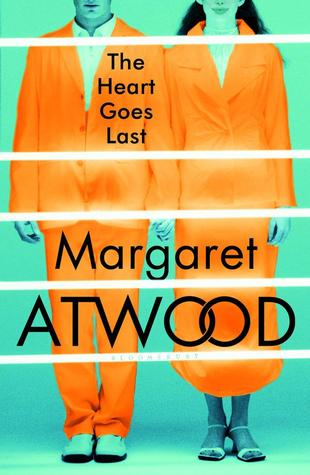
The Heart Goes LastThis is one tough book to describe.

The Heart Goes Last centers on main characters Stan and Charmaine, a married couple who are living in their car as of the beginning of the story. They’ve lost their jobs and their homes as the economy in the US Northeast has completely tanked. Charmaine works at a seedy bar to earn enough for them to buy fast food and gas, but that’s about it. Gas is essential, because even when locked into the car at night, crazy or desperate people may attack, break the windows, and try to rape or kill them, and being able to drive off in case of emergency is what keeps them alive. Life really sucks, and even though they both remember what it was like to be newlyweds in love, it’s getting harder and harder to keep any affection alive when life is just that awful.

Is it any wonder that they sign on, rather blindly, to the promise of a new and better life? Stan and Charmaine are seduced by an advertisement for an experimental town called Consilience. The Consilience project offers a house, safety, security, meaningful life, and the absence of fear and worry. After a quick visit within the gated walls of the town, they’re ready to sign up. The catch is that, once in, it’s permanent, but no worries! Charmaine is too entranced by the idea of a house, her own kitchen, and a cozy couch to even consider walking away, and to Stan, it sure sounds like a great alternative to quick, unsexy sex on the backseat of the car while watching out for attackers.

Once Stan and Charmaine have committed, we start to learn more. There’s a flip side to Consilience: Positron. Positron is a prison, and here’s the deal. For one month, Stan and Charmaine live in their cozy suburban house and go off to work at their pleasant jobs. Then comes switchover day, and the two go over to the Positron Prison, don orange prison garb, and become inmates for a month. Stan goes to the men’s ward, where he tends chickens, and Charmaine goes to the women’s ward, where she’s a medications officer. The prison is safe, filled with other happy Consilience residents, offering delicious food, meaningful work, and even a knitting circle in the evenings to pass the time. Meanwhile, Stan and Charmaine’s house is now occupied by their alternates. Half the town spends each month as residents, half as inmates, and then they switch. This way, the project provides housing and occupation for all, and everyone is happy. Be happy, damn it!

Perhaps picture-perfect suburbia isn’t all it’s cracked up to be:

The hedge trimmer emits a menacing whine, like a wasp’s nest. The sound gives him an illusion of power that dulls his sense of panic. Panic of a rat in a cage, with ample food and drink and even sex, though with no way out and the suspicion that it’s part of an experiment that is sure to be painful.

Things are as weird as they seem, and weirder. There’s sexual obsession and deception, nefarious corporate goons, weird sexual fetishes, secret medical procedures, and a recurring motif of blue knitted teddy bears. Of course this utopian refuge has a dark side, and of course Stan and Charmaine become deeply involved as puppets in the greater scheme of things. When I say things get weird, I really mean it.

By the end of the book, we’re in Vegas. There are hordes of Elvis and Marilyn impersonators, Blue Man Group rip-off artists, brain wipes, and sex/love slaves. And as word of the goings-on in Consilience/Positron is leaked to the greater public:

Instantly the social media sites are ablaze with outrage. Prison abuses! Organ-harvesting! Sex slaves created by neurosurgery! Plans to suck the blood of babies! […] Talk shows roister on into the night — they haven’t had this much fun in decades — and bloggers break out in flames.

I wish I could say that The Heart Goes Last was a great read, but unfortunately, I found it somewhat problematic. I was intrigued at the outset by the set-up, by the collapse of society, and by the way Stan and Charmaine’s marital issues tied into their dilemmas and decision-making about Consilience/Positron. Unfortunately, the book keeps veering off in new and disjointed directions, and by the time the Vegas elements come around, the storyline has passed the line from odd to ridiculous.

There are some truly eerie or disturbing sequences, but eventually, as one after another scenario unfolds, the whole thing loses its power and feels too scattered to be truly affecting. The goofiness of certain plot points (Elvis… Marilyn… the bear) makes the whole story somewhat farcical. While there are some kernels of deeper meaning in there about choice and the illusion of choice, the trade-off between security and free will, and whether unwavering love adds to or subtracts from actual happiness, the lack of overall coherence blunts the impact of all of these.

“Isn’t it better to do something because you’ve decided to? Rather than because you have to.”

“No, it isn’t,” says Charmaine. “Love isn’t like that. With love, you can’t stop yourself.” She wants the helplessness, she wants…

On top of the all-over-the-place plot, the fact is that dystopias are pretty much a dime a dozen these days, and it takes quite a lot to offer something new or startling. The idea of a perfect little town paired with a prison is interesting, especially as the town seems like something out of the movie Pleasantville (the only movies shown on Consilience TV are from the 1950s, and Doris Day is everyone’s darling) — but we’ve all read enough of these new society, perfect world set-ups to know that the people in charge have ulterior motives, there’s surveillance everywhere, and that a controlled world must be intrinsically corrupt at its core. Even though there are some clever and unexpected twists, at its most fundamental level, there isn’t anything all that fresh in the overarching concept.

Sadly, The Heart Goes Last was ultimately a let-down for me. I wouldn’t NOT recommend it, but it’s not Atwood’s best work either. I was never bored, exactly, but at some point, I just kind of rolled my eyes and decided to go with it.

_________________________________________

The details:

Title: The Heart Goes Last
Author: Margaret Atwood
Publisher: Nan A. Talese
Publication date: September 29, 2015
Length: 320 pages
Genre: Science fiction
Source: Review copy courtesy of the publisher via NetGalley

Book Review: The Shade of the Moon by Susan Beth Pfeffer

Book Review: The Shade of the Moon by Susan Beth Pfeffer

The Shade of the Moon (The Last Survivors, #4)

The Shade of the Moon is a continuation of Susan Beth Pfeffer’s Last Survivors series, which began with Life As We Knew It, The Dead and the Gone, and This World We Live In.

In the first three books in the series, the Evans family is the primary focus as they live through a horrific global disaster. When an asteroid strikes the moon and knocks it closer to Earth, “life as we knew it” comes to an end, as the changed gravitational forces lead to tsunamis, earthquakes, and volcanic eruptions — which in turn lead to an ash layer blocking the sun and causing world-wide winter. Agriculture fails, civilization begins to fall apart, and day-to-day survival is constantly a struggle.

The Shade of the Moon picks up four years after the original asteroid strike, and three years after the end of the original trilogy of books. The first three books revolved around teen daughter Miranda; in The Shade of the Moon, Miranda is a background character as the focus is now on her younger brother Jon. Jon was always the baby of the family, but as the story opens, he is now 17 years old, living in an enclave of the privileged — people deemed so important to the future of mankind that they live in guarded communities with access to food, clean air, nice homes, and health care. The not-so-fortunate live outside the enclave but work as laborers — although the “clavers” refer to the laborer population as “grubs”, which gives you a pretty good idea of the esteem in which they hold them.

Jon is a “claver” because he is a “slip” — through a connection, he was able to get a pass to live in the enclave, even though he doesn’t come from an important family or have the status of true clavers. Because he’s a slip, he has to constantly be on guard not to mess up, not to go against the grain. Protesting the treatment of grubs, especially as a slip, is a sure way to get himself, and probably his loved ones too, thrown out of the enclave and sent to the mines, or worse.

My question as I began reading The Shade of the Moon was: When did my disaster book turn into a dystopian novel?? This was not exactly what I’d expected, and not really what I was looking for. What I found so compelling in the first three books was the story of a family’s struggle for survival. It was quite a human story, with parents sacrificing for their children, children forced to grow up too quickly, people coming together in adversity and wondering whether a future would exist for any of them.

In The Shade of the Moon, life has moved on, but the survivors now live in a caste-based society in which human life has little or no value, at least if the humans in question are grubs. Claver boys are encouraged to go raise hell in the grubber town — and it’s clear that their version of fun involves random beatings, arson, and even rape. Clavers debate whether the grubs should have a clinic in their town — why waste resources on them? The grubs may have had lives of note before (Jon’s housekeeper is a former professor of philosophy), but that doesn’t matter. Clavers have domestics to manage their households, and domestics can be beaten, starved, and mistreated in myriad ways, so long as their productivity isn’t compromised.

In reading the Last Survivors books, I accepted the premise even if I wasn’t sure whether the science of the global disaster was at all realistic. In The Shade of the Moon, it’s not the science, but the sociology, that has me puzzled. I’ve certainly read plenty of books set in dystopian societies; that’s not the problem. The issue for me in The Shade of the Moon is how quickly this new dystopia has become the norm. It’s only been four years since the initial disaster, and less than that since the enclaves were set up and developed. Frankly, that just doesn’t seem like enough time for such a dramatic change in beliefs and attitudes to have become so strongly internalized by the people in this world. The members of the enclave don’t just enforce the caste system as a means of self-preservation — they truly believe that “grubs” are less, are not fully human, and are not worthy of adequate food or even a decent burial. Ultimately, I didn’t buy it, and my inability to suspend my disbelief was a constant distraction from the story itself.

That said, The Shade of the Moon is fast-paced, and once I got past the early chapters, it was compelling enough to make me keep going and to want to know how it would all turn out. Author Susan Beth Pfeffer doesn’t pull any punches, and she certainly isn’t kind to the characters we come to care about. The members of the extended Evans family are all wonderful and rich characters, but that doesn’t protect them from the very bad things that come their way in this book. I understand that young adult fiction needs a teen lead character, but Jon is less interesting to me than the rest of his family — and after spending the previous books with Miranda, I missed her throughout The Shade of the Moon, in which she’s older and therefore only relevant to the story as she relates to Jon and his struggles. The Shade of the Moon is also yet another YA book that features an “insta-love” relationship, and I just didn’t buy that either.

If you’ve read the first three books, should you read The Shade of the Moon? Mixed feelings on this question. This new book isn’t so much a continuation of the previous story as a new direction entirely. You’re not necessarily missing out if you don’t continue — but if dystopian settings appeal to you, then you might want to give The Shade of the Moon a try.

In fact, The Shade of the Moon may even work (possibly better) as a stand-alone. Once you understand the backstory, it can be read as a novel of a dystopian world, and while the family connections may not be as clear or powerful, the plot itself works along the lines of all the other “dystopians” in the market — a cruel, divided society with harsh rules, a courageous young person or two willing to risk their own safety in order to make a stand, and hey, even a love story!

It was unclear to me at the end whether there will be more books in the series, although I suspect that there will be. I suppose I’d like to know what happens to the characters and whether their lives improve, but I’m not sure that I’d feel all that compelled to continue. I’d recommend The Shade of the Moon for those who particularly enjoy the dystopian society genre — but if “dystopians” aren’t your thing, I’d say this one is not a must-read.

__________________________________________

The details:

Title: The Shade of the Moon
Author: Susan Beth Pfeffer
Publisher: HMH Books for Young Readers
Publication date: August 13, 2013
Source: Review copy courtesy of Edelweiss, in exchange for my honest review.

Flashback Friday: Parable of the Sower by Octavia E. Butler

It’s time, once again, for Flashback Friday…

Flashback Friday is a chance to dig deep in the darkest nooks of our bookshelves and pull out the good stuff from way back. As a reader, a blogger, and a consumer, I tend to focus on new, new, new… but what about the old favorites, the hidden gems? On Flashback Fridays, I want to hit the pause button for a moment and concentrate on older books that are deserving of attention.

If you’d like to join in, here are the Flashback Friday book selection guidelines:

  1. Has to be something you’ve read yourself
  2. Has to still be available, preferably still in print
  3. Must have been originally published 5 or more years ago

Other than that, the sky’s the limit! Join me, please, and let us all know: what are the books you’ve read that you always rave about? What books from your past do you wish EVERYONE would read? Pick something from five years ago, or go all the way back to the Canterbury Tales if you want. It’s Flashback Friday time!

My pick for this week’s Flashback Friday:

Parable of the Sower by Octavia Butler

(published 1993)

When a friend with exquisite taste in books first recommended this book to me, I delayed and dawdled. It just didn’t sound like something I’d want to read — too Biblical, perhaps? Not at all, she assured me. Just give it a try, she cajoled. When I finally read it, I could have kicked myself. Why, oh why did I wait to read this book? This masterpiece by Octavia Butler scared the heck out of me, kept me up nights, and simply enthralled me.

From Publishers Weekly:

Hugo and Nebula Award-winner Butler’s first novel since 1989’s Imago offers an uncommonly sensitive rendering of a very common SF scenario: by 2025, global warming, pollution, racial and ethnic tensions and other ills have precipitated a worldwide decline. In the Los Angeles area, small beleaguered communities of the still-employed hide behind makeshift walls from hordes of desperate homeless scavengers and violent pyromaniac addicts known as “paints” who, with water and work growing scarcer, have become increasingly aggressive. Lauren Olamina, a young black woman, flees when the paints overrun her community, heading north with thousands of other refugees seeking a better life. Lauren suffers from ‘hyperempathy,” a genetic condition that causes her to experience the pain of others as viscerally as her own–a heavy liability in this future world of cruelty and hunger. But she dreams of a better world, and with her philosophy/religion, Earthseed, she hopes to found an enclave which will weather the tough times and which may one day help carry humans to the stars. Butler tells her story with unusual warmth, sensitivity, honesty and grace; though science fiction readers will recognize this future Earth, Lauren Olamina and her vision make this novel stand out like a tree amid saplings.

Parable of the Sower sets the bar high for dystopian fiction. In a world that is scarily recognizable, as the planet warms and resources become scarce, one young woman finds the strength to lead a makeshift family north toward a better life, guided by her vision of a new faith and a new future. The novel takes place only a little over a decade from now, and it’s all too easy to see that Octavia Butler’s fictional world isn’t that far from reality. Lauren Olamina is an unforgettable heroine, and while her story has more than its share of awful inhumanity and depravity, it has moments of loveliness, inspiration, and connection as well.

Whether or not you typically read science fiction, don’t miss out on Parable of the Sower and its powerful sequel, Parable of the Talents.

So, what’s your favorite blast from the past? Leave a tip for your fellow booklovers, and share the wealth. It’s time to dust off our old favorites and get them back into circulation! 

Note from your friendly Bookshelf Fantasies host: To join in the Flashback Friday bloghop, post about a book you love on your blog, and share your link below. Don’t have a blog post to share? Then share your favorite oldie-but-goodie in the comments section. Jump in!
