
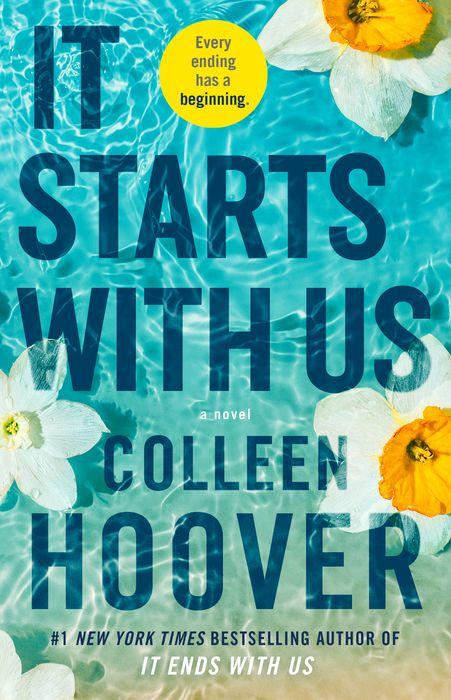
Book Review: It Starts with Us by Colleen Hoover

Title: It Starts with Us
Author: Colleen Hoover
Publisher: Atria
Publication date: October 18, 2022
Length: 323 pages
Genre: Contemporary fiction
Source: Library
Rating:

Rating: 2 out of 5.

Before It Ends with Us, it started with Atlas. Colleen Hoover tells fan favorite Atlas’s side of the story and shares what comes next in this long-anticipated sequel to the “glorious and touching” (USA TODAY) #1 New York Times bestseller It Ends with Us.

Lily and her ex-husband, Ryle, have just settled into a civil coparenting rhythm when she suddenly bumps into her first love, Atlas, again. After nearly two years separated, she is elated that for once, time is on their side, and she immediately says yes when Atlas asks her on a date.

But her excitement is quickly hampered by the knowledge that, though they are no longer married, Ryle is still very much a part of her life—and Atlas Corrigan is the one man he will hate being in his ex-wife and daughter’s life.

Switching between the perspectives of Lily and Atlas, It Starts with Us picks up right where the epilogue for the “gripping, pulse-pounding” (Sarah Pekkanen, author of Perfect Neighbors) bestselling phenomenon It Ends with Us left off. Revealing more about Atlas’s past and following Lily as she embraces a second chance at true love while navigating a jealous ex-husband, it proves that “no one delivers an emotional read like Colleen Hoover” (Anna Todd, New York Times bestselling author).

OK, I’ve paid my dues! I’ve read TWO Colleen Hoover books, and that’s enough for me.

It Starts with Us is the follow up to the author’s 2016 bestseller It Ends with Us, recently made into a movie and generating quite a bit of online chatter. It Starts with Us picks up immediately after the epilogue of the previous book. Read on to learn more… but note that there will be spoilers for both books.

Let’s start with the most important bit: The synopsis above refers to Ryle as a “jealous ex-husband”. Why doesn’t the promotional material for these books come right out and say what’s really going on? Ryle is abusive, physically and emotionally. In the first book, Lily eventually leaves Ryle after he bites her, pushes her down a flight of stairs, leaves her with a concussion and in need of stitches, and attempts to rape her. There’s no sugar-coating this… so no, “jealous” doesn’t even begin to cut it.

In It Starts with Us, Lily is navigating co-parenting with Ryle. While she retains full custody of their toddler daughter, Ryle has visitation rights. Further complicating matters is the fact that Lily’s best friend Allysa is Ryle’s sister, and she lives in the same building as Ryle.

When Lily runs into her first love Atlas (yes, that’s actually his name), they both know that their connection has never gone away, despite all the years apart. Lily is worried about how Ryle will react to her dating anyone post-divorce, but especially Atlas, the man who seems to trigger all of Ryle’s worst impulses just by existing.

Atlas’s life is also complicated by the introduction of a 12-year-old brother whom he never knew about, thanks to his estranged mother’s manipulations and emotional cruelty. Once Atlas meets Josh, he’s determined to get custody and give him a better life than Atlas had at that age.

And meanwhile, Atlas and Lily begin dating, and reignite all the sparks that ever existed between them.

It Starts with Us goes pretty much as you’d expect it to go. The main storyline is about Lily and Atlas’s romance, with chapters alternating between each of their perspectives. Atlas is, of course, simply too good to be true, patient and devoted and kind, refusing to be angered or driven to violence even when Ryle throws the first punch. He’s gentle, yet fiercely protective of Lily.

Lily is a puzzle, to be honest, and she seems to have gotten poor legal advice, among other problems. She never filed charges against Ryle and did not document his abuse as part of their divorce and custody agreements, so when he lashes out again, there’s no pattern to point to. Sure, she can file new charges, but there’s no documented history, and everyone seems to feel that she would have a hard time proving her case.

She also seems to worry a lot about Ryle’s reactions, how to talk to him about her dating life, and how he’ll feel about Atlas being back in her life. And why exactly is this his business? Since when does an ex get to have an opinion on who someone dates?

I’m stuck dealing with Ryle’s feelings forever, and frankly, I’m growing tired of always feeling sorry for him, worried for him, fearful of him, considerate of his feelings.

Lily can’t avoid Ryle, because she’s constantly over at Allysa’s house… but why continue to go there when confrontations seem inevitable? And why on earth would she agree to closed-door, isolated conversations with Ryle when she is fully aware of who he is and how easily his anger erupts?

Late in the book, she insists that he starts working on anger management… but why did no one push him in that direction years earlier?

Lily’s overall take on abuse is really concerning:

I realize in this moment that the hardest part about ending an abusive relationship is that you aren’t necessarily putting an end to the bad moments. The bad moments still rear their ugly heads every now and then. When you end an abusive relationship, it’s the good moments you put an end to.

In the world of these books, the abuse seems to be portrayed as especially awful because there’s so much love in the relationship. So if he was just nasty all the time, it would be easier? I’m not sure what message the author is trying to send here, but I don’t feel it’s a healthy one.

I could go on. There’s so much about this plot that bothers or frustrates me, and it’s not helped by shoddy writing and poor grammar. I suppose you could argue that the first-person narratives are reflecting how Lily and Atlas speak, rather than following grammar rules, but really, is it that hard to say “between Ryle and me”, rather than “between Ryle and I”, which is what actually appears in the book?

There are so many ridiculous elements — here are just a few more:

  • Lily gives Atlas her teen journals to read, to let him see what she felt and experienced when they were together all those years ago. Who on earth would actually do this?
  • Ryle’s sister, brother-in-law, and mother all seem to love and support him, are sad that his marriage failed, but place no restrictions on his role in their lives. His violence seems to be a feature, not a bug.
  • It takes Lily over a year post-divorce to get her house key back from Ryle.
  • Atlas talks to his friend’s 13-year-old son about his personal life and jokingly refers to him as his “therapist”.
  • Ryle continues in his work as a super-successful neurosurgeon… and I still think it strains credulity that he would work in such a high-stress profession and not have his anger issues leak out into his work life.

By the end of the book, Lily at least places restrictions on Ryle’s interactions with their daughter, pending his participation in anger management sessions… but the fact that it took her that long to do so also seems incredible. How does she know that his violence will only affect Lily herself and not their child? She places a degree of trust in him that’s unwarranted, to say the least.

That’s it for my rambles. Both of these books, while highly readable, are also problematic in so many ways. They’re fast reads, and I stuck with them — I did want to see where the author takes the characters and how I’d feel about the wrap-up.

However, I can now safely say that my curiosity about Colleen Hoover’s books has been more than satisfied, and I feel no need to explore further. I know her books are wildly popular… but she just isn’t an author for me.

Book Review: It Ends with Us by Colleen Hoover

Title: It Ends with Us
Author: Colleen Hoover
Publisher: Atria
Publication date: 2016
Length: 386 pages
Genre: Contemporary fiction
Source: Borrowed
Rating:

Rating: 2 out of 5.

Sometimes it is the one who loves you who hurts you the most.

Lily hasn’t always had it easy, but that’s never stopped her from working hard for the life she wants. She’s come a long way from the small town in Maine where she grew up — she graduated from college, moved to Boston, and started her own business. So when she feels a spark with a gorgeous neurosurgeon named Ryle Kincaid, everything in Lily’s life suddenly seems almost too good to be true.

Ryle is assertive, stubborn, maybe even a little arrogant. He’s also sensitive, brilliant, and has a total soft spot for Lily. And the way he looks in scrubs certainly doesn’t hurt. Lily can’t get him out of her head. But Ryle’s complete aversion to relationships is disturbing. Even as Lily finds herself becoming the exception to his “no dating” rule, she can’t help but wonder what made him that way in the first place.

As questions about her new relationship overwhelm her, so do thoughts of Atlas Corrigan — her first love and a link to the past she left behind. He was her kindred spirit, her protector. When Atlas suddenly reappears, everything Lily has built with Ryle is threatened.

Well, at least I can say that I’ve read a CoHo book…

I was pretty sure, based on everything I’ve heard, that Colleen Hoover’s books would not be for me. But the movie version of It Ends with Us has been generating so much buzz (negative and positive), and a friend was super excited to lend me this book… so yes, I finally read a Colleen Hoover book, and it went about as well as I’d expected.

Let me just note, right up front, that it is not okay that the synopsis of the book does not make the key point explicit: This book includes scenes of emotional and physical partner abuse and domestic violence. Readers need to know that ahead of time.

I’m not even sure what to say about this book. It’s the story of 23-year-old Lily, living on her own in Boston, who dreams of opening her own flower shop. She meets a gorgeous neurosurgeon on the roof of a building one night, and they start a game of “naked truths”, where they tell each other major secrets that they wouldn’t normally share with anyone. He’s not a relationship guy at all, but one of his naked truths is that he’d be happy to have a one-night stand with her (although he doesn’t phrase it quite that way). She’s looking for love, not sex, so it’s a no… but she’s mighty tempted.

As their paths continue to cross, the attraction grows, and eventually they do fall into a passionate relationship, but there are all sorts of warning signs.

Oh, why am I bothering to recap this book? Here’s what you need to know (spoilers ahead!):

  • Lily grew up with an abusive father who regularly beat, berated, and raped her mother.
  • Lily’s never forgotten her first love.
  • Ryle does a lot of love-bombing, and bursts into violence when he’s angry (although he claims that he blacks out when it happens)
  • Ryle is physically abusive to Lily, and she eventually leaves him, even though she loves him.

So much of the plot makes no sense. Randomly moving from least offensive to much more offensive… Lily’s flower shop, for one thing — she opens a business in Boston, with no business plan or firm idea of what to do, has a ridiculous description of the aesthetic she’s going for, and yet is instantly, wildly successful.

Ryle’s sister becomes Lily’s best friend and first employee, totally redecorates Lily’s business, and provides whatever Lily needs, whenever she needs. She’s also described as never having had a job in her life, because her husband struck it mega-rich in tech… but really, she’s a grown woman who’s been rich for only a few years and never even had a part-time job?

Lily’s teenaged diaries are written as letters to Ellen DeGeneres. Why? There’s a reason provided, but it’s odd and unnecessary. We learn about her relationship with Atlas through these diaries, which later become something that ignites Ryle’s rage. (Also, the author seems to gloss over the fact that 15-year-old Lily enters into a romantic and sexual relationship with an 18-year-old, I guess because he’s so special and awesome? Just, no.)

After Ryle hits Lily for the first time, she forgives him after warning him that if anything like that every happens again, she’ll dump him. And then they move forward, and all is well and happy and she’s super in love, and they even have a spur-of-the-moment wedding in Las Vegas… but at no point does relationship counseling get mentioned.

We eventually learn about the childhood trauma that’s shaped Ryle, but if his anger is so uncontrollable, how does he function as a neurosurgeon?

Okay, that’s enough rambling. I did not enjoy this book, so why did I give it 2 stars?

If you’d asked me early on, I would have said that 1 star, or maybe 1.5, would be the highest I’d go, and despite how awful I think most of the book is, it was oddly compelling too. My experience reading It Ends with Us was similar to my experience reading Fifty Shades of Grey (yes, I read it…) — I was aware that it was not good, but I also wanted to see where the story went.

I will say that by the end, I could see how the messaging around domestic violence and the exploration of the emotions involved could be important to share. Lily absolutely loves Ryle, and through her first-person narration, we see the inner turmoil she goes through in trying to sort out her love for her husband, dealing with the memories of what she witnessed in her parents’ marriage, and understanding what safety and trust mean for her going forward.

Still, the ending of the book leaves Lily and Ryle in a place that feels unrealistically positive. They’re divorced, but share a child, and their custody arrangements seem courteous… but how does Lily know that she can trust Ryle with their baby? She makes the decision to leave him to end the cycle of violence that she experienced and to create a healthy life for her daughter, but how does that ensure that his anger won’t explode in the future, with Lily, her daughter, or someone else?

Finally, I’ll just mention that the sex scenes earlier in the book, when they’re first falling in love, are unappealingly explicit. There’s one in particular, where he uses a stethoscope to monitor her racing heart rate as she gets more and more into it — I’m sure it’s meant to be hot, but it’s actually just icky.

Clearly, I did not like this book. But I finished it, and it held my attention… so 2 stars seems fair.

And — I hate to even admit this — I’m probably going to read the follow up book (It Starts with Us) too. Maybe some of my complaints will be addressed! Maybe I just need to see if it’s as ridiculous as this one is. Maybe I just can’t help gawking at a train wreck.

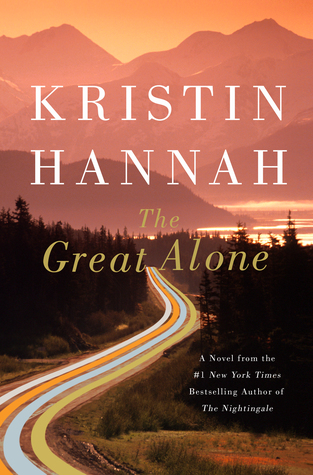
Book Review: The Great Alone by Kristin Hannah


Alaska, 1974.
Unpredictable. Unforgiving. Untamed.
For a family in crisis, the ultimate test of survival.

Ernt Allbright, a former POW, comes home from the Vietnam war a changed and volatile man. When he loses yet another job, he makes an impulsive decision: he will move his family north, to Alaska, where they will live off the grid in America’s last true frontier.

Thirteen-year-old Leni, a girl coming of age in a tumultuous time, caught in the riptide of her parents’ passionate, stormy relationship, dares to hope that a new land will lead to a better future for her family. She is desperate for a place to belong. Her mother, Cora, will do anything and go anywhere for the man she loves, even if means following him into the unknown.

At first, Alaska seems to be the answer to their prayers. In a wild, remote corner of the state, they find a fiercely independent community of strong men and even stronger women. The long, sunlit days and the generosity of the locals make up for the Allbrights’ lack of preparation and dwindling resources.

But as winter approaches and darkness descends on Alaska, Ernt’s fragile mental state deteriorates and the family begins to fracture. Soon the perils outside pale in comparison to threats from within. In their small cabin, covered in snow, blanketed in eighteen hours of night, Leni and her mother learn the terrible truth: they are on their own. In the wild, there is no one to save them but themselves.

In this unforgettable portrait of human frailty and resilience, Kristin Hannah reveals the indomitable character of the modern American pioneer and the spirit of a vanishing Alaska―a place of incomparable beauty and danger. The Great Alone is a daring, beautiful, stay-up-all-night story about love and loss, the fight for survival, and the wildness that lives in both man and nature.

The Great Alone is many things — a portrait of life in rugged Alaska, a story of the damage done by war, a tale of the horrible secrets lurking underneath a family’s facade… and also, a story of love and devotion and commitment.

We first meet Leni as a 13-year-old who never fits in anywhere, thanks to her parents’ inability to settle. Ever since her father returned from his years as a POW in Vietnam, Leni has been pulled from home to home and school to school, as her father’s instability and nightmares make him unable to keep a job or stay put for very long. Meanwhile, Leni’s mother Cora remains madly in love with her husband Ernt, and constantly tells Leni that she wishes she could remember how he was before. Out of options, Ernt comes up with a seemingly crazy idea — they’ll move to Alaska, to a plot of land left him by a war buddy, and live off the land, off the grid, as homesteaders.

Leni, of course, has no say in this, just as she has no say in most of what happens in her life. Cora is desperate to find the answer to making Ernt happy again, so off they go in their battered VW bus, completely unprepared for the realities of the life ahead of them. When they finally reach their land in Kaneq, they find a falling-down dirty cabin, and not much else. Fortunately, the neighbors in this tiny community rally around to teach them what they need to know, with an emphasis on the all-important preparations for their first Alaskan winter.

The land and its surroundings are breathtakingly beautiful, of course… but the winter is harsh, leaving the small family isolated in their cabin for months on end. For Leni and Cora, life becomes increasingly dangerous, not because of the natural threats such as wildlife and climate, but because of the man they live with. Ernt does not do well in the dark, under stress, and he takes out his inner demons on Cora.

Over the years, the family becomes intertwined with their neighbors, and Cora and Leni develop deep bonds with their new friends, but Ernt becomes more and more obsessed with survivalism, his paranoia and nightmares becoming more and more intense. Leni grows up in the shadow of domestic violence, witnessing her father’s brutal treatment of Cora, but unable to do anything to stop it.

And as Leni matures, she falls in love with the boy who was her first friend in Alaska — but her father hates his father and everything he stands for, and it’s clear that the relationship must be kept hidden from Ernt before it pushes him into even more violence.

I have to be honest and admit that I wasn’t so sure about this book for the first third or so. I was interested, but it was slow-going. The description of Alaska and what it takes to build a life there are intriguing, of course, but I’ve read other stories about life in Alaska, so this wasn’t exactly new. I had a hard time at first with the viewpoint, as this section of the book is seen mainly through 13-year-old Leni’s eyes, and there was just something a little limiting about that. Still, it was sadly fascinating to see Leni’s experience of her parents’ toxic marriage — the loving moments, when the two were so obsessed with each other that they couldn’t see anyone else — and the explosively painful moments, when Ernt’s rage would boil over into fists and abuse.

Later, when Leni is an older teen, her story becomes much more compelling. Suddenly, I couldn’t put the book down. (Seriously, I read the 2nd 50% of the book in one sitting.) Leni’s love story builds along a Romeo and Juliet trajectory, and while we can see the inevitable tragedy looming ahead, it’s still a shock when Leni’s life is turned upside down.

In some ways, the story of Ernt’s violence is simply tragic. It’s hard not to hate him as the years go by and his craziness and violence escalate — but there’s an element of pity, too. In today’s world, his PTSD would be recognized for what it is and he’d be able to get help. In the early 1970s, just back from hellish years as a captive in Vietnam, not only was there no psychological help, but he also was subject to the derision of anti-war America when he returned. It might be easy to view Ernt as simply an evil character, but we can’t. He is horrible and abusive and destructive, but his horror stems from his own status as a victim of war and torture. We can absolutely condemn his behavior and his treatment of his family, but I can’t help but feel sorrow too for how different this man might have been without the trauma of Vietnam.

The depiction of domestic violence is harrowing but has a ring of truth. At that time, there was much less support for “battered women”, and a woman who fought back could easily end up either dead or behind bars, without much in the way of legal defense or public awareness. Seeing Leni’s need to protect her mother, and Cora’s inability to find a way to leave, is painful and tragic.

At the same time, I loved the way Leni’s life in Alaska grows. She becomes a part of the community, part of Alaska itself, and this stays with her and changes her in deep and unalterable ways.

I won’t say more about the love story or its outcome, other than WOW and SOB and TEARS and… well, read it yourself to find out!

The Great Alone is powerful and moving, with a unique setting and memorable characters. Check it out.

_________________________________________

The details:

Title: The Great Alone
Author: Kristin Hannah
Publisher: St. Martin’s Press
Publication date: February 6, 2018
Length: 448 pages
Genre: Contemporary fiction
Source: Review copy courtesy of the publisher via NetGalley

Save

Save

Save

Save

Save

Save

Save

Save

Save

Save

Save