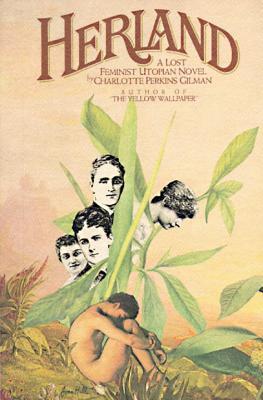
Title: Herland
Author: Charlotte Perkins Gilman
Publication date: 1915
Length: 147 pages
Rating:
Synopsis (Goodreads):
A prominent turn-of-the-century social critic and lecturer, Charlotte Perkins Gilman is perhaps best known for her short story “The Yellow Wallpaper,” a chilling study of a woman’s descent into insanity, and Women and Economics, a classic of feminist theory that analyzes the destructive effects of women’s economic reliance on men.
In Herland, a vision of a feminist utopia, Gilman employs humor to engaging effect in a story about three male explorers who stumble upon an all-female society isolated somewhere in South America. Noting the advanced state of the civilization they’ve encountered, the visitors set out to find some males, assuming that since the country is so civilized, “there must be men.” A delightful fantasy, the story enables Gilman to articulate her then-unconventional views of male-female roles and capabilities, motherhood, individuality, privacy, the sense of community, sexuality, and many other topics.
Decades ahead of her time in evolving a humanistic, feminist perspective, Gilman has been rediscovered and warmly embraced by contemporary feminists. An articulate voice for both women and men oppressed by the social order of the day, she adeptly made her points with a wittiness often missing from polemical writings.
Herland by Charlotte Perkins Gilman is an ahead-of-its-time feminist novel imaging a secret society of women living in an isolated utopia that’s existed for 2,000 years. The plot is narrated by one of a trio of male explorers who “discover” Herland and must learn to adapt to its highly evolved society.
According to Wikipedia:
Herland is a utopian novel from 1915, written by American feminist Charlotte Perkins Gilman. The book describes an isolated society composed entirely of women, who bear children without men (parthenogenesis, a form of asexual reproduction). The result is an ideal social order: free of war, conflict, and domination. It was first published in monthly installments as a serial in 1915 in The Forerunner, a magazine edited and written by Gilman between 1909 and 1916, with its sequel, With Her in Ourland beginning immediately thereafter in the January 1916 issue. The book is often considered to be the middle volume in her utopian trilogy, preceded by Moving the Mountain (1911). It was not published in book form until 1979.
As the book opens, narrator Van and his traveling partners, Terry and Jeff, become obsessed with the idea of locating a hidden land that’s rumored to be inhabited only by women. The men are all scientists of one sort or another, and each has his own attitude toward women. All find it hard to believe that such a place could actually exist, but they finally organize an expedition to discover the truth.
Before arrival, they seem to share a belief that there must be men in this land somewhere, whether residents or occasional guests. How else could this society continue to exist? As well, there’s a doubt about a society of women’s ability to manage — they can’t conceive of women as builders, providers, or growers, and deduce that they must have men’s help. On the other hand, Terry is the womanizer of the group, and while he’s doubtful about the rumors, he’s also sure that a group of women deprived of male company will be absolutely delighted to have him in their midst.
Once the men arrive in Herland, it becomes clear that their expectations are completely off-base. After initial tensions that seem likely to erupt into violence, the men are treated as guests — although without permission or opportunity to leave, they’ve more like gently-treated prisoners. They’re provided shelter, food, and clothing, and the women of Herland begin a lengthy, patient process of teaching the men their ways, culture, and habits.
The men are astonished — Herland is civilized and thriving, with beautiful cities, rich agriculture, and swarms of happy, healthy children. Motherhood is valued above all else, and the women eventually teach the men how their country came to be, and how parthenogenesis spontaneously occurred many generations back, allowing their people to continue to reproduce and flourish.
The men bring with them the expected sexism of their time, and only Terry seems to find it difficult to let the old attitudes go once faced with the reality of a women’s utopia.
Herland examines early 20th century attitudes toward femininity and masculinity, gender-based social roles, appearance and age, and the dynamics of relationships and marriage. Nothing is as the men expect, and their firmly-held beliefs about women’s abilities, about the purpose and goals of wives and mothers, and about the necessity of men to a healthy society are all proved wrong, time and time again.
The writing flows well and contains plenty of amusing outbursts and exclamations each time the men discover some new and unexpected aspect of Herland. I had to laugh over Van’s description of the clothing they’re provided with:
I see that I have not remarked that these women had pockets in surprising number and variety. They were in all their garments, and the middle one in particular was shingled with them.
See? Even in 1915, it’s clear that women’s clothing with pockets absolutely ruled.
After hearing about Herland for years, I’m glad to have finally read it. There is apparently a sequel, With Her In Ourland, which follows immediately upon the events of Herland, showing what happens when a woman from Herland accompanies the men back to the United States. Right now, I don’t feel all that inclined to read the sequel, although I may come back to it at some point down the road.
All in all, Herland is a fast, enjoyable read, with a style reminiscent of the works of H. G. Wells, The Lost World by Arthur Conan Doyle, or other adventure tales of the era. Herland provides a compelling look at the state of feminist theory and literature in the early 20th century. It’s a fascinating story about cultural and gender-based biases and expectations from that time, and has many concepts and situations that resonate even today.
Another terrific read thanks to a Classics Club Spin!




 Bookshelf Fantasies