
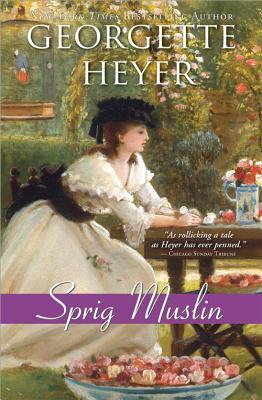
Book Review: Sprig Muslin by Georgette Heyer

Title: Sprig Muslin
Author: Georgette Heyer
Publisher: Sourcebooks Casablanca
Publication date: 1956
Length: 298 pages
Genre: Historical fiction/romance
Source: Purchased
Rating:

Rating: 4.5 out of 5.

A dashing man of honor…

En route to propose to his sensible acquaintance Lady Hester, Sir Gareth Ludlow finds young, pretty Amanda wandering unattended and knows it is his duty to bring her back to her family. This turns out to be a challenge as Amanda seems to possess an imagination as intriguing as it is dangerous.

A shocking refusal…

Lady Hester stuns both him and her family when she refuses him. At her age, no one would expect her to turn down such an eligible suitor. But Lady Hester has met the indomitable Amanda. How can the quiet, intelligent Hester hope to compete with such a lively young lady?

After finishing Georgette Heyer’s Cotillion, I felt like my appetite for her books was reignited, and turned to Sprig Muslin, a paperback I’d picked up a few years ago. I’m so happy I did! Sprig Muslin is silly, sweet-natured, fun — and a refreshing contrast to some of Heyer’s more dramatic books about rakes and rogues and dashing men with terrible reputations.

In Sprig Muslin, the two anchors of the story are good-natured, respectable adults who nonetheless find themselves caught up in a whirlwind of shenanigans. Sir Gareth Ludlow, at age 35, is fashionable, well-off, and after losing his fiancée in a tragic accident many years earlier, still single. It’s time for him to take a wife and start producing heirs.

Sir Gareth decides to propose to Lady Hester Theale, a kind, intelligent woman he’s been friends with all his life. Lady Hester, at age 29, is on the shelf and seemingly content with her lot, although she does seem to get bossed around by her overbearing brother and sister-in-law quite a bit. Hester is appalled to learn that Sir Gareth has declared his intentions to her father and is en route to propose to her; although she won’t give a reason, she definitely does not want this proposal.

Sir Gareth’s plans are interrupted when he stops for refreshment along the way and discovers a young girl on the verge of trouble. Amanda, not quite 17, has apparently run away and is determined to remain at large. Clearly belonging to an upper class family, she states that she intends to marry an up-and-coming soldier, and by running away, she intends to force her grandfather to give his consent. Amanda is headstrong and passionate, and Gareth realizes that his duty is to see her safely returned to her family rather than leaving her to make her way unchaperoned and without an actual plan.

There’s a hitch, however: Amanda refuses to name her family, where they live, or even who her soldier fiancé is. She spins story upon story, and while initially thankful that Gareth seems willing to help her, she soon realizes that he’s going to keep her from her schemes, and attempts to get away from him too.

Thus begins a madcap series of escapades, as Amanda creates one fabulous story after another to explain her situation, drawing in Gareth and then others met along the way. Each tale leads to further complications, and before too long even Hester is drawn into Amanda’s web of stories and fake identities.

Sprig Muslin is utterly delightful. As Amanda’s stories get more and more inventive, various bystanders take on roles, and her tales result in all sorts of rescue attempts, misguided escapes, and even a daring kidnap attempt that goes disastrously wrong. It’s all quite ludicrous, and so very, very enjoyable.

As with all Georgette Heyer books, the unusual words and expressions make the reading experience extra entertaining — here are a few from Sprig Muslin that I highlighted:

  • nodcock (fool or idiot)
  • marplot (one who ruins a plan through meddling)
  • bosky (drunk)
  • daffish (stupid, silly)
  • spinney (small area of trees and bushes)
  • gammon (trick)
  • nonesuch (a person or thing unrivaled or unequaled)
  • gaby (a foolish person)
  • elbow-crooker (drinker)
  • bobbery (a squabble, a noisy disturbance)
  • humdudgeon (loud complaint or noise)
  • flat (as in, “A flat, my child, is one who is easily duped”)

And as for phrases, can’t beat:

  • a fashionable fribble
  • a real top-of-the-trees, slap up to the echo (top-of-the-trees = someone of high esteem)
  • chuffy thing to do
  • in the petticoat line (associating with women of “easy virtue)

While I always enjoy Georgette Heyer’s books, Sprig Muslin may have just become my new favorite. It’s so good-natured, and the sense of fondness for Kitty’s exploits makes this a sweet read. I came away from it really appreciating all the main characters, and had plenty of giggles along the way. If you’re looking for a GH book but aren’t crazy about rakish men being cast as heroes, Sprig Muslin is a great choice!
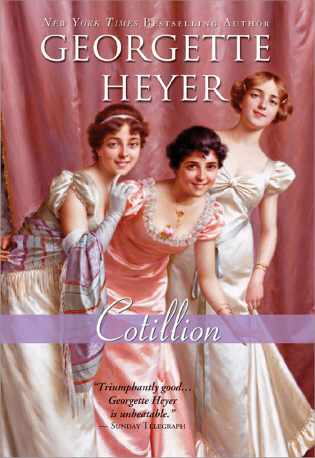
Book Review: Cotillion by Georgette Heyer

Title: Cotillion
Author: Georgette Heyer
Publisher: Sourcebooks Casablanca
Publication date: 1953
Length: 355 pages
Genre: Historical fiction/romance
Source: Purchased
Rating:

Rating: 4 out of 5.

Almost an heiress
Country-bred, spirited Kitty Charings is on the brink of inheriting a fortune from her eccentric guardian — provided that she marries one of his grand-nephews. Kitty has spent her secluded life pining for the handsome, rakish Jack, who is well aware of her attachment.

A plan of her own
But when Jack fails to respond to his great-uncle’s ultimatum, Kitty hatches a strategy of her own — a counterfeit betrothal to mild-mannered Freddy Standen (who neither needs nor wants the money).

A most unlikely hero
And when Kitty’s generous heart leads to all sorts of unintended troubles, there is only one man who can rescue her from more than one dreadful fix, pick up the pieces of her plotting and in the process, win her heart…

Cotillion is a light-hearted addition to Georgette Heyer’s huge collection of Regency romances, and it’s a silly read that still manages to surprise.

Main character Kitty is the ward of a grumpy, gouty, rich old man who has named her his heiress — but only if she marries one of her many eligible cousins-by-adoption. Great-uncle Matthew summons the lot of them to his gloomy estate, but not all show up: Jack, the dashing rake whom Kitty has loved since girlhood, has declined the invitation.

Several others do arrive as ordered — Lord Biddenden, the oldest cousin — already married and there to keep an eye on things; Lord Dolphinton, the sweet but slow-witted Earl of an Irish estate (and apparently Irish nobility isn’t considered nearly as impressive as English nobility); Hugh, a rector who’s entirely too upright and stodgy to suit Kitty… and then there’s Freddy, a “Pink” of the ton, a nice guy who likes Kitty well enough but has no interest in Great-uncle Matthew’s schemes (and as an eldest son, doesn’t need the money that comes with marrying Kitty).

Kitty is stuck — she’ll get nothing if she doesn’t marry one of the cousins, and she’s more than a little heart-broken that Jack hasn’t come to her rescue. She’s been raised in this boring home with no opportunity for society, and is desperate for at least a taste of what’s she’s missing before resigning herself to a life working as a governess or a chambermaid. What Kitty wants above all else is the chance to spend time in London — even just a month would be a treat! And so she comes up with a scheme — she asks Freddy to “offer” for her and enter into a fake betrothal. If they were betrothed, it would be proper for him to take her to London to stay with his family and introduce her to society. If they don’t publicly announce the betrothal, there will be no harm in calling it off after a month. Kitty feels quite sure that after that small taste of fun and freedom, she’ll be ready to face the rest of her life.

Freddy is a friendly, affable sort and agrees to the plan, which soon gets even more complicated. Freddy’s mother is unavailable to chaperone, so he installs her with his married sister, who’s quite a lot of fun, and soon Kitty is enjoying fashion, parties and outings. She also can’t refrain from befriending unusual people and wanting to help them, and before long, she’s caught up in the affairs of two different couples who seem to have all the odds stacked against them — but Kitty is determined to sort out their challenges and get them all a happy ending.

A note on the title: According to an essay on Tor.com:

A cotillion is a Regency dance where you change partners, and Georgette Heyer’s Cotillion is a Regency Romance where everybody twirls and faces their partners and ends up in a happy set of not-entirely predictable couples. 

What’s more, a cotillion is a dance for four couples, and that’s pretty apt for this book.

Cotillion is quite a fun read. Sure, I could quibble with the terribly sexist attitudes portrayed here, but they’re a product of their time — so I can despise the seemingly admirable rake who’s known for his string of mistresses without despising the book itself.

Reading Georgette Heyer’s Regency books is a lesson in idioms, slang, and speech patterns. Freddy in particular speaks without including subjects in his sentences:

“Thing is,” said Freddy, recognizing his cue, “never thought my uncle would permit it. Thought it was useless to approach him. As soon as I read his letter — bespoke a chaise and came at once! Trust you’ll allow me to speak to him in the morning.”

And here are just a few of the words or phrases I had to stop, highlight, and look up:

  • objurgations (harsh reprimands or criticisms)
  • retroussé (a nose that turns up at the tip)
  • wear the willow (to grieve a death)
  • fustian (pompous or pretentious speech)
  • out-and-outer (possessing a particular quality to an extreme degree)
  • bamming (hoaxing, tricking, cheating)
  • percipience (perceptiveness)
  • gudgeon (a credulous or easily fooled person)
  • Joliffe-shallow (type of hat)
  • cognomen (nickname)
  • cicisbeo (the professed gallant or lover of a woman)
  • havey-cavey (dubious, shady)

And as for dialogue, here are a few choice selections:

“Dashed bacon-brained notion to take into your to your cockloft!”

Jack’s too downy to play cards with a leg. But he ain’t a flat either.

When I go into wedded shackles in will be in my own time, and in my own fashion.

Kitty’s adventures are not to be taken terribly seriously. Having read a bunch of GH’s Regency romances already, I was sure from the start that I knew where the story was going, but — surprise!! — about midway through I realized that my expectations were way off base, and the way it all worked out really charmed me. (I’ve seen a few Goodreads reviews say that the surprise is most effective if you’ve read at least a few other Heyer romances first — and that makes sense to me!)

I can’t say that Cotillion is my favorite of Georgette Heyer’s books, but I’m certainly glad to have read it, and found it really entertaining the whole way through.

Any Georgette Heyer fans out there? Which of her books do you recommend? This is #8 for me, and I’ll happily read more (although I think about 1 or 2 per year is probably the most I can handle).

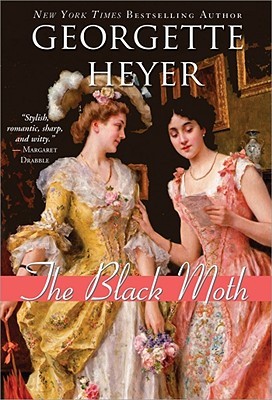
Book Review: The Black Moth by Georgette Heyer

Title: The Black Moth
Author: Georgette Heyer
Publisher: Sourcebooks Casablanca
Publication date: 1921
Length: 355 pages
Genre: Historical fiction/romance
Source: Purchased
Rating:

Rating: 4 out of 5.

A disgraced lord, a notorious highwayman

Jack Carstares, the disgraced Earl of Wyndam, left England seven long years ago, sacrificing his honor for that of his brother when he was accused of cheating at cards. Now Jack is back, roaming his beloved South Country in the disguise of a highwayman.

And the beauty who would steal his heart

Not long after Jack’s return, he encounters his old adversary, the libertine Duke of Andover, attempting the abduction of the beautiful Diana Beauleigh. At the point of Jack’s sword, the duke is vanquished, but foiled once, the “Black Moth” has no intention of failing again.

This is Georgette Heyer’s first novel, a favorite of readers and a stirring tale to be enjoyed again and again.

The Black Moth was Georgette Heyer’s first novel, published when she was just 19 years old. The author went on to publish over 60 novels and became known as the queen of Regency romances. Apparently (according to Wikipedia and other online articles), she wrote The Black Moth in serial installments as a way to entertain her ailing, bedridden younger brother, and her father thought the story was so good that he encouraged her to publish it. And the rest, as they say, is history!

The Black Moth is quite the adventurous, swash-buckling tale, full of men behaving badly and women steeling their spines and standing up for themselves (with a little swooning thrown in too). Set during the Georgian era, the plot revolves around aristocratic men bound by family loyalty and what would now be considered out-of-proportion concern for honor and reputation.

Jack Castares, the elder son of the Earl of Wyncham, has been living in exiled disgrace for years as of the opening of the book, ever since he was caught cheating at cards — a fatal blow to a gentleman’s reputation. He spends his days as a highwayman, raiding carriages and terrorizing travelers — although he’s actually a highwayman with a heart of gold, more often than not helping the helpless or “donating” his ill-gotten gains to those in need.

But Jack’s younger brother Richard knows the truth. Richard was, in fact, the one who’d been cheating, but Jack took the blame rather than see his brother shamed and disgraced, which would have resulted in him losing the woman he loved.

Richard’s wife Lavinia’s oldest brother, Tracy Belmanoir, the Duke of Andover, was the one who “caught” the cheating. A man nicknamed “Devil”, the Duke is cold, decadent, and deadly when provoked. When he attempts to abduct a young woman who’s caught his eye, Jack intervenes, at risk to his own life. Family secrets, love, and honor become intertwined, until a final showdown involving yet another abduction, a duel, and (naturally) a happy ending.

The Black Moth is highly entertaining, but clearly a product of its time. I had to leave my feminist sensibilities firmly tucked away on a shelf while reading this book, or the paternalism and disrespect toward women would have driven me crazy — although to be fair, there are two lead women characters who are strong-willed, determined, and capable, and I love their portrayals.

On the negative side, however, is the plot climax that includes threat of a forced marriage — or, if the woman will not consent, the implied threat of a rape and marriage anyway. These fates are avoided by the hero’s arrival and success in a duel, but the fact remains that the evildoer goes unpunished and the incident is largely resolved through a gentlemen’s agreement that everyone will be better off keeping this a private affair.

Daring adventure and danger is the name of the game in The Black Moth, and the scenes that include either action sequences or social manners and maneuvers are the most enjoyable. I was less enthralled by the gambling and settling of debts and manly men being manly in their men’s clubs… but there was enough good stuff in the mix to outweigh these bits.

I ended up reading The Black Moth for the Classics Club Spin challenge, and I’m so glad I did! This book has been on my shelf for several years, and I’m happy that I finally had an incentive to pick it up and read it. I started The Black Moth via the Serial Reader app, thinking I’d read it over the course of a month in daily installments, but this approach ended up not working for me. The small bites didn’t give me enough immersion in the story and made it hard to keep the characters straight — I was much happier once I picked up my paperback edition and read straight through to the end.

This is, I believe, my 7th Georgette Heyer book, and I have a stack of unread books by her still sitting on my bookshelf. Overall, The Black Moth was a great pick for a light and easy classic read, and I’m glad to have gone back to this author. And now that I have, I’m feeling motivated to squeeze in at least one or two more this year!

If you’ve read any Georgette Heyer books, please let me know — which are your favorites? I’d appreciate any and all recommendations!