Another series? Spare me!

Do you remember this terrific Sesame Street song?

http://www.youtube.com/watch?v=hnoJwfnzmqA

“Every story has a beginning, middle, and an end…”

Words to live by… except nowadays, when just about every other book I pick up is part of a series. Seriously? Whatever happened to starting and ending a story within the covers of a single book?

It’s frustrating beyond words, especially when you don’t know what you’re getting into from the outset. I remember picking up a copy of The Hunger Games when it first came out, and wondering, as I approached the end, how the author could possibly wrap things up with so few pages left to go. The answer, of course, is that she didn’t. Yes, I’ve since read and loved the entire trilogy, but I wish I’d read the reviews more carefully ahead of time so I wouldn’t have been taken by surprise. Same thing happened to me just a couple of years ago when I read Haters by David Moody. I absolutely had no idea that the story wasn’t complete in one book until I saw those dreaded words on the last page: “to be continued”.

Why so many series, trilogies, sequels? One cynical answer is that there’s more money to be made from three books than one. I especially wonder when I look at the young adult fiction shelves: does every story need so many parts? Or is this an after-effect of the Twilight phenomenon, which proved that teens (and adults) will get hooked on a story and then buy more, more, and more?

And then there are the series that just never seem to end. Charlaine Harris has announced that next year’s Sookie Stackhouse novel will be the last… but in my opinion, this is a series that passed its sell-by date a few years ago. Whether the blame lies with the publisher, the marketing team, the agents, or someone else entirely, it’s hard to see the stretching out of this series as anything other than good business sense. You’d be hard-pressed to claim that these books still have much to offer in terms of plot or character development; in fact, in the most recent few installments, I firmly believe that if the author had cut all the pages devoted to Sookie’s daily beauty routines, we might have been able to condense it all into one decent book instead of three or four mediocre ones.

Even when the writing is excellent and I’m immediately engrossed in the plot, it’s the year or so of waiting in between installments that really drives me nuts. And at my “advanced” age, who knows if I’ll even remember what happened in book one by the time book two comes out?

My new resolution, which I’m trying to keep without too much waffling, is to begin a new series only if I know that the entire series has already been published. A friend had been after me to read Jim Butcher’s Codex Alera series for quite some time, knowing how much I enjoy the Dresden Files books. I resisted and resisted – “I don’t need another series in my life!!” – but when I heard that the sixth and final book had been released, I started from #1 and read all the way through the series, barely coming up for breath in between. And you know what? It was fantastic! I enjoyed the books, and I loved being able to follow the characters along their varied trajectories in a seamless journey, without losing the thread of the plotlines due to the long intervals in the publishing schedule.

The same friend has been urging me to read Patrick Rothfuss’s Kingkiller Chronicles. I’m sure I’ll love the books… but for now, I’ve declined my friend’s entreaties. My response so far: “Tell me when there’s a publication date for the third book in the trilogy, and then we can talk.”

Not to say that I don’t have series that I faithfully follow and adore. Give me a never-ending supply of Outlander novels by Diana Gabaldon, and I’ll be happy as a clam. (So what if Claire and Jamie are in their 90s? I bet they’ll still be one hot couple!) Likewise, I’ll wait as long as it takes until George R. R. Martin publishes books six and seven in the amazing A Song of Ice and Fire series.

But picking up a new series at this point? I think I’ll pass. Give me a beginning, middle, and an end, all in one tidy volume, and I’m yours.
Tally ho, Alaska bound!

My lovely daughter, now a college graduate, is about to embark on a year-long service project in Juneau, Alaska. In her honor, let’s talk Alaska books. I’m putting together a list of books, fiction and non-fiction, that are set in Alaska and convey a bit of local flavor, drama, and adventure. Based purely on my own arbitrary set of rules, I’m leaving out travel guides (no Fodor’s or Frommer’s) and straight-up history; anything else goes.

Here’s what I have from my own personal library:

A couple that I’ve read:

Alaska by James Michener. Michener’s historical novels make good doorstops, but they really do  provide an excellent overview of the history of a place, told in a way that’s both informative and engaging. An easy solution for those of us who always choose fiction over non-fiction.

If You Lived Here, I’d Know Your Name: News from Small-Town Alaska by Heather Lende. A warm-hearted memoir of one woman’s experiences, both introspective and amusing.

A couple still on my to-read shelf:

Tisha: The Story of a Young Teacher in the Alaska Wilderness by Robert Specht and Anne Purdy. According to the blurb on Amazon: “Anne Hobbs is a prim and proper 19-year-old schoolteacher who yearns for adventure. She finds this and much more in a town with the unlikely name of Chicken, located deep in the Alaskan interior. It is 1927 and Chicken is a wild mining community flaming with gold fever. Anne quickly makes friends with many of the townspeople, but is soon ostracized when she not only befriends the local Indians but also falls in love with one.”

The Blue Bear: A True Story of Friendship, Tragedy, and Survival in the Alaskan Wilderness by Lynn Schooler. Again from Amazon: “With a body twisted by adolescent scoliosis and memories of the brutal death of a woman he loved, Lynn Schooler kept the world at arm’s length, drifting through the wilds of Alaska as a commercial fisherman, outdoorsman, and wilderness guide. In 1990 Schooler met Japanese photographer Michio Hoshino and began a profound friendship forged by a love of adventure and cemented by their mutual obsession with finding the elusive glacier bear, an exceedingly rare creature, seldom seen and shrouded in legend. But it was only after Hoshino’s tragic death from a bear attack that Schooler succeeded in photographing the animal — and only then that he was able to complete his journey and find new meaning in his own life.”

Coming Into The Country by John McPhee. Amazon description: “Coming into the Country is an unforgettable account of Alaska and Alaskans. It is a rich tapestry of vivid characters, observed landscapes, and descriptive narrative, in three principal segments that deal, respectively, with a total wilderness, with urban Alaska, and with life in the remoteness of the bush.”

What else? Add your ideas and recommendations in the comments!

My shelves runneth over (a bookish sort of survey)

My piles of books are having babies overnight, I swear. The stacks keep growing. My shelves are all double-layered, with a few extra paperbacks squeezed in on top of all the neat, orderly books. I have bags of books on my office floor, which will remain where they are until I get some more shelves or until the magic book fairy turns my living room into a Tardis-style library that’s bigger on the inside.

I do take books out of the library. I lend my books (reluctantly, and only after extracting severe promises to maintain my books’ pristine conditions). I sell the books I can live without back to my local friendly used book dealers — although I often walk away from these transactions with more used books to take back home with me. I give away the books I really don’t want any more, and sometimes the ones I’ve picked up but then never really felt like reading. And yet… my shelves runneth over, my house is filled to bursting with books, and I keep getting more.

So what’s a book lover to do? What do you do with your books after you’ve read them?

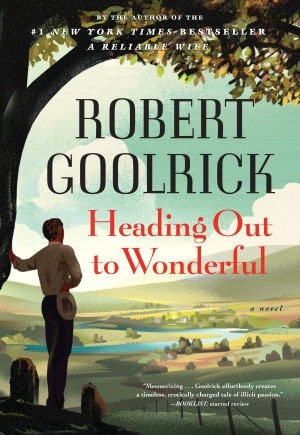
Book Review: Heading Out To Wonderful by Robert Goolrick

Book Review: Heading Out To Wonderful by Robert Goolrick


I’m struggling to figure out just what I want to say about Heading Out To Wonderful. The writing is lovely, and I became involved enough in the plot that I stayed up way past my bedtime to finish the book. On the other hand, I’m not sure that the whole is greater than the sum of its parts.

Heading Out To Wonderful is set in the sleepy rural town of Brownsburg, Virginia in 1948, post-war years when life in America was on the cusp of change. The author lovingly describes the quality of life in Brownsburg:

Brownsburg, Virginia, 1948, the kind of town that existed in the years right after the war, where the terrible American wanting hadn’t touched yet, where most people lived a simple life without yearning for things they couldn’t have…

And also:

A particular town, then, Brownsburg, in a particular time and place. The notion of being happy didn’t occur to most people, it just wasn’t something they thought about, and life treated them pretty well… the notion of being unhappy didn’t occur much either.

Into this small town arrives Charlie Beale, an attractive and pleasant man who appears in his truck one day, bringing nothing but two suitcases, one filled with butcher knives and one filled with cash. Charlie seeks out work with the local butcher, buys a plot of land out by the river, and settles in.

Charlie remains something of an enigma throughout the book. He is 39 years old, athletic and graceful, skilled with his hands and his knives. He served in Europe in the war, but doing what exactly, we never find out. The only clue we get about his wartime experiences is that his butcher knives are German; we can only speculate as to where or how he acquired them.

Charlie doesn’t speak about his childhood or background except in vague generalities. Where did all that cash come from? We don’t know. Charlie is full of yearning, for a place, for land, for connections, and for goodness. Somehow along the way, Charlie lost his sense of hope, and so he set out traveling, looking for “something wonderful”. His new friend and employer Will tries to reset Charlie’s expectations:

Let me tell you something, son. When you’re young, and you head out to wonderful, everything is fresh and bright as a brand-new penny, but before you get to wonderful you’re going to have to pass through all right. And when you get to all right, stop and take a good, long look, because that may be as far as you’re ever going to go. Brownsburg ain’t heaven, by any means. But it’s perfectly fine. It’s all right.

Charlie seems to have found “all right” in Brownsburg. He earns the friendship of the townspeople, and is the adored companion of Will’s young son Sam. Charlie might even have been content at last, until he meets Sylvan Glass, a 17-year-old “hillbilly” girl, bought and paid for by the richest man in town, now a trophy wife who dreams of glamour and Hollywood. What follows is a year-long affair which consumes Charlie and disrupts the lives of everyone in town. Reading about Charlie and Sylvan, we know that something disastrous has been set in motion; I could only wait to see what shape the disaster would ultimately take.

A sense of foreboding hangs over the story from the outset. It’s clear that nothing good can come out of the affair. By the time I reached the half-way mark in the book, it became very difficult to put down, and I had to keep reading to see which way it would go. To avoid spoilers, I won’t say anything about the book’s climax, other than to say that events unfold that are at the same time tragic yet not unexpected.

At the conclusion, I was disturbed by the lack of overall coherence. Many plot elements that are compelling are introduced, but I didn’t see the follow-through. The black and white communities live completely separate lives in Brownsburg. Both Charlie and Sylvan develop relationships that reach out across the color lines, yet I didn’t feel that this part of the story particularly went anywhere. Concepts of sin and salvation are introduced as Charlie struggles to fit into the spiritual life of the community, but again, I didn’t feel the points were carried through as the plot unfolded.

Ultimately, dramatic as the story is, Heading Out To Wonderful left me a bit puzzled at the end, wondering about the point of it all. Robert Goolrick is a terrific and thoughtful writer – I loved his previous novel, A Reliable Wife, with its dark secrets and twisty-turny plot developments. Unfortunately, despite the lovely prose, Heading Out To Wonderful doesn’t quite deliver.

Hurray for public libraries!

Posted by the Grand Forks Public Library (http://www.gflibrary.com/)

Wishlist Wednesday

What fun! I’m so happy to have discovered Wishlist Wednesday, hosted by the lovely Pen to Paper blog. The concept is to post about one book from our wish lists that we can’t wait to read. Want to play? Here’s how:

  • Follow Pen to Paper as host of the meme.
  • Please consider adding the blog hop button to your blog somewhere, so others can find it easily and join in too! Help spread the word! The code will be at the bottom of the post under the linky.
  • Pick a book from your wishlist that you are dying to get to put on your shelves.
  • Do a post telling your readers about the book and why it’s on your wishlist.
  • Add your blog to the linky at the bottom of this post.
  • Put a link back to pen to paper (http://vogue-pentopaper.blogspot.com) somewhere in your post.
  • Visit the other blogs and enjoy!

My Wishlist Wednesday book is:

Horns by Joe Hill

From Amazon:

Ignatius Perrish spent the night drunk and doing terrible things. He woke up the next morning with one hell of a hangover, a raging headache . . . and a pair of horns growing from his temples. Once, Ig lived the life of the blessed: born into privilege, the second son of a renowned American musician, and the younger brother of a rising late-night TV star, Ig had security and wealth and a place in his community. Ig had it all, and more – he had the love of Merrin Williams, a love founded on shared daydreams, mutual daring, and unlikely midsummer magic. Then beautiful, vivacious Merrin was gone – raped and murdered, under inexplicable circumstances – with Ig the only suspect. He was never tried for the crime, but in the court of public opinion, Ig was and always would be guilty. Now Ig is possessed with a terrible new power – with just a touch he can see peoples’ darkest desires – to go with his terrible new look, and he means to use it to find the man who killed Merrin and destroyed his life. Being good and praying for the best got him nowhere. It’s time for a little revenge; it’s time the devil had his due.

Why do I want to read this?

Horns has been sitting on my shelf for quite some time now, and so far I haven’t been in the mood. However… I just heard from a friend today that the movie version of Horns will star Daniel Radcliffe, and that’s enough of a reason to give Horns a boost higher on the to-read pile. Plus, I do think Joe Hill is a fantastic writer. His Heart-Shaped Box scared the heck out of me!

Book Review: Talulla Rising by Glen Duncan

Book Review: Talulla Rising by Glen Duncan

I can’t talk about Talulla Rising without talking about its predecessor, The Last Werewolf and what happened in it, especially some major twists toward the end. So consider this your obligatory spoiler alert. SPOILERS AHEAD! Caveat lector — let the reader beware.

Now that that’s out of the way…

The Last Werewolf was one of my favorite books of 2011. Simply put, I was blown away by the language as well as the plot. Glen Duncan’s writing is extraordinary, and the voice he created for lead character Jake Marlowe was remarkable. In a nutshell, The Last Werewolf is a first-person narrative told from the perspective of the titular character Jake, who is, in fact, the very last werewolf in existence. After a lifespan of 200 years, WOCOP (the World Organisation for the Control of Occult Phenomena) has finally succeeded in wiping out the rest of his species and has let it be known that Jake is next. Jake is world-weary, bone-weary, and overall rather sick of it all, so he decides to let WOCOP hunt him down and put an end to it, once and for all.

AND THEN… (and this is where the serious spoilers arise, so — last chance — avert your eyes now!)… Jake meets Talulla, and discovers that he’s not the last after all. Talulla is a recently turned werewolf, who quickly becomes his lover, his soulmate, and his partner in monstrosity. The pair go on the road, a lupine Bonnie and Clyde, but their joy in finding true love is not fated to last. Suffice it to say, The Last Werewolf does not end with a happily-ever-after.

Talulla Rising opens several months after the conclusion of The Last Werewolf. Jake is gone, and Talulla is alone in the world, pregnant, and full of despair. Her pain over the loss of Jake is intense; her fears of impending motherhood are enormous. Can a monster be a mother? What will her child be, and how can she make sure it survives? When her newborn werewolf son, born during Talulla’s full-moon transformation, is brutally ripped from her arms by a familiar team of enemies, events are set in motion that lead to ongoing violence, desperate acts, and unlikely alliances.

Along the way, despite Talulla’s efforts to harden her heart and not let herself love, she becomes a fierce mother/protector, whose only motivation is to save her young, no matter the expense.

Talulla Rising is not for the easily disturbed. If scenes of bodily mayhem make you queasy, this will not be your cup of tea. The violence is brutal, explicit, and quite often disgusting — although, frankly, it is a team of scientists rather than any supernatural beings who carry out the worst of the atrocities committed in the course of this book.

As in the first book, Glen Duncan’s writing is magnificent. His use of words continues to astound, as he twists and turns the English language to his will. I found Talulla’s voice a little too similar to Jake’s at times, but that’s a minor complaint.

While the first book had plenty of action, it focused to a great degree on Jake’s internal dialogue. Talulla Rising is much more plot-driven, with events and disasters piling up at a tremendous clip.

When I finished The Last Werewolf, the story felt complete, and I had no idea that a sequel was planned. Likewise, after finishing Talulla Rising, I read this Q&A with Glen Duncan and was surprised to learn that this is, in fact, a trilogy, and that a third and final book is forthcoming. While some plot threads are left dangling at the end, Talulla Rising ends on a satisfying note and is complete on its own, so that it was not immediately evident to me that the author planned a follow-up. That said, I’ve truly enjoyed these two werewolf novels by Glen Duncan, and will certainly gobble up the third as soon as it’s available.

Book Review: Fables (volumes 1 – 3) by Bill Willingham

Fables (volumes 1 – 3) by Bill Willingham

I have quickly fallen in love with the Fables graphic novel series. By the end of volume 1, “Legends in Exile”, I was pretty sure it was just a crush. After reading volume 2, “Animal Farm,” I realized my feelings had deepened and that this just might be the start of a serious relationship. And now, three volumes in, after reading “Storybook Love”, I know it’s the real thing. I’m hooked.

Fables, written by Bill Willingham, is a DC Comics series that originally appeared in comic book format, now compiled in trade paperback volumes. So far, 17 volumes are available in print, with volume #18 due for publication in January of 2013.

Fables tell the story of fairy tale and other assorted mythical and magical characters, forced to flee their homelands after the invasion of the Adversary (about whom we know nothing so far, other than the fact that he’s unstoppable and ruthless. If you’ve read further in the series than I have — hush! I don’t want to know.) The survivors have taken refuge in our world — more specifically, Manhattan — where they live a secret life, concealing their magic from the mundys (that’s us, folks).

The mayor of the Manhattan Fable town is Old King Cole, but he’s merely a figurehead. The true authority lies with deputy mayor Snow White (our fearless heroine!), backed up by sheriff and overall enforcer Bigby Wolf (Big B. Wolf — get it?), whose gruff human exterior hides a predator with a core of integrity. Between the two of them, they ride herd on a mish-mash of misfits, including Little Boy Blue, Prince Charming (such a cad!), the Frog Prince (known as Flycatcher due to his unfortunate snacking habits), and Bluebeard (who reminds me of a really buff version of Walter White of Breaking Bad).

Their less human-looking counterparts reside on a hidden farm in upstate New York, concealed from the outside world, but also chafing under their enforced seclusion. A brilliant plot involving an uprising at the Farm is what truly got me involved in this series. Let’s just say that there’s a lot more to Goldilocks and the three bears than you might assume. And don’t get me started on nasty old Shere Khan either.

Fables is not for children. Mature themes abound, as well as plenty of gruesome deaths, sexy bedroom scenes, conspiracies, deceptions, murder and mayhem. The plotting is detailed and fast-paced, with masterful storytelling at every turn. It’s been a real pleasure for me to discover a tale well-told in a format that’s fresh and engaging. For someone who’s relatively new to the world of graphic novels, I’m really having a ball with this series, and I’m finding it seriously difficult to put Fables down in order to pick up a “real” novel.

Onward we go. So long as I have more volumes of Fables close at hand, it would appear that I’m not going to get anything else done.


A word from my reluctant reader

“Mom, it’s not that I can’t read. I just prefer not to.”

Courtesy of my 9-year-old. Proof that being an insatiable reader isn’t genetic after all.

Quickie Book Review: Code Name Verity by Elizabeth Wein

Code Name Verity is one of those books that makes me wonder why certain novels get marketed as young adult fiction. In my mind, and on my bookshelves, it just goes on the shelf marked Incredibly Well-Written and Moving Fiction. So there! It will be in very good company, right next to The Book Thief and The Fault In Our Stars, two other so-called YA novels that anyone with any sense ought to read immediately.

Code Name Verity is breathtaking, suspenseful, emotional, and even funny at times. I don’t want to give anything away, but here are the bare bones: This is the story of two young women who manage to find a friendship that elevates them above the harshness of life in wartime. Set in England and France during WWII, Code Name Verity… well, dammit, just read the book! You’re better off starting with a clean slate and not knowing anything before you read it.

Suffice it to say, I was blown away and couldn’t put it down. I took the book out of the library after reading a glowing review, but I think I’ll have to quickly purchase my own copy so I can re-read it at leisure.

Why a quickie book review? It’s simple, really: A) I loved this book and want everyone to know!, and B) this is a book better appreciated with no foreknowledge, so the less said the better.