Outlander Rewatch: Episode 104, “The Gathering”

Outlander, Season 1, Episode 4: “The Gathering”

OL rewatch

The official synopsis, courtesy of Starz:

As the Castle prepares for The Gathering, Claire plots her escape. But after a dangerous encounter with a drunken Dougal and an unexpected run-in with Jamie, her plans are dashed.

My synopsis:

We open on a scene that seems fraught with peril. Claire is running through the woods, breathing hard, seemingly desperate. Is she in danger? Is someone pursuing her? Yes, there are pursuers — but they’re not at all dangerous. Claire is playing games with the castle children, rollicking through silly chases with them, laughing and making herself the center of attention. But does this mean that Claire has settled into castle life and accepts that she must stay there? Not a bit. She’s a smart cookie, that Claire. She’s using the forest games to learn the routes in and out of the castle, leave behind ribbons and other items to mark her path, and study the sentries’ habits and schedules. Claire is determined to escape Leoch once and for all, and figures that the Gathering will provide her with the best opportunity, while the men of Clan MacKenzie are busy and distracted.

Still, Claire can’t help but feel that she’ll miss the community and the people she’s come to know over the past several weeks, the “simple joy” she sees as the folks gather to share food, songs, and games, the pleasure they seem to take in spending time together.

6ca484a8-537a-434f-802d-f7dd0eaf7ab9

Geillis shows up early for the Gathering, surprising Claire in her surgery and making a lot of pointed statements. It seems as though Geillis knows exactly what Claire is planning, and questions her without ever saying exactly what she means. Claire is on her toes around Geillis at this point and send her on her way, but this is yet more evidence that all eyes are on Claire.

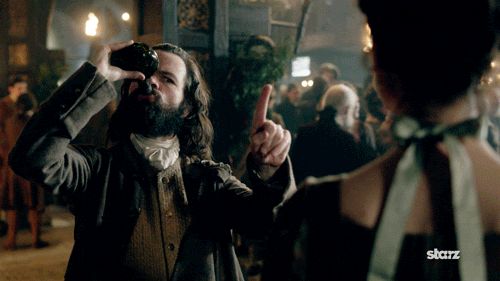
Claire plans to run off while everyone is attending the Oath Taking, a formal ceremony during which each man present swears his allegiance to Colum as Laird of the clan. Claire’s plans are foiled by the doting (but interfering) Mrs. Fitz, who drags Claire off to get properly dressed and then takes her to watch the ceremony. Finally, Claire slips out (after dosing her guard Angus with port laced with valerian root, a sedative) and heads for the stables. Her plan is to steal a horse and escape under cover of night.
c76542f11606a6aba2023d8e2500543b

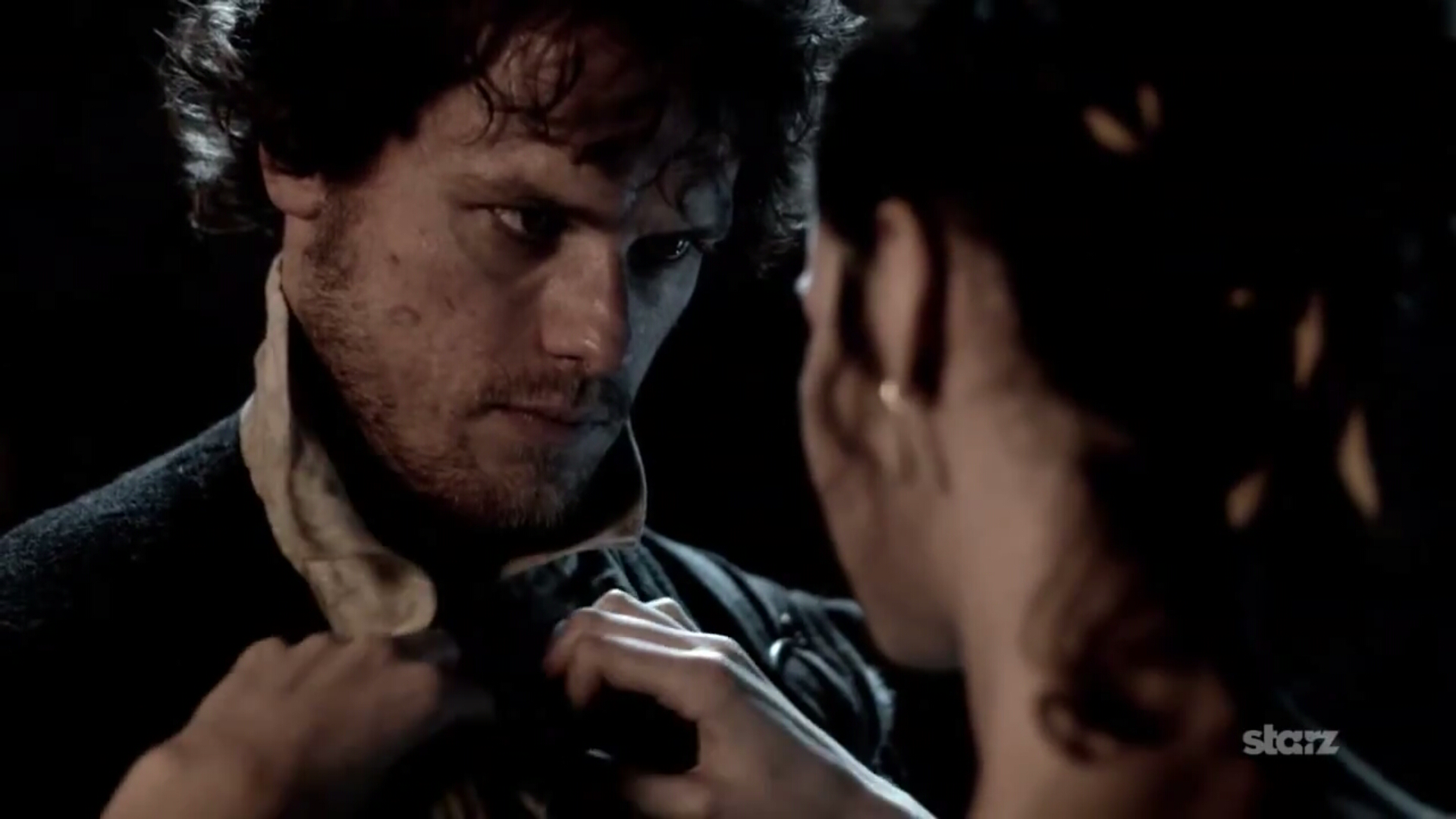
This does not go as planned. First, Claire encounters a group of drunk and randy Highlanders who want to have some fun with Claire. She’s not having it, and neither is Dougal, who comes along and kicks their butts. But Dougal is quite drunk as well, and after getting particularly handsy with Claire, she bops him over the head with a stool and makes her escape… only to trip over Jamie, who’s been sleeping in the stable in the hopes of lying low until the ceremony is all over.

Jamie talks reason to Claire. She’ll never make it, if she tries to escape. There are guards posted throughout the woods. She has absolutely no chance of getting away without being noticed, and if she’s caught escaping, her treatment as an honored member of the castle will change dramatically, and she’ll end up locked up as a prisoner. Claire is forced to recognize the futility of escape — for the moment — and agrees to return to the castle with Jamie as an escort, as it’s clearly not safe for her to be out alone while there are so many drunk and horny men out and about.

Alas, the two are found, and Jamie is bustled off to the castle to take his oath before Colum. No big deal, am I right? thinks Claire. Nope, she’s wrong. This place is just teeming with political machinations. As nephew to the Laird, if Jamie takes the oath, he’ll stand a good chance of being next in line to be Laird himself, which would not sit well with Dougal and Colum. But if he refuses to take the oath, it’s a huge insult, and the MacKenzie men will have his blood. Basically, he’s screwed. Either way, he ends up dead.

Not to worry – Jamie can maneuver with the best of ’em. When Jamie gets to the front of the line, he tells Colum that he cannot make a pledge to him, as his loyalty is already given to the clan whose name he bears. But, he can offer friendship, and swears to be obedient to Colum and to serve the MacKenzies as long as he is on MacKenzie land. After a tense moment with lots of hands hovering over sword hilts, Colum smiles and drinks with Jamie. Whew! That was a close one.

Outlander 2014

The next morning, a large group heads into the forest for a boar hunt. Claire is brought along, because boars have very sharp tusks and the skills of a healer are likely to be needed. And they are. A man named Geordie is gored by a charging boar, and at first Claire thinks he’s treatable so long as she tourniquets the leg — but then she sees the blood on his shirt and looks beneath to see that his stomach has been ripped open as well. It’s fatal, she tells Dougal — and in a moment of surprising tenderness, Dougal holds the dying man in his arms, talking to him and giving him comfort until he passes. It’s a rare bonding moment for Dougal and Claire.

On returning to the castle, Dougal works off his rage over the loss of his friend by jumping into a very lively (and dirty) shinty game. This is one of my favorite action sequences in Outlander — check it out:


Finally, Dougal visits Claire in her surgery and praises her help with Geordie. He tells her that he leaves the next morning to travel through the MacKenzie lands to collect the quarterly rents, and he’s bringing her with him, as it will be good to have a healer along. Once again, Claire’s hopes rise — away from the castle, on the road for weeks, will she finally have the escape opportunity she’s been looking for?

Cameo Alert!

Author Diana Gabaldon and show creater Ron Moore each had cameos in this episode, and Diana even had a brief speaking part. They both looked fab all done up in period costume:

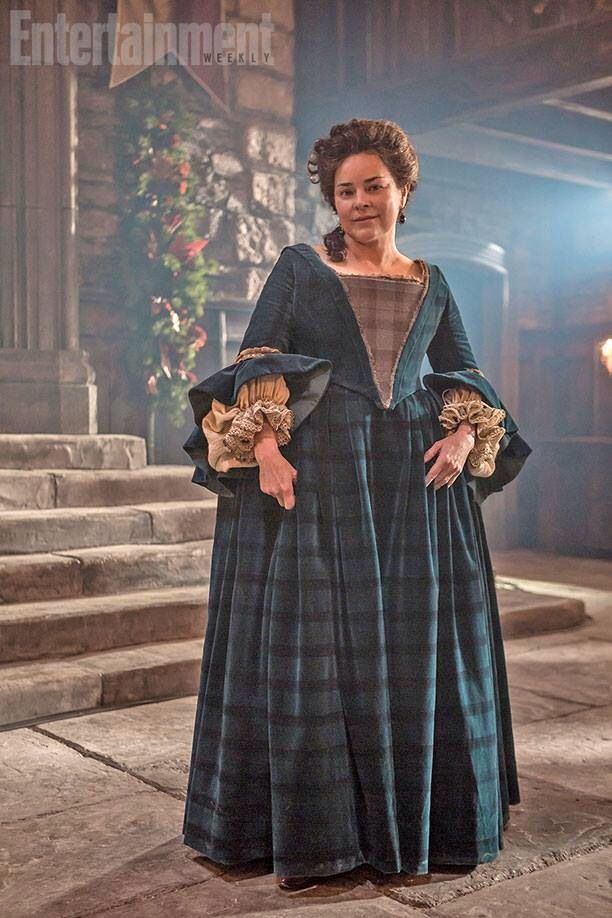
cameos DG cameo

Steam factor:

This episode was pretty low on the steam factor, unless you count Angus and Rupert pulling straws to determine who gets first crack at the lovely wench stirring the pot of soup.

Fashion statements:

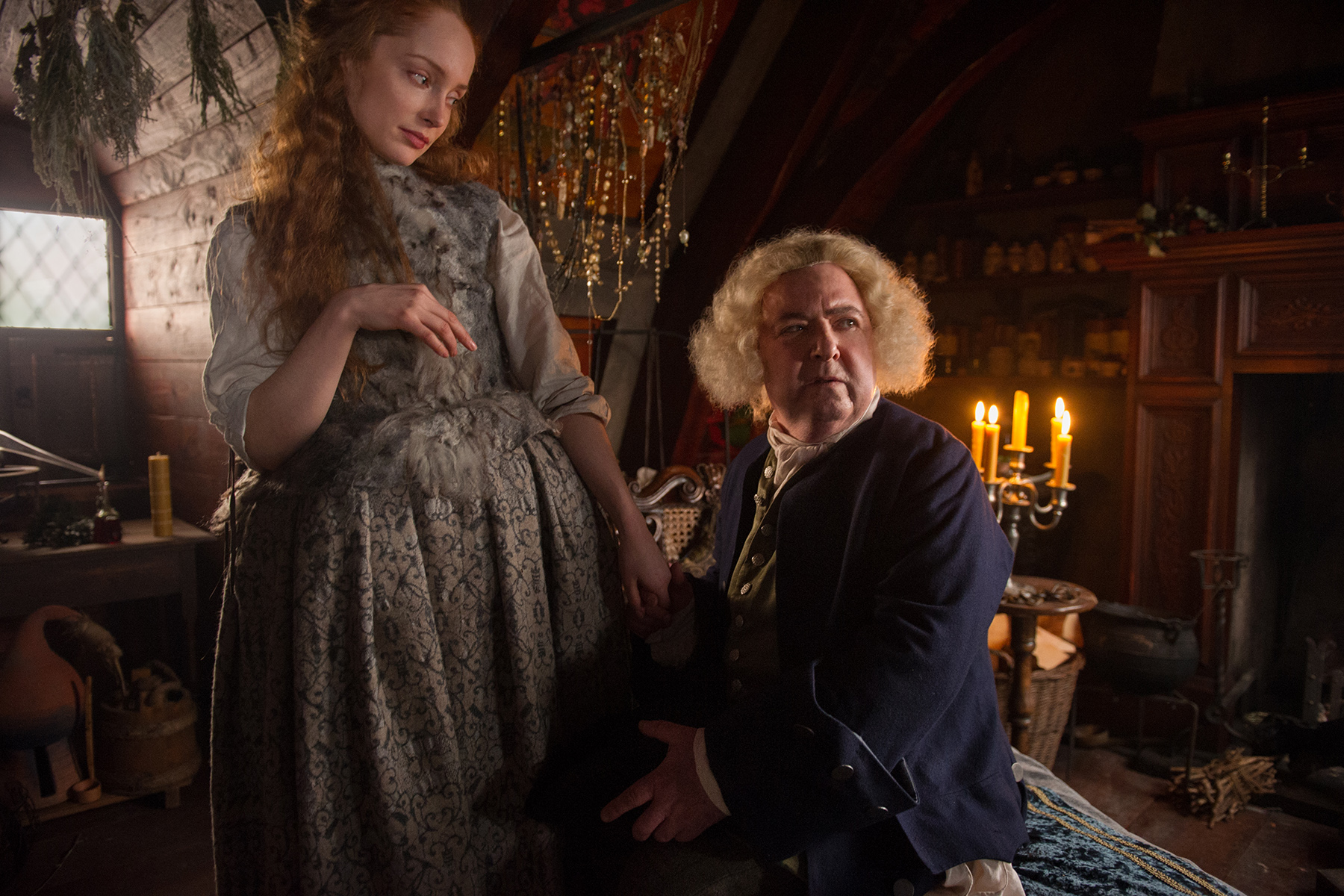
Once again, gorgeousness abounds! Can we just talk about the awesomeness that is Geillis? Her look changes so greatly from scene to scene, but you can always tell that she’s in control, but never just part of a crowd. First, she looks practically perfect as a presentable, proper wife of an important man, during the scene in which she visits Claire in the surgery:

bwz0rc1caaaikes

But at the Gathering, her hair is down, and she’s wearing this amazing, flowing dress that sets her apart from the crowd even while not straying too far from what’s acceptable. All that, and a sly little hint of Jacobite loyalties, too — that brooch on her shoulder features a painting of Bonnie Prince Charlie’s eye.
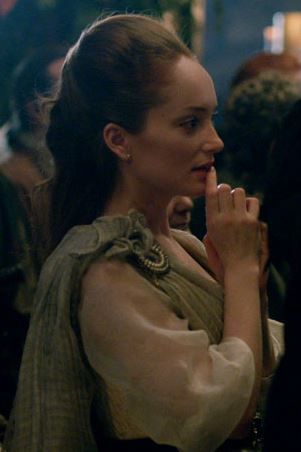
6bd5d723b45347d414c915a8f7cc1ecf

Claire certainly look beautiful in her pretty party clothes:

34812199bcf53d9b217b02642f000a17

And even Mrs. Fitz gets dolled up for the special occasion!

AnnetteBadlandSpeakOutlander6

And as the riding party leaves in the final moments of the episode, Claire has yet another new garment. Check out the fancy fur on her traveling cloak! (Jamie looks pretty dashing too, with the jaunty angle of his cap.)

Outlander-104-Jamie-Claire-horses470x281

Key points:

Major facts that the episode gets on the table:

  • Clan politics is serious business that can get you dead.
  • Jamie is Dougal and Colum’s nephew, and if not officially a MacKenzie, he at least has the MacKenzie talent for manipulation and maneuvering one’s enemies.
  • Dougal’s drunken pawing at Claire seems to reveal an unacknowledged desire on his part for the lovely Englishwoman. Claire had better watch herself around him.
  • Healing in the Highlands gets pretty intense, and boars are deadly.
  • Murtagh always has Jamie’s back.

Memorable lines:

Laoghaire asks Claire for a love potion, something to “open a lad’s heart to a lassie”. The kissing part is going fine, for sure, but she needs help “moving his heart forward.”

Claire is in too big of a rush to worry about Laoghaire, and gives her a concoction of horse dung, telling Laoghaire to sprinkle it near the man she wants, click her heels together three times, and chant:

“There’s no place like love, there’s no place like love… “

Gaellis’s matter-of-fact storytelling seems to contain a warning for Claire:

“The Highlands are no place for a woman to be alone.”

Character impressions:

With each episode, we see more and more sides of Dougal. Here, he’s the loyal brother at the side of his chief, but he’s also a political mastermind who isn’t afraid of a little murder if that’s what it takes to hold onto power. He’s never shown any tenderness toward Claire before, but between his drunken fumbling and his reluctant acknowledgement of her help with the dying man, we get the sense that he wants her and that he sees her as valuable.

Takeaway:

Claire still wants to escape and return to Frank more than anything, but she has also adapted quite a bit to her new surroundings and has carved out a place of respect for herself. Her friendships and entanglements with the Highlanders will be complications if she wants to see her plans through and get away.

Outlander Rewatch: Episode 103, “The Way Out”

Outlander, Season 1, Episode 3: “The Way Out”

OL rewatch

The official synopsis, courtesy of Starz:

Claire decides to use her medical skills to aid her escape from Castle Leoch – with Jamie’s help, she tends to an ill child. During an evening’s entertainment, a story gives Claire hope for her freedom.

My synopsis:

We open on a train platform in the 1940s, as Claire and Frank, dressed in uniforms, say good-bye. It’s a typical wartime scene, except Claire is the one heading to the front. As the train pulls away, they share one last kiss, and Frank asks Claire to promise to return to him. “I will, Frank Randall. I promise.”

Screen-Shot-2014-07-25-at-9.20.31-PM

Quick-cut to the 1740s, and Claire is in Castle Leoch, once again being fussed over by Mrs. Fitz, who washes her hair and admires her purty skin. Claire is moved to confess the truth to Mrs. Fitz: Her husband isn’t dead. He hasn’t been born yet. Claire has fallen through time. She describes her journey through the stones and her need to return. Mrs. F. understands Claire’s meaning all right — she’s a witch! Slap!

But no, it was all a dream, and Claire realizes that she can never share her secret with Mrs. Fitz or anyone else at Leoch. Mrs. F. tells Claire that a big Gathering is taking place soon at Castle Leoch, during which the people of Clan MacKenzie come from all over to swear fealty to the Laird. It’ll be a big affair with tons of people, and they’re sure to need a skilled healer. Mrs. F. advises Claire to get in Colum’s good graces through her “physicking”, and Claire decides that perhaps if she’s successful at treating the illnesses and wounds of Colum’s people, he’ll be more inclined to treat her with kindness and allow her to leave. (Yeah, right…)

Claire sets up the surgery, sorting through all the odds and ends left behind by her predecessor (icky wood lice and ant eggs among the treasure trove) and finding some useful herbs and powders that she can use. Angus and Rupert are assigned to watch her pretty much round the clock, although they find her medical business horribly boring and tend to sneak off to the kitchen to drink whenever possible.

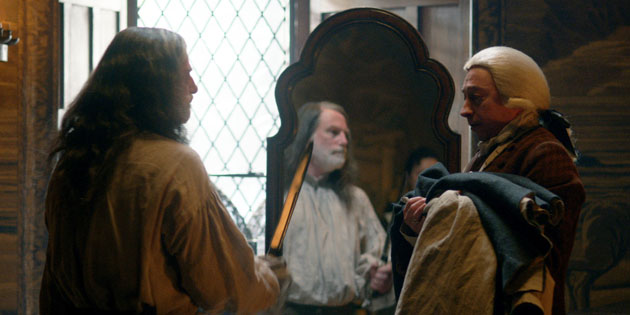
Claire finds out that a young boy has died, supposedly killed by demons after playing at the “black kirk”. Uh oh! Mrs. Fitz’s nephew Thomas was good friends with the boy who died. Young Thomas summons Claire to Colum’s chambers, where the Laird is busy terrorizing a tailor whose work was not up to standards. Colum then asks Claire to massage him in order to relieve the pain he experiences from his deformed legs. Claire complies, and the two share a less tense moment than they have so far. In gratitude for her skilled hands, Colum invites Claire to be his guest in the hall that night to hear a visiting singer.

Bad tailoring = knife at your throat.

Bad tailoring = knife at your throat.

At the hall, Claire hangs out with Laoghaire and tries to encourage the girl in her crush on Jamie, but Jamie isn’t especially kind to the poor girl, focusing on chatting with Claire instead. Claire has a bit too much of the Rhenish again and Jamie sees her safely back to her room in the surgery. Claire insists on checking on Jamie’s wound, and there’s a heated energy between the two as she stands very close to him to untie his stock and unbutton his shirt. Sparks and sizzle!

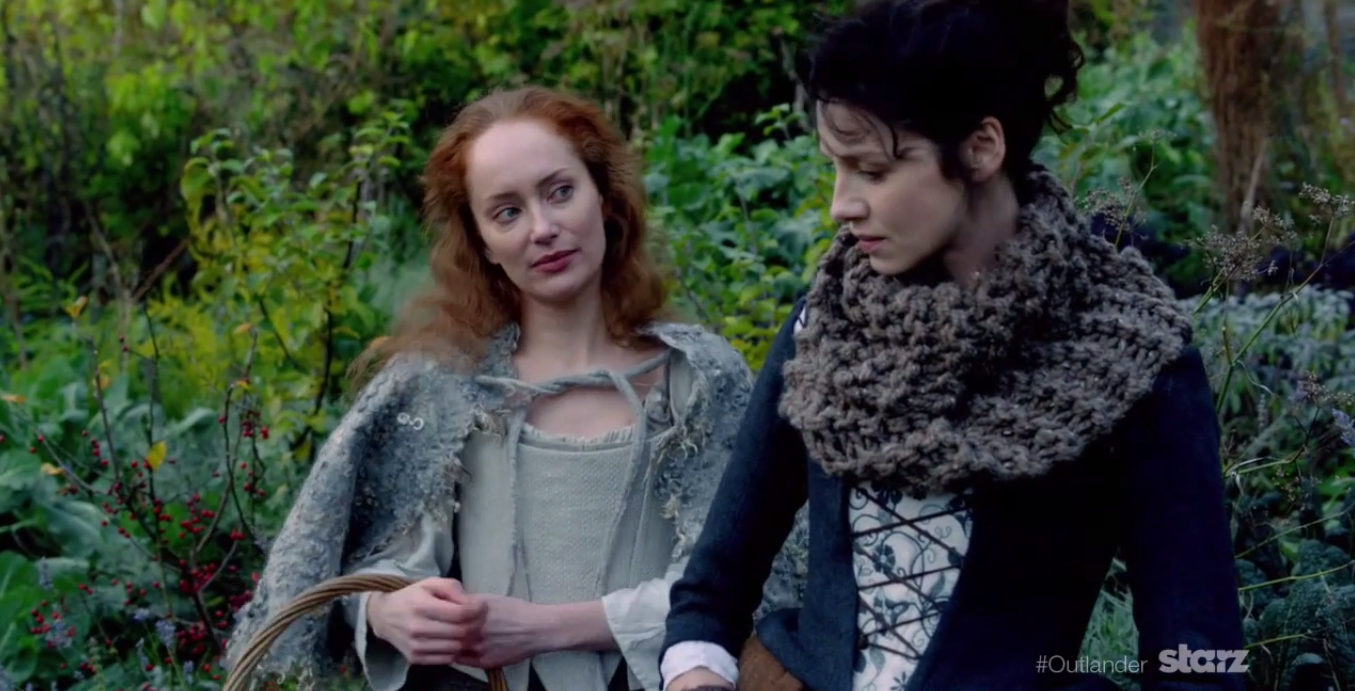
The next day, Claire and Geillis are picking herbs in the garden, and Claire hears that young Thomas is possessed by the same demon that killed the other boy. Father Bane is going to perform an exorcism! Claire is horrified, and Geillis tries to warn Claire away from interfering, but to no avail — Claire scurries off to the village and demands to treat the boy, earning herself a fierce enemy in the affronted Father Bane. The priest is a scary dude, forcefully splashing holy water all over the sick boy while Claire watches with dismay.

Back at the castle, Claire happens to see Jamie and Laoghaire stealing a kiss in the corner of the kitchen. Jamie sees Claire watching and gives her a look before diving back in for another kiss. Claire can’t help teasing Jamie about it over dinner later. It’s pretty hilarious, but Murtagh warns Claire off, saying that if Colum or Laoghaire’s father were to find out, Jamie could find himself stuck with a wife, and Laoghaire’s definitely not the wife he should have. (Well, obviously!)

Dougal offers to take Claire to the village with him in the morning to see Geillis so she can stock up on herbs and powders before the Gathering. Geillis’s workroom is half distillery, half witch’s lair, with potions brewing and a fire in the fireplace that backlights her just so — a slightly hellish symbolism, perhaps? A rabble gathers in the street as a young boy is dragged in for justice by — who else? — Father Bane. The boy is accused of stealing, but Geillis uses her feminine wiles to convince her husband, the judge in such matters, to be lenient. The boy is sentenced to an hour in the pillory and to have one ear nailed, which is just as gross as it sounds. Claire is again horrified by the local customs, and Geillis makes pretty clear that she knows that Claire is hiding secrets about where she came from and who she really is.

Jamie comes to bring Claire back to the castle, rescuing her from Geillis’s prying, and Claire convinces Jamie to help her free the boy while she distracts the crowd. After pulling this off, she asks for more help — they visit the ruins of the Black Kirk, and Claire realizes that the possessed boy was poisoned by a plant that grows there. Claire to the rescue! She bursts into the boy’s sickroom and provides an antidote, earning the love and devotion of Mrs. F and her family and the eternal hatred of Father Bane.

Once again listening to the singer that evening, Jamie translates a song for Claire, all about a woman who traveled through stones on a fairy hill to a time not her own, spent years there, but finally came back to her own husband. It’s an extremely literal version of Claire’s story, which made me laugh, but Claire took it to mean that others had been through her experience before and made it back to their own time.

By the end of the episode, Claire is more determined than ever to escape the castle and find a way back to the standing stones.

Steam factor:

Some intense looks were shared by Jamie and Claire as she opened his shirt to check his wounds. Can you say sexual tension? Claire may be too consumed with the need to get back to Frank to pay too much attention just yet, but Jamie sees to be very much aware of Claire’s awesomeness.

wpid-2014-01-18-09-23-54

There’s also the Jamie/Laoghaire kiss, but let’s pretend that never happened, shall we?

214901

Fashion statements:

So many gorgeous outfits in this episode! Mrs. Fitz seems to have a never ending supply of pretty lady clothes, as Claire looks terrific in every scene, dressed in lovely dark colors that set off her beautiful skin and rich brown hair.

Screen-Cap-103-clip

Geillis takes the prize for this episode, though, with that crazy furry top of hers (that she seems to keep petting)…

OUT_103-20131205-ND_0580.jpg

… not to mention those amazing red shoes.

ddefa7a0495e4d6399d3d0d39b688da0


Key points:

Major facts that the episode gets on the table:

  • Do not judge Colum MacKenzie’s appearance or try to cover up his legs. He’ll shiv ya.
  • Geillis is sly and manipulative, and seems to know an awful lot about Claire. Claire had better watch out around that one.
  • Jamie and Claire seem to be clicking. They have an easy connection and trust between them already.
  • Laoghaire seems like a lovestruck girl so far.
  • Murtagh is protective of Jamie, and make no mistake about it.
  • The Gathering, in the next episode, will be a big deal.
  • Claire’s healing skills are earning her the respect of the MacKenzie brothers, but this only makes them less willing to let her leave.
  • Father Bane is not an enemy you want to have, Claire. Watch out.

Memorable lines:

Father Bane: “I smell the vapors of hell on you.”

Claire’s teasing of Jamie at dinner, after witnessing the kiss:

“Your lip looks a little swollen, Jamie. Did you get thumped by a horse? […] Those fillies can be dangerous.”

And Murtagh’s reprimand to Claire:

“That’s no the wife he should have. He needs a woman, not a lassie. And Laoghaire will be a girl until she’s fifty.”

Jamie, after freeing the boy nailed to the pillory:

“Ye wouldn’t expect me to be less bold than a wee Sassenach lassie, would ye?”

After an evening of drinking way too much wine:

Claire: “Are you implying that I’m intoxicated?”   Jamie: “I’d be impressed if ye weren’t.”

Character impressions:

Claire is making a name for herself as a healer, and although she doesn’t want to stay there, it seems as though she’s adapting to life in the castle and getting some satisfaction from being useful and doing what she’s good at. She seems to have earned herself a loyal supporter in Mrs. Fitz, but she’s also gaining enemies, and that’ll come back to bite her.

We see more sides of Jamie, who lets Claire learn a bit more about his background (he seems to want her to know that he’s an educated man, not just a roughneck). Jamie’s appears to be attracted to Claire, but he’s also a healthy young man, and with Laoghaire throwing herself at him, I suppose we can forgive Jamie for sneaking kisses.

Colum has a streak of violence that’s perhaps less obvious than Dougal’s, but he certainly knows how to threaten without ever raising his voice.

Takeaway:

Claire hasn’t made much progress in gaining the MacKenzies’ trust, but she is establishing herself as a lady and a healer and has earned some grudging respect. Her high hopes of escape seem like a pipe dream, though, but Claire isn’t one to give up easily.

Outlander Rewatch: Episode 102, “Castle Leoch”

Outlander, Season 1, Episode 2: “Castle Leoch”

OL rewatch

The official synopsis, courtesy of Starz:

Claire is taken to meet the Laird. As suspicions about her grow, Claire befriends the mysterious Geillis Duncan. When the clan discover her medical skills, Claire goes from guest to prisoner.

My synopsis:

Our gang of Highlanders arrive at Castle Leoch with Claire in tow. It’s not clear how long they’ve been away, but they get a joyous greeting, especially from Mrs. Fitz, the head of the household of the seat of the MacKenzie. After goofily greeting the guys (and telling Murtagh how bad he smells), Mrs. Fitz gets a good look at Claire, who appears somewhat like a drowned kitty with her bedraggled hair and dirty shift ripped to well above her knees. Mrs. Fitz wants to drag Claire off to get presentable, but Claire insists that she must tend to Jamie’s wounds first. Although Mrs. F initially seems suspicious, once she discovers that Claire is a “charmer”, something like a “Beaton” (i.e., a healer), she readily assists with getting Claire the herbs and dressings she needs to take care of the dear boy.

Alone together in front of a fire, Jamie tells Claire how he came by the horrific scars on his back, which Claire sees as she tends his injuries. Conveniently (for the viewers), Jamie is shirtless, wearing just his kilt. Jamie tells the story of being imprisoned at Ft. William and flogged twice in the space of a week, and explains how he was imprisoned in the first place after trying to defend his sister Jenny from being raped by the scum of the earth, Black Jack Randall. Sadly, as far as Jamie knows, Jenny was unable to escape being assaulted, as Jamie was knocked out and taken away, leaving her in redcoat hands.

After Jamie compliments Claire’s skills and says that her husband is a lucky man, Claire breaks down and sobs over thoughts of Frank, and confesses to Jamie that her husband is not alive. (Quite true — he hadn’t been born yet as of the 18th century.) Jamie takes Claire in his arms to comfort her, but the moment of comfort becomes awkward. Is that a wee spark we see igniting between the two of them? Jamie assures Claire that no one will hurt her, so long as he’s around to protect her — but that she should be cautious as well, being an Englishwoman in a place where the English are decidedly unpopular.

After some much needed sleep, Mrs. Fitz yanks Claire out of bed and (finally) out of her torn, dirty clothes and into a proper Scottish lady outfit, corset and all. Claire is then taken to see the Laird of Castle Leoch, Colum MacKenzie, Dougal’s brother and head of the clan. Colum bids Claire welcome, questions her closely on how she came to be wandering in the woods. She claims to be an English widow who was traveling to family in France and beset by highwaymen, robbed of all possessions, and then nearly raped by Captain Randall before being rescued by Dougal and the gang. Everyone who meets Claire suspects her of something, it would seem. Claire is able to at least confirm when she is — she spots a letter on Colum’s desk dated 1743. Claire requests transport back to Inverness, believing she can find her way from there to Craigh na Dun and attempt to return to her own time through the standing stones. Colum tells her that she can accompany a traveling tinker in five days’ time.

With five days to kill, Claire attempts to fit in, keep her head down, and just get by. She is not very good at being unobtrusive. At dinner in the great hall, she overdoes it with the wine, playing straight into Colum and Dougal’s hands and having a hard time keeping her story straight. She also screws up big time by assuming that Colum’s son is Dougal’s son. Do we detect a big secret here?

Claire once again goes to take care of Jamie’s wounds, finding him out at the stables working with a young horse. They have a picnic lunch, during which Jamie shares more of his past with Claire, including the fact that he’s living under an alias as there’s a price on his head. Claire is highly irritated to be followed everywhere by Rupert, upon Dougal’s orders, but there’s no shaking him.

Still trying to keep busy, Claire heads out to pick plants and meets the mysterious but friendly Geillis Duncan, who seems to know more than she should about plants and their uses, including which are poisonous and which can cause a woman to abort an unwanted pregnancy. The notion of being suspected of being a witch comes up, which Claire doesn’t take seriously. Take it seriously, Claire!

Still, Geillis seems to be the closest thing Claire has found to a friend at the castle, and later Geillis acts as translator as various townsfolk bring their complaints in front of the Laird for judgment. A father brings his teen-aged daughter for punishment, accusing her of looseness and disobedience. Just when things look bad for the girl, up jumps our noble hero Jamie, who offers to take the girl’s punishment for her. Dougal and Colum take advantage of the moment to have their nephew beaten into a bloody mess. Claire takes care of Jamie yet again (what, is that the 5th time already?), and the two say good-bye, as she expects to leave the next day. The girl, Laoghaire (who turns out to be Mrs. Fitz’s granddaughter) seems to be lurking around to thank Jamie for his heroics, and Claire leaves them alone.

Alas for Claire, she’s stopped from leaving with the tinker at the very last moment. The brothers MacKenzie have decided to keep her at the castle and put her to work as the official resident healer until they can figure out what her true story is. They suspect her of being a spy for the English, and meanwhile intend to keep her. Claire is pissed, and accuses them of holding her prisoner. Only if she tries to escape, replies Colum.

We leave Claire, in despair, in the very castle cellar where she’d had such fun with Frank only days ago. Now she’s stuck in a place and time she doesn’t want to be, but at least she has the herbs, potions, and medical books to make the surgery her own.

Stand-out moments:

As Claire enters Castle Leoch, we see her walking through the hallways of the 18th century castle, interpersed with flashes from her visit there with Frank from the previous episode, allowing us to experience her displacement and the sense of unreality from having been in the very same place at two very different times.

There are some gorgeous shots of the countryside around the castle, and we get to enjoy a brief respite from worry as Claire acknowledges that some things, like boys playing in the yard with grown-ups who love them, are timeless.

Steam factor:

Nothing blatant, but when Claire tends Jamie’s wounds (again!), the chemistry between the two seems to ignite. She runs a hand over his scarred back and lingers for a minute. He seems to be painfully aware that he’s half-naked in front of this Sassenach woman. And when he holds her as she cries, the mood changes from comfort to something that both seem to recognize at the same moment as a physical spark between the two.

And hey, it’s our first glimpse of shirtless Jamie!

Fashion statements:

Mrs. Fitz transforms Claire from ragged wild woman in a torn shift to a proper 18th century lady in a terrific scene that shows all the various layers and steps required to dress from the skin out — shift, corset, bum roll, and more. From Claire’s bed-head:

OL 102_2

to finished product, it’s a wonderful little vignette that captures being transformed from one type of woman to something else entirely.

OL 102_7

We also get our first peeks at the stylish knitwear — mitts, cowls, capelets, and more — that give the day-to-day clothing of the characters such a distinctive (and cozy) look:

OL 102_3

Outlander 2014


Key points:

Major facts that the episode gets on the table:

  • The MacKenzie brothers are not to be trifled with. They’re master manipulators, and they’ve got their eyes on Claire.
  • Little Hamish’s parentage is a sore spot.
  • Mrs. Fitz is a formidable woman, but once she’s on your side, I think she’ll stay there.
  • Jamie is a protector, of anyone who needs it. He puts his own body at risk again and again to save people. Oh, Jamie…
  • Geillis Duncan is different from the other women Claire has met. She might be friendly toward Claire, but should not be trusted.
  • Laoghaire. Ugh. I can’t even.
  • Claire may be out of her depths for the first time in her life, but she’s not giving up without a fight.

Memorable lines:

A few classics from Mrs. Fitz:

“We’ll find ye something to eat. Something to wear that’s a bit more… well, a bit more.”

“What kind of corset is that?” “It’s a brassiere. Well, it’s from France.” “Ohhhhh.”

Jamie gallantry (be still, my heart!):

“Ye need not be scairt of me, nor anyone else here, so long as I’m with ye.”

Claire’s startling recognition about Frank, under questioning from Jamie:

“Is he not alive?” “No, actually. He’s not alive.”

And Rupert’s line to Claire:

“For a woman, ye do ask a fair amount of questions.”

Character impressions:

Jamie’s heroic nature becomes more pronounced in this episode, as he volunteers to take a beating for Laoghaire, a girl he barely knows, in order to spare her the shame of public punishment. Jamie shows a kindness and tenderness toward Claire when she breaks down in tears, and his bravery and vulnerability is evident as he lets her see both his physical scars as well as the shadow that’s stayed with him in remembering Jenny and Black Jack Randall.

This episode shows us the closeness of Colum and Dougal, who seem to understand one another without even needing words, the power struggles within Clan MacKenzie, and the suspicions that they all feel toward this strange Englishwoman who has the flimsiest of cover stories.

We get hints of relationships that will become more fleshed out, such as Murtagh’s support of Jamie, Laoghaire’s growing feelings for Jamie, and the odd sense of commonality between Claire and Geillis.

Takeaway:

Claire is certainly in a pickle, isn’t she? She may have ended up with the MacKenzie clan purely by accident, but now it looks like she’s there to stay. By dress and daily habit, Claire is starting to learn what it will take to fit in, and even more importantly, she’s starting to learn who’s on her side… and who’s not.


Outlander Rewatch: Episode 101, “Sassenach”

Counting down until the premiere of the 2nd season of Outlander… and what better way to get ready than by rewatching season 1!

OL rewatch

Outlander, Season 1, Episode 1: “Sassenach”

The official synopsis, courtesy of Starz:

While on her honeymoon, WWII combat nurse Claire Randall is mysteriously transported back to 1743 Scotland, where she is kidnapped by a group of Highlanders – and meets an injured young man named Jamie.

My synopsis:

Claire and her husband Frank are trying to rekindle their marriage, and perhaps start a family, after five years of separation during WWII. Claire was a battlefield nurse, Frank an intelligence officer, and they saw each other only ten days during those five years. Now reunited, they’ve traveled to the Scottish Highlands to reconnect and share a little romance — although Frank seems to be a tad too focused on genealogy when he should be concentrating on his sexy-nightgown-wearing wife.

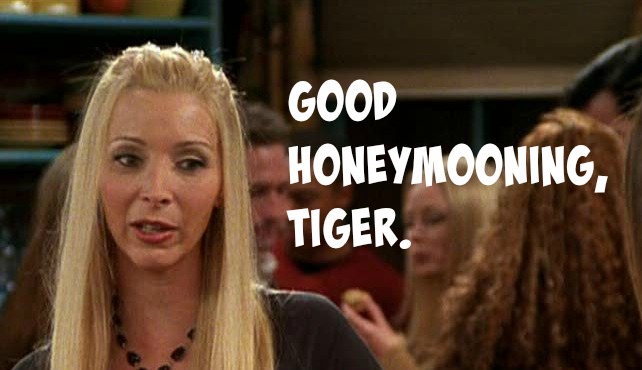
In the immortal words of Phoebe Buffay:

Phoebe2

After a peek at the local Druids dancing (beautifully) on the hilltop of Craigh na Dun amidst the standing stones on the eve of Samhain, Claire returns to the site to pick some flowers, places her hands on the stones, and is transported back through time to 1743…. where she is threatened by none other than Frank’s nefarious ancestor, Black Jack Randall, then rescued by a band of Highlanders.

Between the kilts, the redcoats with muskets, the very smelly smells, and the lack of electrical lights in Inverness, Claire accepts the bizarre truth that she’s journeyed through time. After mending the dislocated shoulder of gorgeous “young Jamie”, she’s taken along with the gang as they flee their redcoat pursuers. Claire shares Jamie’s horse — and isn’t she lucky? He’s both the cleanest and handsomest of the bunch, and also seems to be the only one to treat her with an ounce of respect. (Well, can you blame them? Even in her own time, Claire would stand out as a woman who speaks her mind and defers to exactly no one.)

Claire applies the 20th century knowledge she’s picked up from her historian husband (thanks, Frank!) to warn the Highlanders of a redcoat ambush, then takes advantage of the skirmish to try to flee. Jamie stops her, quite dashingly, and gives her the choice of coming along willingly or being thrown over his shoulder and carried. Back on Jamie’s horse she goes.

The episode wraps up with Claire treating Jamie yet again for his injuries — this will be a recurring theme! — and then arriving back at Castle Leoch with her kilted road buddies.

Stand-out moments:

Can I say — all of them?

More specifics, then. First of all, I’m convinced that Outlander has the world’s most beautiful opening song and title sequence ever:


Second, the visual WOW of it all. The landscapes are gorgeous. The costumes? We’ve only just begun, but the work to make them stunning and historically fitting is remarkable.

Third, for the book lovers, this first episode was a hold-your-breath, edge-of-the-seat moment: Could the TV version capture the magic and the spirit of the books?

Episode 1 answers that question with a resounding YES.

Two other elements that are important to note:

1 – The color palette, as used to emphasize the journey through time. We don’t even really notice how muted the colors are in the 1946 segment of the episode until Claire opens her eyes for the first time in 1743, and we suddenly have these incredibly vivid hues popping from the screen.

2 – Claire’s disorientation is perfectly shown by showcasing her lack of comprehension as the Highlanders around her speak to one another in Gaelic. There are no subtitles — Claire doesn’t understand what they’re saying, and neither do we. It’s a strong but subtle way for the production to emphasize Claire’s isolation, as well as an effective means for putting us in her shoes and letting us see through her eyes.

Steam factor:

It’s all about Claire and Frank in this episode, at least while in the 1940s, much to the dismay of book fans who simply can’t stand the idea of Claire with anyone but you-know-who. Claire and Frank get it on… and on… and on… most notably, in the dingy, dusty cellar of Castle Leoch, in which Claire shows no hesitation about demanding what she wants from her husband, exactly the way she wants it.

The show seems to be making a definitive statement from the very beginning that this is a woman who enjoys her body, enjoys being a sexual being, and expects her lover(s) to be both skilled and attentive. You go, Claire!

Fashion statements:

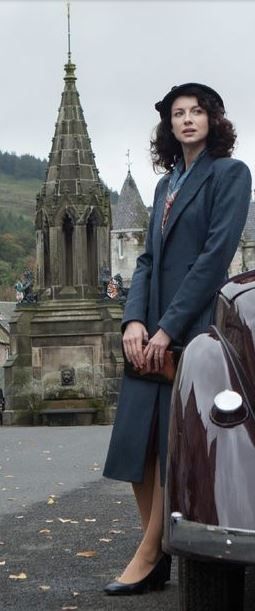
Claire’s 1940s blue coat outfit is a stunner:

ol blue


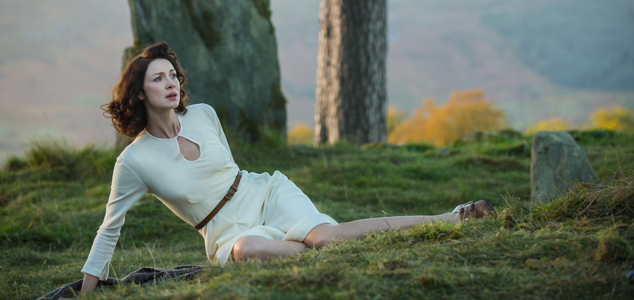
Her white dress is perfect for the transition from stylish 20th century gal to wild woman running around in a shift:

outlander-101 Outlander-101-Claire-runs250x266


And of course, we get our first glimpse of what a bunch of Highlanders look like when they’re out raiding and rumbling with the redcoats:

Outlander 2014


Key points:

Again, book fans may not like it, but the show is making it very clear that Claire loves her husband very much. This is important — we have to believe it, or why would she try so hard later on to get back to him? This episode does a good job of establishing several things:

  • Claire’s independence and toughness, as shown by the flashbacks to her unusual childhood and her wartime experiences
  • Her strong sense of herself as a woman with sexual desires who’s comfortable in her own body
  • Her love for Frank
  • Black Jack Randall’s black, black heart… and his reputation
  • That Jamie is a fighter, is tough, has a heart of gold, and is a prince among men. (Okay, maybe a bit of personal bias is intruding here!)

Memorable lines:

“Strange, the things you remember.”

“I don’t hold with rape. And we’ve not got time for it anyway.”

“On your horse, soldier.”

Character impressions:

Dougal comes across as dark, mysterious, clearly in charge, but with a sense of honor too. Most of the other Highlanders (in fact, all but Jamie and Murtagh) seem more like buffoons here, and the episode gives us a brief introduction to Angus and Rupert and their goofy behavior. Frank? Well, besides being more excited about old documents than his wife for half of his honeymoon, he does seem to be an upright, decent sort of guy, if a bit unexciting. (Really, you arrive in your honeymoon suite with your amorous wife and the first thing you do is take out a book? Not cool, dude.)

Takeaway:

Fabulous opening. This oversized episode (64 minutes) does everything it needs to do — introduces the key characters, the setting, the politics, and the major conflicts; creates drama on a micro and macro level; and leaves us wanting more!

Outlander Obsessions: Prepping for season 2

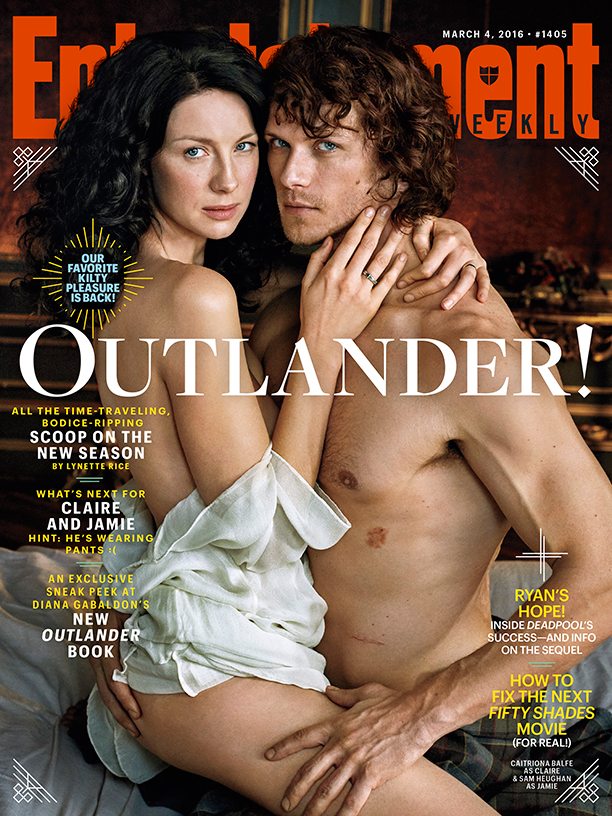
The new issue of Entertainment Weekly arrived in my mailbox today, and it has me jumping out of my skin with excitement:

ew-cvr-1406-outlander

Hey you! Wipe the drool off your chin and pay attention!

Season 2 premieres April 9th, and it can’t get here a moment too soon. It’s been a long, long Droughtlander indeed.

Leading up to April 9th, I think it’s time to get serious and do a season 1 re-watch. My plan is to watch all 16 episodes between now and April 9th. I’ll be writing up my reactions to each episode (most of which I’ve already viewed 2 or 3 times) and will post as I go along. Feel free to chime in and share your thoughts!

OL rewatch

And I suppose it goes without saying… but if you haven’t indulged in the “kilty” pleasure of watching Outlander yet, now is the perfect time to start.

Or hey, go old school and read the books!

outlander-book-series

As they say in Paris:

OLs2


Outlander season 2!

Let the countdown begin! Starz announced this week that season 2 of Outlander will premiere on April 9th.

OLs2

Want to get even more excited? Check out the newest season 2 trailer:


April 9th cannot get here soon enough!

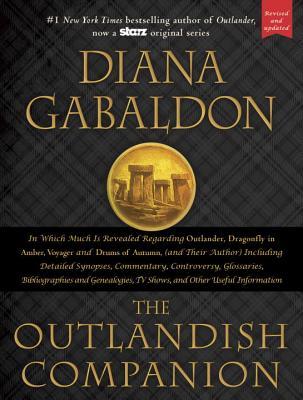
The Outlandish Companion, Volume I (revised edition): A Reading & Listening Guide

Revised edition of OCI, 2015

Revised edition of OCI, 2015

Last week, I posted a reading and listening guide for The Outlandish Companion, Volume II — and working my way backward, I’m now doing the same for Volume I of this essential reference book for Outlander fans.

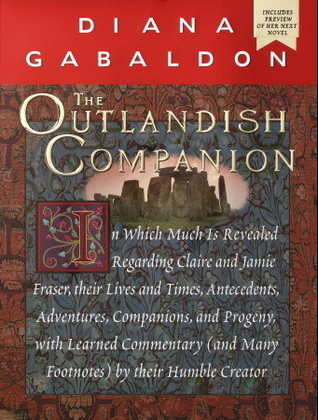
First, a note on editions. The Outlandish Companion was originally published in 1999, providing all sorts of reference information on the first four books in the Outlander series (Outlander, Dragonfly in Amber, Voyager, and Drums of Autumn). This book has been a go-to resource for book fans ever since, who have (pretty much non-stop since 1999) never stopped asking for a volume two.

In 2015, fans finally got their wish, and more. Not only was The Outlandish Companion, Volume II published in October 2015, but earlier in the year, Diana Gabaldon also released a newly revised and updated edition of the Companion, Volume I.

OC

The 1999 edition

The new edition of The Outlandish Companion, Volume I includes most of the original, plus some additional essays on writing and being a writer, as well as a section on the Starz TV series. Although I already owned a copy of the original edition, I simply had to treat myself to the revised edition as well… and then immediately put it on my shelf once it arrived, figuring I’d page through it eventually.

But now, having listened to the OCII audiobook, I thought it would be only fair to give the OCI audiobook a listen as well. And, as a public service for anyone who’s interested, I’m here to share with you a guide to what’s inside the OCI revised edition, plus what’s on the audiobook and what’s not.

As I mentioned in my OCII review: What you get in the audiobook, which you don’t get in the hard copy, is the voice of Herself, our beloved author Diana Gabaldon. I actually can’t stress this enough: Most of the audiobook is narrated by Diana, and I’ll explain a bit further on why this really matters… and really, why this alone is worth the price of the audiobook, even if you already own the physical book.

[Note: Except where indicated, all sections of OCI are read by Diana Gabaldon on the audiobook.]

Without further ado, what follows is an overview of what’s in the book, what I especially enjoyed, and a few tips and comments for anyone thinking about listening to the audiobook, either instead of or in addition to getting a copy of the physical book.


What’s inside:

Prologue:

Well, it was all an accident, is what it was. I wasn’t trying to be published; I wasn’t even going to show it to anyone. I just wanted to write a book — any kind of book.

And with this opening, we’re off! Diana takes us through her background, explaining how Outlander was just supposed to be what she was writing “for practice” to learn how to write a novel, and how it grew from there. It’s funny and personal and a must-read, particularly if you haven’t yet had the pleasure of hearing Diana tell her own writing story.

Part One: Synopses:

This is a major chunk of the book, and well worth the investment for true fans. The synopses included — Outlander, Dragonfly in Amber, Voyager, and Drums of Autumn  — are lengthy and incredibly detailed. The books’ plots are thoroughly summarized, start to finish, with plenty of passages directly from the original texts.

Lengths of synopses (hardcover edition):

Outlander: 10 pages
Dragonfly in Amber: 30 pages
Voyager: 34 pages
Drums of Autumn: 42 pages

Reading tip: If you find yourself picking up the series after a break and need a refresher on what’s already happened, these synopses are detailed enough to give you everything you need to keep going, if you just can’t spare the time for a complete re-read of the books themselves.

Listening note: On the audiobook, the synopses are read by the incomparable Davina Porter, who narrates all of the Outlander series audiobooks. Just listening to her read the synopses and the quoted passages is a total treat.

Part Two: Characters

This section starts with a lengthy essay entitled “Where Characters Come From: Mushrooms, Onions, and Hard Nuts”. Diana explains her approach to creating characters, how they talk to her, and where their names come from, as well as how she incorporates historical characters, and even which characters in her books have connections to people in her life.

The second section of Part Two is a Cast of Characters, which is an alphabetical index of all characters in the first four books, with a brief explanation for each, a notation of which book they appear in, and a marker for any who are historical figures. Beyond that, there is a list of various minor characters, named or not, who in general are part of a group but don’t particularly have roles of their own, including Dougal’s men, Monks at the Abbey of Ste. Anne de Beaupré, Lallybroch tenants, and more.

Additional sections of Part Two are:

  • “I Get Letters”  – in which Diana describes some of the various and sundry gifts and items she receives from readers. This part includes a rather lengthy section on astrology, including astrological charts for Jamie and Claire, sent to Diana by a reader named Kathy Pigou. The full charts and explanations are included here, along with diagrams and a basic introduction to astrological methodology.
  • “Magic, Medicine, and White Ladies” – an overview of women’s roles as healers, the concept of white women, Claire’s medical background, and why WWII makes sense as a starting point for Claire’s medical experience.

Listening note: The essays in this part are included in full on the audiobook. The Cast of Characters is not included, being more or less a dictionary, which would make is not very useful to listen to. The astrology-related pieces are narrated by a woman whose name I didn’t catch — not Davina Porter, not Diana Gabaldon. As I have no interest in astrology, I ended up fast-forwarding this piece once I realized how long it was going to be.

Part Three: Family Trees

Includes background, family trees, and coats of arms for the Beauchamp, Randall, Fraser, and MacKenzie families.

“A Genealogical Note” is a section concerning the genealogy of Roger MacKenzie Wakefield, in which Diana breaks down the detailed explanation of just where Roger came from and addresses certain points that always seem to confuse readers. Includes Roger’s family tree.

Listening note: The section about Roger is on the audiobook. The rest of this part is not.

Part Four: Comprehensive Glossary and Pronunciation Guide

For those with an interest in linguistics, you’ll love this part. After a brief introduction in which Diana addresses the difficulty of including so many languages (especially languages she herself doesn’t speak!) in her books, she includes some very helpful reference pieces, including:

  • A Very Brief Guide To Gaelic Grammar by Iain MacKinnon Taylor — this includes the Gaidhlic alphabet, a pronunciation guide, grammar overview, and spelling notes.
  • Comprehensive Glossary of Foreign Terms (including British slang) — a mish-mosh of all sorts of phrases and words from the books, from Scots, Gaelic, English, Latin, French, Spanish, and more — even Kahnyen’kehaka (Mohawk).

Listening note: Unfortunately, not on the audiobook at all. While no one would want to hear a list of words and definitions, it might have been fun to get at least a bit of the Scottish pronunciations of some of the phrases used most frequently in the Outlander series.

Part Five: Research

This section is sure to be fascinating to readers, and I can’t help imagining that writers and aspiring writers will find it incredibly helpful and inspiring as well. Diana talks about methods of doing research for historical novels and what works for her, and then talks about resources and basic skills, such as using a library, working with a card catalog, reading for information, and locating sources.

As I mentioned for a similar section in OCII, Diana is incredibly generous with her insights and personal revelations here. She goes into quite a lot of detail on how she organizes her research, what she finds most effective and why, and offers such practical advice that if I were even thinking of writing historical fiction (I’m not), I’d both want to follow in her footsteps and to give her a hug, for making it all sound so doable.

She’s also just funny — for example, one section of this part is called “I’ve Done My Research, and Now You’re Going to Pay”, in which she cautions against falling into the trap of cramming in so much detail that the story itself gets lost.

Don’t forget that the purpose of research is to support the story; not the other way around.

A further section of Part Five is entitled “Botanical Medicine: Don’t Try This At Home” Here, Diana explains some of the plants and natural substances which are used in the Outlander books as medicines, how she researched these and some of the sources used, and the properties of certain herbs and their healing effects. She also includes a word of caution:

Well… I really hope no one would use antiquated medical treatments described in a time-travel novel (I mean, it does say FICTION on the spine, after all …. ) but what with the increasing interest in herbal therapies and alternative medicine in general, I do get frequent questions regarding my sources, or requests for recommendations. People want to know how I know all this stuff — am I an herbal practitioner myself? Am I a professional botanist?

Definitely not.

This section concludes with “Penicillin Online: A Writer’s Thread”, in which Diana shares a conversation generated by her query to one of her online communities about a passage concerning penicillin which she was writing for The Fiery Cross (book #5). It’s a lengthy conversation (20 pages), but very interesting for the back-and-forth sharing of information, insights, and ideas.

Listening note: All of Part Five is included on the audiobook with the exception of the final section (“Penicillin Online”).

Part Six: Where Titles Come From (And Other Matters of General Interest)

Lots of terrific information on the crafting and shaping of the novels, with sections including:

  • Outlander vs. Cross Stitch — Discussing the main differences between the US and UK versions of the first book in the series, and some notes on foreign editions as well.
  • The Cannibal’s Art: Writing and Real Life — Diana talks about her writing life, and how she balances family, writing, and having a life. Amazing.
  • Book Touring for Beginners — Did you ever want to know what it’s like to experience a book tour. This very funny section gives us a pretty good idea.
  • A side bar section entitled “A Brief Disquisition on the Existence of Butt Cooties” — basically, Diana’s thoughts on the state of public restrooms, based on her extensive exposure to such as part of her book touring travels.
  • The Shape of Things — Quite a lovely piece on how thoughts turn into words on a page. I’ve heard a version of this before as part of a talk by Diana that I attended, but it’s really so amazing to read. She also explains how each of her books has a “shape”, and how that affects the overall tone and structure of the book.
  • The Gabaldon Theory of Time Travel — Exactly what it sounds like, and a must-read for devoted series readers, all of whom usually have theories of their own as to just how it all works.

Listening note: All of Part Six is included on the audiobook.

Part Seven: The View From Lallybroch: Objects of Vertue, Objects of Use

This section consists of passages from the various books that describe certain things (Claire’s pearls, her wedding bands, Jamie’s sword) and places (the stone circle, Lallybroch), interspersed with drawing and photos related to the objects described. It’s lovely to read and hear the descriptive passages and to admire how Diana paints a picture of these items and locations through her use of words.

Listening note: All of the text in included in the audiobook, but without the hardcopy book on hand, I did feel that I was missing something in this section. It definitely adds a great deal to have the physical book as a reference in order to see the illustrations that accompany the various quoted sections.

Part Eight: Frequently Asked Questions

Fascinating, of course. This section includes all sorts of questions related to the books, the characters, Diana’s personal experiences, and more, as well as some more esoteric questions such as why Jamie can’t blink and what ever happened to Claire’s pearls in Dragonfly in Amber. The answers are all thoughtful, amusing, and truly informative… and often quite tongue-in-cheek.

Listening note: This entire section is included on the audiobook.

Part Nine: Controversy

Diana discusses some of the topics about which she gets the most communication from readers, and shares with us some of her answers as well. Main topics include sex scenes, language (profanity/blasphemy/vulgarity), homosexuality, abortion, wife-beating (specific to the famous/infamous “strapping” scene in book 1), and other issues. The answers are all quite thought-provoking, and often funny too. (She’s a very funny woman, that Diana Gabaldon).

Also included in this section is the essay “Jamie and the Rule of Three”, which is also available via Diana’s website (or was, anyway, last time I looked for it). It’s a marvelous piece that explains why Outlander was constructed as it was, and why the terrible things that happen to Jamie had to happen for the sake of the story.

Listening note: This entire section is included on the audiobook.

Part Ten: From Book to Screen

A very interesting section on the making on the TV show, which explains how books in general get made (or not) into movies or other types of productions, and then goes into the background of the Starz TV series, from concept to production, including notes on the cast, the filming process, and Diana’s role as a consultant. Also included here are two blog entries she’d written on “My Brief Career As a TV Actor”, very funny pieces describing her days on-set filming a cameo appearance for one of the episodes.

Listening note: This entire section is included on the audiobook — and this is where the audiobook ends.

What’s left in the book? Well, the hard copy in my hands continues for another 125+ pages beyond this point! The remainder of the book is:

Annotated Bibliography

A lengthy listing of Diana’s sources and all sorts of reading material related to everything under the sun in her books.

Appendix I: Errata

As Diana says in the introductory paragraph to this section: “Well, look — nobody’s perfect.” This section includes all of the corrections to dates, language, and other minor facts (such as whether certain fruits would really be in season at the time they’re eaten in the books).

I won’t go into the contents of all of the rest of the appendices, as there are a whole bunch more — but they are:

Appendix II: Gaelic (Gaidhlig) Resources: A Writer’s Short Guide to Scottish Speech Patterns

Appendix III: Poems and Quotations

Appendix IV: Roots: A Brief Primer on Genealogical Research

Appendix V: A Brief Discography of Celtic Music

Appendix VI: Foreign Editions, Audiotapes, and Strange, Strange Covers

Appendix VII: The Methadone List (Diana’s recommended reading list — what she likes to read for fun and feels good about recommending!)

End papers: Several pages of photos from the Starz TV series.


What else do you need to know?

My wrap-up points and overall tips regarding the Outlandish Companion, Volume I are exactly the same as for OCII, so I’ll just re-post the main bits of my conclusion from that review:

Thanks to the audiobook, I spent much more time on [this book] than I might have if I’d only stuck to the physical copy. The hardcover edition is a beautiful physical specimen, but I don’t think it would have occurred to me to treat it as something to read from start to finish. By listening to the audiobook, I had the opportunity to slow down, pay attention, and really absorb all of the wonderful information contained in the book.

Highlights: What ended up really making this an extraordinary listen for me was the the narration by Diana Gabaldon herself. And I’ll tell you, I was skeptical at the start. Diana is not a professional audiobook narrator. For one thing, she is FAST. (Big tip: Use .75 speed if you can to listen to Diana’s sections — listening at regular speed is the equivalent of listening to any other audiobook at 1.5x!). It was an adjustment to get used to her speed and speech patterns, but once I got into the groove, I loved it! She shares so much of herself here, and hearing her deliver the content makes it an especially personal experience. Plus, in case you’ve never heard Diana Gabaldon give a talk before — she’s really funny. Listening to Diana narrate her own book lets us hear her emphases and inflections, and it becomes clear just what she finds funny about her content and where she’s being ironic or tongue-in-cheek.

Key advice:

The audiobook is a brilliant way to get a rich experience from [this book] — but it’s incomplete without the physical book at hand. My strongest advice for fans: Get them both.

If you’re a true fan of the Outlander series, then both volumes of the Outlandish Companion are essential books to have on  your shelves. I know I’ll be using mine, over and over again, every time a pesky question arises — such as “where have I seen that character before” or “how the heck is that even pronounced?” These books are about the same price as a standard hardcover novel, and I consider them really valuable investments for Outlander fans.

Interested in The Outlandish Companion, Volume II? See my reading and listening guide, here.

_________________________________________

The details:

Title: The Outlandish Companion, Volume I (revised edition)
Author: Diana Gabaldon
Publisher: Delacorte Press
Publication date: March 31, 2015
Printed book length: 577 pages
Audiobook length: 13 hours, 48 minutes
Genre: Reference
Source: Purchased

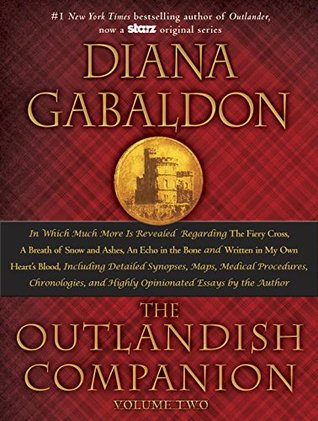
The Outlandish Companion, Volume II: A Reading & Listening Guide

OCIIThe Outlandish Companion, volume II, is a reference book. Does it surprise you to hear that it was also one of the most enjoyable reading and listening experiences I’ve had in months?

First, some background: As anyone who even occasionally visits my blog surely knows by now, I’m a pretty dedicated fan of Diana Gabaldon’s Outlander series. In 1999, Diana published The Outlandish Companion, a reference guide covering the first four books in the Outlander series (Outlander, Dragonfly in Amber, Voyager, and Drums of Autumn). And pretty much ever since, fans have been clamoring for a second volume to cover the rest of the books.

In March 2015, Diana Gabaldon published a new and revised edition of The Outlandish Companion, volume I, updated to include some additional commentary, especially regarding the Starz TV series. [Blogger note: I’m working a bit backwards here, I know. I’ll post a separate piece about volume I in the next week or so.] And in October of 2015, we finally got The Outlandish Companion, Volume II, and what a treat is is!

OC

The 1999 edition

I bought myself a hardcover edition of OCII as soon as it came out, but hadn’t done much with it beyond opening it at random and flipping through. When I saw that the audiobook had been released, it seemed like the perfect way for me to enjoy the contents of OCII in a laid-back, kind of mellow sort of way.

What you get in the audiobook, which you don’t get in the hard copy, is the voice of Herself, our beloved author Diana Gabaldon. I actually can’t stress this enough: Large portions of the audiobook are narrated by Diana, and I’ll explain a bit further on why this really matters… and really, why this alone is worth the price of the audiobook, even if you already own the physical book.

Revised edition of OCI, 2015

Revised edition of OCI, 2015

An added bonus for those who’ve listened to the audiobooks of the Outlander series and the spin-off Lord John books is the participation of the books’ narrators. Davina Porter — marvelous Davina Porter — narrates all of the Outlander book synopses in OCII, and Jeff Woodman, who does such a fantastic job as the honorable and wryly funny Lord John Grey, narrates the synopses for all of the Lord John pieces.

Without further ado, what follows is an overview of what’s in the book, what I especially enjoyed, and a few tips and comments for anyone thinking about listening to the audiobook, either instead of or in addition to getting a copy of the physical book.


What’s inside:

Introduction

Yes, this matters! Diana’s introduction is as funny and smart as you’d expect, explaining how the revised OCI and the new OCII came about. It’s also a great intro to her style throughout the book, which is liberally sprinkled with footnotes, often humorous and tongue-in-cheek, and sure to include at least a few nuggets of odd but interesting little known facts.

Part One: Chronology

Identifying and explaining the chronology of all the parts in the story — so if you’re wondering what to read when, and just where all those novellas fit in, this will tell you.

Part Two: Synopses:

This is the longest part of the book — in my hardcover edition, the synopses start on page 15 and end on page 245. On the audiobook, we’re talking hours and hours. (Sorry, I can’t be more specific… but if I had to guess, at last 8 – 10 hours out of the whole.)

The synopses for the four Outlander books — The Fiery Cross, A Breath of Snow and Ashes, An Echo in the Bone, and Written in My Own Heart’s Blood  — are lengthy and incredibly detailed. The books’ plots are thoroughly summarized, start to finish, with plenty of passages directly from the original texts.

Lengths of synopses (hardcover edition):

The Fiery Cross: 30 pages
A Breath of Snow and Ashes: 66 pages
An Echo In the Bone: 30 pages
Written In My Own Heart’s Blood: 80 pages

Reading tip: If you’re midway through the series, or perhaps took a break in between volumes, these synopses are so detailed that you could easily read these as prep before moving on to the next novel. Although, in my humble opinion, it’s never a waste of time to do a re-read of the books themselves!

After the four Outlander books, we come to the synopses of the Lord John books and novellas. These are much less detailed, with simple plot overviews, not much in the way of spoilers, and no details on the mysteries or their solutions. This section is useful as a refresher, but doesn’t provide enough information if you’re looking for a full-blown recap.

Part Three: Cast of Characters

As the introductory paragraph states:

This list includes all the characters from the second four novels and from the Lord John books, with brief notes as to which book each character is introduced in, who they are, their role in the story, and whether they’re fictional or real historical persons.

This is simply invaluable. Arranged alphabetically, this 118-page section is a must-have for series readers, providing instant access to the who’s who necessary to keep straight the huge number of people who come and go in the books.

Part Four: Sex and Violence (subtitle: Spanking, Beating, Flogging, and Other Interesting Topics Involving Physical Interactions of a Non-Consensual Sort)

Now here’s where it gets truly interesting! Up to now, the OCII is largely reference material. Finally, in Part Four, we get Diana’s insight into her characters and their actions, and it is absolutely fascinating.  She spends quite a bit of time on some of the more controversial elements in the books — the spanking scene in Outlander, the occurrence of rape in the plot and whether it’s too much, the historical context of rape in the Highlands, Black Jack Randall’s sadism — and for those with an opinion on any of these, or who’ve read or participated in any of the heated debates that seem to crop up among readers, it’s enlightening to hear the author’s take on the issues and understand the thought processes behind her writing of these elements.

Part Five: History and Historical Fiction: Organizing the Past

If I had to pick one section to recommend above all others as a resource for writers, this would be it. Whether or not you read the Outlander books, I think this marvelous section would be inspiring to anyone who ever dreamed of writing their own novel.

Diana is incredibly generous with her insights and personal revelations here. She discusses the challenges and pleasures of historical research, and just what’s involved in writing historical fiction, using documentary evidence to enhance and ground her fiction. Not only that, but she also shares her own organization and tracking methods for her research — everything from how she organizes her bookshelves to her computer files’ naming systems.

If I were a writer (and I’m not), I think I’d be incredibly uplifted by Diana’s no-nonsense approach to writing. You want to write? Then write. Don’t delay because you haven’t finished your research yet, or because you need a dedicated space, or until your kids are out of the house, or any of a thousand other reasons. She repeatedly stresses that she began writing Outlander for practice, just to see if she could. I’m simplifying things quite a bit here, but the bottom line is that this is a section that should be read and shared and appreciated. (Also, see Part Seven)

Part Six: A Comprehensive Scottish Language Glossary and Pronunciation Guide – by Adhamh O Broin

Comprehensive is right! 77 pages worth of Scottish phrases, with a guide to pronunciation, origin, use in the books, and meaning, written by the esteemed Adhamh O Broin, who is the official Gaelic (Gaidhlig) consultant for the Outlander TV series.

Part Seven: Writing, and Other Games You Play By Yourself

Along with Part Five, this is simply indispensable knowledge and advice for writers. Diana talks about her own writing processes, and digs deeply into “Mind Games” — the many ways that people’s minds get in the way of their writing. If you’re even thinking about maybe someday starting to write, read this section. Not kidding.

But wait, there’s more! A fabulous part of this section of the book is “A Coda in Three-Two Time” (Annotated). “A Coda in Three-Two Time” is an amazing section of Written In My Own Heart’s Blood, showcasing the wedding night experiences of three couples. It’s intimate, sexy, personal, and even funny — and here, Diana’s annotates the scene to explain the linguistic and stylistic elements behind the writing. The thought and craft that go into the creation of “Coda” is beautiful to learn about.

Also in Part Seven is a section called “One Word Speaks Volumes”, in which Diana explains that she has one word that for her sums up the theme of each novel. From Outlander (love) to The Fiery Cross (community) to A Breath of Snow and Ashes (loyalty) and beyond, the meaning behind the theme is explained and supported. As with so much in the OCII, it’s fascinating.

Finally, Part Seven includes Recipes — I’m not sure exactly why this fits in the writing section, but here it is. Diana shares some favorites recipes, with explanations about her family’s experiences with the dishes included and detailed instructions on cooking and serving them.

Part Eight: The Invisible Talent

As Diana states in the introduction to this section:

“Talent” is what publicists, producers, and agents call the people who provide the visible face of entertainment — actors, for the most part. But anyone who is even temporarily appearing in his or own persona is “talent” — even me. But what about the people who give so much to the TV show and the world of Outlander, who normally don’t show their faces and talk about what they do?

I asked a few of the many, many talented people who create the world of the TV show (and other aspects of the ever increasing world of Outlander) to give us a brief glimpse of what they do and how they do it.

Included are essays by four behind-the-scenes, exceptionally talented individuals:

Terry Dresbach, the show’s brilliantly gifted costume designer, writes about just what it takes to design and produce costumes for a production of this magnitude, and includes several of her sketches for outfits for Claire and Jamie.

[Listening note: The narrator for this section (whose name I didn’t catch) does a fine job, except she mispronounces a couple of character names — most notably, Jamie’s last name! It’s FRASER, not FRASIER. Seems like something that should have been corrected during the production.]

Bear McCreary, the show’s composer, talks about his love of Scottish music (especially bagpipes!) and the reasons for the types of music we hear throughout the episodes. While some of his information is rather technical, it’s presented in such a way that even a non-musical person like me could understand and appreciate it.

Dr. Claire MacKay: Dr. MacKay is an herbalist with expertise in the historical use of herbal medicine. She provides a really interesting overview of the history of herbal medicine in the  Highlands, as well as explaining nine herbs from Claire’s medicine kit, their traditional and modern uses, and their use in the Outlander books.

Theresa Carle-Sanders, author of the upcoming cookbook Outlander Kitchen, writes about “The Diet and Cookery of Eighteenth-Century Highlanders”, explaining not just what types of foods were eaten, but what this diet meant in terms of health, mobility, and class distinctions.

Part Nine: Maps and Floor Plans

Oh, what a treat! If you’re like me, you’ve spent a lot of mental energy trying to figure out just what’s where, and now we know! Included are floor plans for Lallybroch and the Big House on Fraser’s Ridge, as well as maps of the Lallybroch estate and the layout of the Fraser’s Ridge houses and cabins. Also included are maps of the American Colonies circa 1775, the British Isles, the city of Philadelphia, and the battlefields of Culloden and Saratoga.

Part Ten: The Methadone List

Diana’s fans are familiar with the concept of “The Methadone List”. Outlander is, after all, an addiction for its devoted readers — yet even the most devoted sometimes need to read something else. Diana shares this list in response to the question she’s always asked about what ELSE to read. “The Methadone List” is a list of some of her favorite books and writers, with brief plot descriptions and in some cases, excerpts from the books themselves.

Part Eleven: Bibliography

No explanation needed, right?

End papers: Several pages of photos conclude the OCII, include pictures of Castle Leod (seat of Clan MacKenzie) and a few behind-the-scenes photos from the TV production. The front and back inside covers are a detailed family tree (which you can download here as a PDF).

Listening tips:

Thanks to the audiobook, I spent much more time on the OCII than I might have if I’d only stuck to the physical copy. The hardcover edition is a beautiful physical specimen, but I don’t think it would have occurred to me to treat it as something to read from start to finish. By listening to the audiobook, I had the opportunity to slow down, pay attention, and really absorb all of the wonderful information contained in the book.

Highlights: What ended up really making this an extraordinary listen for me was the the narration by Diana Gabaldon herself. And I’ll tell you, I was skeptical at the start. Diana is not a professional audiobook narrator. For one thing, she is FAST. (Big tip: Use .75 speed if you can to listen to Diana’s sections — listening at regular speed is the equivalent of listening to any other audiobook at 1.5x!). It was an adjustment to get used to her speed and speech patterns, but once I got into the groove, I loved it! She shares so much of herself here, and hearing her deliver the content makes it an especially personal experience. Plus, in case you’ve never heard Diana Gabaldon give a talk before — she’s really funny. Listening to Diana narrate her own book lets us hear her emphases and inflections, and it becomes clear just what she finds funny about her content and where she’s being ironic or tongue-in-cheek.

As I mentioned earlier, getting another opportunity to listen to Davina Porter and Jeff Woodman is delightful. I’ve listened to the audiobooks of the entire Outlander series and Lord John books, and spending time with the narrators again here is like hanging out with old friends.

What’s missing: It may go without saying, but listeners should be aware that there are some elements of a reference book that just can’t be provided via audio. The OCII audiobook does not include the character guide, Scottish language glossary, maps and floor plans, or bibliography. And obviously, no illustrations.

Further tips:

Recipes and Methadone List — you can listen to these sections with the audiobook, but if you actually want to make use of them, whether to try the recipes or to track down books to read, you’ll need to refer to the hard copy.

Key advice:

The audiobook is a brilliant way to get a rich experience from the OCII — but it’s incomplete without the physical book at hand. My strongest advice for fans: Get them both.

If you’re a true fan of the Outlander series, then this is an essential and worthwhile investment! I know I’ll be referring to this book over and over again, whether it’s to look up a random character, check out a battlefield, or get some inspiration for my non-Outlander reading.

Blogger’s note: As I mentioned, I’m going about this backwards! Having listened to the OCII audiobook, I’m now going back and listening to the OCI audiobook as well. This is the longest piece I’ve ever posted, and I’m exhausted!! — but if I have the energy, I’ll write up a reading and listening guide to OCI once I finish.

_________________________________________

The details:

Title: The Outlandish Companion, Volume II
Author: Diana Gabaldon
Publisher: Delacorte Press
Publication date: October 27, 2015
Printed book length: 656 pages
Audiobook length: 21 hours, 17 minutes
Genre: Reference
Source: Purchased

TV Time: Yippee for Spring!

2016 is here, and so much TV amazingness is on its way!

First of all, I was tickled pink and purple by the return of two very different shows last weekend. I’ve had a love/hate relationship with Downton Abbey over the years, but there’s just no way I’ll miss the final season. Season 6 premiered in the US last Sunday:


Also last Sunday? On a completely different note, it was the ultra-silly return of Gallavant! If you enjoy random singing, surprising guest stars, and Python-esque humor, check it out!


But wait! There’s so much more exciting TV on the way. Here are my can’t-wait top 6 picks for spring:

January 19th: Agent Carter, season 2! Season 1 was so much better than I had expected, and the trailers for season 2 look like such fun:


January 23rd: The return of Black Sails (season 3):


In March, it’s season 4 of The Americans on FX:

Americans


And then… oh boy… here comes April, with:

Game of Thrones, season 6 – premieres April 24:


Turn, season 3 – premieres April 25:

Turn s3


And last, because last is best and amazing and awesome… no firm date yet other than April, but that’s good enough to keep me going for the next few months: The return of Outlander! Season 2 is on its way, and it looks gorgeous:


What shows are you most looking forward to in the next few months? Are any of my top picks on your list?

Fans, Fanatics, and Frenzy

So, you may have noticed that I’m an Outlander fan. Right?

Yes, another Outlander post from me… but this one is about fan reactions.

OL pic

It seems to me that fans may very well be a fandom’s worst enemies. Here’s why.

For years prior to the announcement of a TV show, when Outlander was *only* a bestselling series of books with a huge, devoted fanbase, fans spent countless hours and brain cells on fantasy casting. The perfect Jamie! The ideal Claire! Oh, the fights. I swear, I would not be surprised at all to hear that friendships were lost over such important issues. Because we all know that Jamie is the king of men and he is PERFECT.

But it was all a dream, alas.

Until Ron Moore read Diana Gabaldon’s books, put together a TV deal with Starz, and the rest is TV history.

So here we are, two weeks into season 1, part 2, and are fans happy?

If you relied only on social media comments, you’d be justified in thinking the answer is “no”.

I suppose it’s only to be expected, and we need look no further than Game of Thrones for similar fan reactions, but people are more or less going NUTS over the changes from book to screen. And while I used to just roll my eyes and move on, the tone of some of the comments is seriously starting to irritate me and worry me.

Because, oh ye gods above, it’s getting insane.

Yes, there are changes. Sometimes the changes are big, sometimes they’re just minor details. But hey, as Diana Herself said in one of her endless rounds of pre-premiere interviews, “I understand what the word ‘adaptation’ means.” The question is, do the fans?

Early on, before the show premiered and immediately afterward, a lot of the focus of fan complaints was on the physical: Claire’s eyes are the wrong color. Jamie isn’t tall enough. Okay, fair enough in terms of facts, but would you rather have a Claire with whiskey-colored eyes or a Claire portrayed by an actress who can actually ACT? I love Caitriona Balfe as Claire, so I’m perfectly okay with a change in eye color. Anyway, look at the Harry Potter movies or at the Targaryens in Game of Thrones — maybe the eye color is important in the books, but the overall dramatic effect is not altered in the slightest by the fact that Harry’s eyes are blue in the movies or that Daenerys’s are not violet.

Soon after the premiere, the focus of fan comments seemed to have shifted to plot changes:

In the book, Claire does buy the vase!

In the book, it’s Beltane, not Samhain!

In the book, Claire has a certain KIND of sex for the first time with Jamie — she doesn’t do that with Frank! (This isn’t true, according to Herself, but it certainly is many fans’ perception.)

And what about this line, or that line? Wait, the wedding ring is wrong! Jamie’s tartan isn’t red enough! Old Alec is supposed to be old!

Yes, there are variations. ADAPTATION, people. Still, I know some people take pride in spotting every little difference, and that’s fine.

What’s bothering me, though, is that the tone seems to have shifted to a “blame the production team” mentality in some quarters, and that’s starting to feel not okay. I’ve read comments saying that “of course, Ron doesn’t get it” or “they ruined xyz scene” or “the writers don’t care about the book”. I’ve even seen devoted fans say “that’s it! I’m not watching anymore!” And that’s just so frustrating to me, and feels so counter-productive.

Without Ron’s vision and dedication, we wouldn’t have a TV show. Period. Is that really what people want?

Again, yes, there are differences. Any time you change from one artistic medium to another, there are going to be changes. And so long as the new production is true to the important themes, characters, and events, I’m okay with the details that get altered, combined, or skipped. Because it’s a TV show! It’s not a word-for-word reproduction! If you want word for word, go listen to audiobooks!

The Starz production is a representation of Diana Gabaldon’s work, recreating her stories and characters as filmed drama. It has to work on the screen. It has to fit into one-hour episodes within a sixteen-episode first season. It has to attract new viewers as well as appeal to fans. That’s a really tall order.

I hope the fan noise around changes from the books doesn’t get so loud that it starts to drown out the applause and the enthusiasm from people who are just LOVING the show. It would be a terrible shame if Outlander fans themselves were responsible for shifting the tone of discussion into widespread negativity.

We want our show. Right? So let’s support it. We can acknowledge the changes, track them, debate them, and discuss the potential plot disruptions that might result five seasons from now. But let’s try to move the discussion away from “ruining” and “destroying”, and stop casting blame on the magnificent and dedicated people behind the scenes every time we wish a certain scene had happened a wee bit differently. Because the production team does love this story, and they get it, and they want it to succeed. And they’re pouring their hearts and souls into it.

Personally, I  can only say that I’m loving every moment. I know the Outlander books pretty much backwards and forwards by now, and yes, I’m very much aware of the elements that are changed for the show. But I can still love the show, and the show’s differences in no way subtract from my love of the books. They’re two different art forms, and they’re two different pieces of art, and I love them both.

Here’s a cheer for Ron Moore and the cast and crew of the beautiful production of Outlander! And here’s wishing them — and us — many more seasons to come. And to all the fans, all I can say is — maybe it’s time to dial down the upset, sit back, and enjoy TV Outlander on its own merits.

As the T-shirt says:

Keep calm