
Book Review: Talulla Rising by Glen Duncan

Book Review: Talulla Rising by Glen Duncan

I can’t talk about Talulla Rising without talking about its predecessor, The Last Werewolf and what happened in it, especially some major twists toward the end. So consider this your obligatory spoiler alert. SPOILERS AHEAD! Caveat lector — let the reader beware.

Now that that’s out of the way…

The Last Werewolf was one of my favorite books of 2011. Simply put, I was blown away by the language as well as the plot. Glen Duncan’s writing is extraordinary, and the voice he created for lead character Jake Marlowe was remarkable. In a nutshell, The Last Werewolf is a first-person narrative told from the perspective of the titular character Jake, who is, in fact, the very last werewolf in existence. After a lifespan of 200 years, WOCOP (the World Organisation for the Control of Occult Phenomena) has finally succeeded in wiping out the rest of his species and has let it be known that Jake is next. Jake is world-weary, bone-weary, and overall rather sick of it all, so he decides to let WOCOP hunt him down and put an end to it, once and for all.

AND THEN… (and this is where the serious spoilers arise, so — last chance — avert your eyes now!)… Jake meets Talulla, and discovers that he’s not the last after all. Talulla is a recently turned werewolf, who quickly becomes his lover, his soulmate, and his partner in monstrosity. The pair go on the road, a lupine Bonnie and Clyde, but their joy in finding true love is not fated to last. Suffice it to say, The Last Werewolf does not end with a happily-ever-after.

Talulla Rising opens several months after the conclusion of The Last Werewolf. Jake is gone, and Talulla is alone in the world, pregnant, and full of despair. Her pain over the loss of Jake is intense; her fears of impending motherhood are enormous. Can a monster be a mother? What will her child be, and how can she make sure it survives? When her newborn werewolf son, born during Talulla’s full-moon transformation, is brutally ripped from her arms by a familiar team of enemies, events are set in motion that lead to ongoing violence, desperate acts, and unlikely alliances.

Along the way, despite Talulla’s efforts to harden her heart and not let herself love, she becomes a fierce mother/protector, whose only motivation is to save her young, no matter the expense.

Talulla Rising is not for the easily disturbed. If scenes of bodily mayhem make you queasy, this will not be your cup of tea. The violence is brutal, explicit, and quite often disgusting — although, frankly, it is a team of scientists rather than any supernatural beings who carry out the worst of the atrocities committed in the course of this book.

As in the first book, Glen Duncan’s writing is magnificent. His use of words continues to astound, as he twists and turns the English language to his will. I found Talulla’s voice a little too similar to Jake’s at times, but that’s a minor complaint.

While the first book had plenty of action, it focused to a great degree on Jake’s internal dialogue. Talulla Rising is much more plot-driven, with events and disasters piling up at a tremendous clip.

When I finished The Last Werewolf, the story felt complete, and I had no idea that a sequel was planned. Likewise, after finishing Talulla Rising, I read this Q&A with Glen Duncan and was surprised to learn that this is, in fact, a trilogy, and that a third and final book is forthcoming. While some plot threads are left dangling at the end, Talulla Rising ends on a satisfying note and is complete on its own, so that it was not immediately evident to me that the author planned a follow-up. That said, I’ve truly enjoyed these two werewolf novels by Glen Duncan, and will certainly gobble up the third as soon as it’s available.
Book Review: Fables (volumes 1 – 3) by Bill Willingham

Fables (volumes 1 – 3) by Bill Willingham

I have quickly fallen in love with the Fables graphic novel series. By the end of volume 1, “Legends in Exile”, I was pretty sure it was just a crush. After reading volume 2, “Animal Farm,” I realized my feelings had deepened and that this just might be the start of a serious relationship. And now, three volumes in, after reading “Storybook Love”, I know it’s the real thing. I’m hooked.

Fables, written by Bill Willingham, is a DC Comics series that originally appeared in comic book format, now compiled in trade paperback volumes. So far, 17 volumes are available in print, with volume #18 due for publication in January of 2013.

Fables tell the story of fairy tale and other assorted mythical and magical characters, forced to flee their homelands after the invasion of the Adversary (about whom we know nothing so far, other than the fact that he’s unstoppable and ruthless. If you’ve read further in the series than I have — hush! I don’t want to know.) The survivors have taken refuge in our world — more specifically, Manhattan — where they live a secret life, concealing their magic from the mundys (that’s us, folks).

The mayor of the Manhattan Fable town is Old King Cole, but he’s merely a figurehead. The true authority lies with deputy mayor Snow White (our fearless heroine!), backed up by sheriff and overall enforcer Bigby Wolf (Big B. Wolf — get it?), whose gruff human exterior hides a predator with a core of integrity. Between the two of them, they ride herd on a mish-mash of misfits, including Little Boy Blue, Prince Charming (such a cad!), the Frog Prince (known as Flycatcher due to his unfortunate snacking habits), and Bluebeard (who reminds me of a really buff version of Walter White of Breaking Bad).

Their less human-looking counterparts reside on a hidden farm in upstate New York, concealed from the outside world, but also chafing under their enforced seclusion. A brilliant plot involving an uprising at the Farm is what truly got me involved in this series. Let’s just say that there’s a lot more to Goldilocks and the three bears than you might assume. And don’t get me started on nasty old Shere Khan either.

Fables is not for children. Mature themes abound, as well as plenty of gruesome deaths, sexy bedroom scenes, conspiracies, deceptions, murder and mayhem. The plotting is detailed and fast-paced, with masterful storytelling at every turn. It’s been a real pleasure for me to discover a tale well-told in a format that’s fresh and engaging. For someone who’s relatively new to the world of graphic novels, I’m really having a ball with this series, and I’m finding it seriously difficult to put Fables down in order to pick up a “real” novel.

Onward we go. So long as I have more volumes of Fables close at hand, it would appear that I’m not going to get anything else done.


Quickie Book Review: Code Name Verity by Elizabeth Wein

Code Name Verity is one of those books that makes me wonder why certain novels get marketed as young adult fiction. In my mind, and on my bookshelves, it just goes on the shelf marked Incredibly Well-Written and Moving Fiction. So there! It will be in very good company, right next to The Book Thief and The Fault In Our Stars, two other so-called YA novels that anyone with any sense ought to read immediately.

Code Name Verity is breathtaking, suspenseful, emotional, and even funny at times. I don’t want to give anything away, but here are the bare bones: This is the story of two young women who manage to find a friendship that elevates them above the harshness of life in wartime. Set in England and France during WWII, Code Name Verity… well, dammit, just read the book! You’re better off starting with a clean slate and not knowing anything before you read it.

Suffice it to say, I was blown away and couldn’t put it down. I took the book out of the library after reading a glowing review, but I think I’ll have to quickly purchase my own copy so I can re-read it at leisure.

Why a quickie book review? It’s simple, really: A) I loved this book and want everyone to know!, and B) this is a book better appreciated with no foreknowledge, so the less said the better.


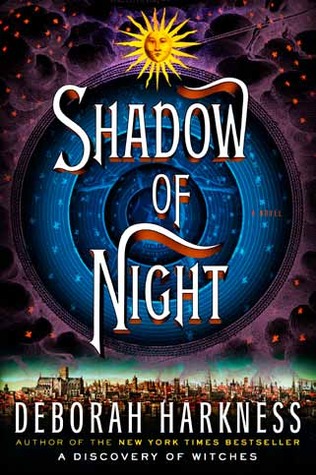
Book Review: Shadow of Night by Deborah Harkness

Shadow of NightShadow of Night is book #2 in Deborah Harkness’s All Soul’s Trilogy, which kicked off last year with bestseller A Discovery of Witches. At the time ADOW was published, I remember scads of reviews referring to it as “Twilight for grown-ups”, which is and isn’t a fair comparison.

True, ADOW has as its focal point a forbidden romance between a witch and a vampire… and we all know that LOVE + VAMPIRE = TWILIGHT, right? Calm down, I’m just kidding. ADOW is much more than a romance, and the intelligence and emotional truth at its core elevate it far above the standard, popular, seemingly endless supply of vampire fiction.

I loved the heck out of ADOW for its combination of smarts (Oxford professors! Secret manuscripts! Alchemy! Mitochondrial DNA!), supernatural beings (the aforementioned witch and vampire, plus their various and assorted family members, clans, secret societies, etc. Oh, and did I mention daemons?), and yes – be still my heart – passionate, forbidden love. Also, yoga, running, and rowing, for those who get hot and bothered by reading about exercise freaks.

ADOW ended with a plot point that left us hanging off the proverbial cliff, and Shadow of Night picks up the narrative mere moments after the conclusion of the first book. Witchy Diana Bishop and gorgeous vampire Matthew Clairmont have just timewalked back to Elizabethan England in the year 1590. Their goal is two-fold: to find a remedial witchcraft teacher for Diana, who never learned to use her talents, and to find the mysterious manuscript before the rest of the supernatural world gets to it.

First, bigger challenges await. Diana must learn to dress in awkward clothing, write with a quill, and speak with an accent that doesn’t scream “hello, I’m a time-traveler!” in order to fit in with the locals. And such locals! 1500-year-old Matthew has always been an important guy, and in the 1590s, he is a spy for Queen Elizabeth, a member of the powerful supernatural ruling body, the Congregation, and a member of the School of Night, a group of influential men which includes Sir Walter Raleigh, playwright Christopher Marlowe, and various other scholars and scientists of the time. A bit of a problem for me: I didn’t know who all of these historical figures actually were, so I had to sidetrack a bit in order to figure it out. Thank you, Wikipedia!

The plot moves from Oxford to London, France, and Prague. There are a ton of new characters introduced, some of whom matter more than others. How thoughtful of the publisher to give us a list of characters at the end – seriously, after a while I really needed it.

This is a dense, long book. At nearly 600 pages, there’s a lot to keep track of. I found it a bit slow-going for the first 75 – 100 pages, with too much time spent on Diana adjusting to life in 1590, and not enough emphasis on her relationship with Matthew. In addition, during the early sections, Diana and Matthew are surrounded by an entirely new cast of characters, and I thought the mood and urgency of the book suffered from the lack of the other people we’d come to care about in book one.

The pace definitely picks up once the couple travels to Sept-Tours in France, where Matthew reconnects with his family and he and Diana take the final steps toward formalizing and cementing their bonds. I was surprised by how moving I found this section. I won’t go into spoilers, but suffice it to say that Matthew’s reunion and reconciliation with one particular family member brought tears to my eyes.

Quibbles (there are always quibbles): Besides the enormous cast and the seemingly endless amount of period detail, there are two main items that bothered me about SON, and they’re significant plot points.

One, I still don’t fully buy the author’s concept of time travel. In these books, when Diana and Matthew step into the past, the 21st century version of Matthew essentially takes the place of the 16th century Matthew… so when they get to 1590, the Matthew who’d been there disappears (much to the consternation of his associates) and the new Matthew steps in, picking up his social life, his work connections, his obligations and his loyalties. When they leave, the old Matthew will presumably reappear and pick up where he left off, but can’t know what the new Matthew did during that time for fear of changing the future. Huh? Yeah, it all works, more or less, but I never really got on board with this presto-change-o business.

Secondly, the whole point of the timewalking was to find a teacher for Diana. They spend about two-thirds of the book searching for a witch to teach Diana how to be a witch (at a time when witch hunts are rampant, so this doesn’t necessarily sound like a smart plan, IMHO). When they finally find a witch mentor, however, I felt a bit short-changed; the story actually spends very little time on her lessons, so it felt to me that Diana made big leaps in her mastery of her powers without us seeing it happen.

Perhaps this makes it sound as though I didn’t care for the book, and that’s simply not the case. Let me make it clear: I loved Shadow of Night! I really couldn’t put it down, stayed up too late at night to read it, and even skipped TV nights so I could finish. (Now that’s devotion!). The author does a marvelous job with the love story, and I found Matthew and Diana’s trajectory through SON both captivating and electrifying. There are so many beautiful moments throughout the book, as well as moments of fear, tragedy, betrayal, and adventure. Ms. Harkness’s love of history shines through, and she clearly had a ball recreating life in Elizabeth’s England, from the clothing to the coins to the “latest” in scientific developments.

SON ends at a key turning point, and once I realized it was approaching, I found myself slowing down as I got nearer to the end of the book, not wanting to face the fact that this installment was done. I eagerly await the third and final book in the trilogy, and just hate not knowing THIS INSTANT how it all turns out. If you loved ADOW, then you simply have to read SON. And if you didn’t read ADOW, what are you waiting for? Read these books now!