Book Review: A Curious Beginning (Veronica Speedwell, #1) by Deanna Raybourn

Curious BeginningA Curious Beginning is a delightful Victorian adventure romp that tells an exciting, mostly stand-alone story while setting readers up for an ongoing series. From the talented Deanna Raybourn, a pro at creating period settings that ring true, comes plucky heroine Veronica Speedwell, a no-nonsense young woman who very much knows her own mind.

Veronica is twenty-five years old, and so could be considered a spinster by the standards of that time period, but she truly doesn’t care what anyone else thinks. Veronica has been raised by two elderly aunts who adopted her as a young orphan, and ever since she’s been grown enough to exercise some independence, she has set out to see the world while on expeditions to collect the finest and rarest butterfly specimens. A talented lepidopterist, Veronica doesn’t shrink from adventure, scientific or amorous, and has left a trail of lovers behind as well… but with stipulations:

Over time, I developed a set of rules from which I never deviated. Although I permitted myself dalliances during my travels, I never engaged in flirtations in England — or with Englishmen. I never permitted any liberties to gentlemen either married or betrothed, and I never corresponded with any of them once I returned home. Foreign bachelors were my trophies, collected for their charm and good looks as well as attentive manners. They were holiday romances, light and insubstantial as thistledown, but satisfying all the same.

The action kicks off with the death of the Veronica’s remaining aunt, leaving her on her own with no ties and no obligations. Almost immediately, however, she is thrust into danger, as a strange man ransacks her aunts’ cottage and appears on the verge of kidnapping her — which she escapes thanks to the assistance of yet another stranger, Baron von Stauffenbach, who whisks her off to London for protection and promptly stashes her for safekeeping with an associate, a young, dangerous-looking man by the name of Stoker. Stoker has wild hair and tattoos, wears an eyepatch, and is busy trying to taxidermy an elephant when Veronica is deposited into his care. Neither of the two are thrilled by their enforced companionship — but when the Baron is found murdered, they realize that they’ll be spending a lot more time together as they run from both the police and whichever mysterious villains are responsible for the Baron’s death.

Along the way, of course, the tension and hostility between Stoker and Veronica morph into trust, admiration, and perhaps something deeper too, although they’re too busy trying to outwit a host of pursuers and simply stay alive to have time to explore any feelings, romantic or carnal, that might pop up.

Veronica is a super-smart, nerves-of-steel, take-no-prisoners woman. She has a hatpin and isn’t afraid to use it! In temperament and repartée, she reminded me very much of Gail Carriger’s Alexia Tarabotti — proper, demanding, capable, and unafraid, and prone to the most delicious quips and arguments. Her back and forth with Stoker is quite fun:

He shook his head as if to clear it. “I smoked opium once. It felt like listening to you, only rather more mundane.”

Another example:

“Veronica, are you weeping?” he asked suspiciously.

“Don’t be ludicrous,” I returned tartly. “I do not weep. It is a symptom of the rankest sentimentality, and I am never sentimental.”

By the end of the novel, the two have joined a circus, escaped evil henchmen by jumping into the Thames, and burned down a warehouse, among other more sedate approaches to investigation. The mystery of the Baron’s death is resolved in a way that makes clear that while this chapter is more or less complete, there are plenty of loose ends and further threats to deal with in the future.

A Curious Beginning is a thoroughly enjoyable romp, and should particularly appeal to readers who like Victorian settings with plenty of action thrown in. Veronica is a wonderful main character, and Stoker is intriguing — in that dark, broody, mysterious way that just might win him a spot on the “book boyfriends” list of quite a few readers. Together, the two bounce off one another constantly, making it clear that their surface disagreements and irritation are covers for an attraction and connection that are likely to continue deepening as this series progresses.

I, for one, can’t wait to see what sort of adventures await these two. This is a delightful start to a new series, and I look forward to reading much more.

Want to know about some of Deanna Raybourn’s other novels? Check out my reviews of:
Night of a Thousand Stars
City of Jasmine
A Spear of Summer Grass

_________________________________________

The details:

Title: A Curious Beginning
Author: Deanna Raybourn
Publisher: NAL/Penguin
Publication date: September 1, 2015
Length: 337 pages
Genre: Historical fiction
Source: Review copy courtesy of the publisher via NetGalley
Audiobook Review: Unfamiliar Fishes by Sarah Vowell

Unfamiliar Fishes

Synopsis:

(via Goodreads)

Many think of 1776 as the defining year of American history, when we became a nation devoted to the pursuit of happiness through self- government. In Unfamiliar Fishes, Sarah Vowell argues that 1898 might be a year just as defining, when, in an orgy of imperialism, the United States annexed Hawaii, Puerto Rico, and Guam, and invaded first Cuba, then the Philippines, becoming an international superpower practically overnight.

Among the developments in these outposts of 1898, Vowell considers the Americanization of Hawaii the most intriguing. From the arrival of New England missionaries in 1820, their goal to Christianize the local heathen, to the coup d’état of the missionaries’ sons in 1893, which overthrew the Hawaiian queen, the events leading up to American annexation feature a cast of beguiling, and often appealing or tragic, characters: whalers who fired cannons at the Bible-thumpers denying them their God-given right to whores, an incestuous princess pulled between her new god and her brother-husband, sugar barons, lepers, con men, Theodore Roosevelt, and the last Hawaiian queen, a songwriter whose sentimental ode “Aloha ‘Oe” serenaded the first Hawaiian president of the United States during his 2009 inaugural parade.

With her trademark smart-alecky insights and reporting, Vowell lights out to discover the off, emblematic, and exceptional history of the fiftieth state, and in so doing finds America, warts and all.

My Thoughts:

Unfamiliar Fishes has been on my to-read list for a few years now. I’m fascinated by Hawaiian history, and have heard all sorts of good things about the author, Sarah Vowell. Since I’m rarely in the mood to sit down with a non-fiction book when there are ALL THE NOVELS to be read, I thought the idea of listening to the audiobook was rather brilliant on my part.

Sadly, the audiobook was a big disappointment, in several ways.

First of all, the content: Unfamiliar Fishes can’t seem to decide whether it wants to be history, social commentary, or personal travelogue. The historical facts and interpretations are there, sure, but mixed in are the author’s narrative of hikes, visits to Hawaii with her nephew, and other random observations. The history is presented chronologically — except when it’s not. So, for example, we may learn about a school founded by missionaries, then jump to President Obama’s school days and quotes from his memoir, before hearing from a modern-day descendant of native Hawaiians on her thoughts about the school, before returning to the historical record.

The narrative jumps from King Kamehameha to the last queen of Hawaii, Queen Liliʻuokalani — a jump of at least 80 years. When a section about the whaling industry and its impact on Hawaii gets underway, we have all sorts of digressions about Herman Melville and Moby Dick, as well as a visit to the Melville museums and tourist attractions in Massachusetts.

The story is all over the place, and particularly in an audiobook, this makes it hard to follow. Without being able to flip back to the last place where the history left off in pursuit of other digressions, it’s practically impossible to keep track of the various missionaries, chiefs, and Hawaiian royalty.

Second, the narration of the audiobook: Most of the audiobook is read by Sarah Vowell herself. To say that she has an odd voice is putting it mildly. Her voice is quirky and sounds as though every line is expected to produce a reaction, so that it’s hard to take it entirely seriously, even when dealing with serious matters. (Of course, some will love this kind of thing. I found it hard to listen to.)

What was even harder for me, and rather puzzling, was the use of some big-name comedians and actors to read sections of the books where there are quotes. According to the audiobook description, narrators include Fred Armisen, Bill Hader, John Hodgman, Catherine Keener, Edward Norton, Keanu Reeves, Paul Rudd, Maya Rudolph, and John Slattery. Impressive? Well, not if their voices are unrecognizable. Listening to the book, it just sounded like random people. Not all quotes were read by these folks — some are just done by Sarah Vowell as part of her narration. But every once in a while, when there’s a quote from a missionary’s memoir or a document written by some other historical feature, one of these random voices pops in to read it. It makes for a very weird and disjointed listening experience, and is distracting too. I found myself losing focus on the context and thinking instead, “Should I know who’s speaking right now?”

Having these people as the voice of the missionaries also seems to imply that we should view everything the missionaries wrote as funny or mock-worthy, and I’m not convinced that the actual content of their writing supports that interpretation. It’s certainly an odd approach to historical documents.

True confession time: I didn’t finish this audiobook. By about the 50% mark, I knew I was struggling. I tried to force myself to continue — I even took the advice of a Twitter friend who suggested listening at 1.5x speed to get through it faster! (Believe me, the higher speed did nothing for the quality of the narration.) Finally, I quit at about 67%. I wasn’t enjoying it, I was fighting to pay attention, and it just wasn’t working.

This was a sad DNF for me. As I mentioned, I do really enjoy learning about Hawaii, but this experience taught me very little except that I should find myself a more traditional history of the islands to read. Unfamiliar Fishes couldn’t seem to decide if it was serious or snarky, and in the end, it ends up somewhere in the muddy middle, not successfully achieving either.

I’ve heard from friends that two other books by Sarah Vowell, The Wordy Shipmates and Assassination Vacation, are worth checking out. Based on my experience with Unfamiliar Fishes, I’m not inclined to read more by this author — but if you’ve have a positive experience with her books, please tell me so!

_________________________________________

The details:

Title: Unfamiliar Fishes
Author: Sarah Vowell
Publisher: Riverhead Books
Publication date: March 22, 2011
Audiobook length: 7 hours, 28 minutes
Printed book length: 258 pages
Genre: History/social commentary (non-fiction)
Source: Library (audio download)

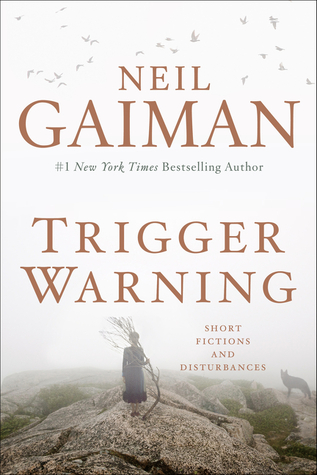
Audiobook Review: Trigger Warning by Neil Gaiman

Trigger WarningI’ve said it a bazillion times already on my blog: I suck at short stories. My attention wanders. I get impatient. I feel as though I’m just serving time until I can get back to my “real” reading… meaning reading a full-length novel.

And yet — after attending a talk by Neil Gaiman last spring and coming home with a signed copy of his latest book, I felt compelled to actually READ Trigger Warning, instead of just sticking in on a shelf to be admired for its prettiness.

Trigger Warning is a story collection (or, as the cover states, a collection of “Short Fictions and Disturbances”). While I love Neil Gaiman’s writing, pretty much always and no matter what, my dreaded aversion to short stories was keeping me from starting Trigger Warning, until I finally had the brilliant idea of listening to the audiobook.

Success!

I listened to (almost) the entire audiobook of Trigger Warning during the past week, and I must admit that I really enjoyed it.

Of course, the fact that Neil Himself is the narrator does not hurt. Nope, not one bit.

Neil Gaiman is in fact a terrific, animated, nuanced narrator, and his reading of the stories is never dull. I loved the tiny inflections and emphases, the slight accents for different characters, and the pacing and delivery. And there’s an odd sense of rightness in hearing the author read his own book. He, of all people, should know which parts are meant to be spoken boldly, which to trail off, when to be quiet, and when to practically chant. The eerie stories were read eerily; the funny bits had laughter hiding in the tone of his voice. Simply marvelous.

As for the stories themselves, this is really a very mixed assortment. Most (all?) appeared elsewhere originally, whether in other anthologies or written for special projects or events. I’d read two stories previously, “Orange” and “The Thing About Cassandra”, and enjoyed them immensely here in spoken format.

Other standouts for me are “Down to a Sunless Sea”, a short but entirely chilling tale told by a mysterious woman one rainy day along a wharf. “The Truth Is a Cave in the Black Mountains…” is a long, mythical-feeling piece involving a quest for gold, truth, and revenge, and I loved it. “A Calendar of Tales” grew out of a Twitter project, with a brief story for each month of the year. I especially loved the March tale, about the pirate Anne Bonny, and the wonderful October tale about a genie.

Weird, scary, funny, epic — the stories in Trigger Warning range from fairy tale to science fiction to horror, but all have a twist and a tone that make them surprising, entertaining, and captivating.

The only small irksome thing about the audiobook is that the description of the context for each story appears in the book’s introduction, and with an audiobook, there really isn’t a good, easy way to flip back and forth. I was glad I had the hard copy on hand so I could reference the intro again and again, and would suggest that if you’re going to listen to the audiobook, get your hands on a printed book or e-book so you can follow along.

Even if you’re — like me — not normally into story collections, it’s worth the time to give Trigger Warning a try, especially if you’re a Neil Gaiman fan. The audiobook definitely worked for me, and I’m so glad that I had the idea of listening to the stories rather than trying to force myself to concentrate on reading them in printed book form. An added bonus for me, based on my experience with Trigger Warning, is that I think I can use audiobook listening in the future to enjoy story collections that I might otherwise have skipped.

And even more than that, having now listened to Stardust and Trigger Warning, I’m super motivated to listen to even more by Neil Gaiman. I’ve been wanting to re-read The Graveyard Book for a while now, and I think audio might be just the ticket!

_________________________________________

The details:

Title: Trigger Warning
Author: Neil Gaiman
Publisher: William Morrow
Publication date: February 3, 2015
Audiobook length: 11 hours, 1 minute
Printed book length: 310 pages
Genre: Stories
Source: Purchased (hard copy)/Library (audio download)

YA new releases: A trio of mini-reviews!

I read three new young adult fiction releases this past week, and thought a three-fer review post would be fun! Here’s a quick look at what I read and what I thought.

another dayTitle: Another Day
Author: David Levithan
Release date: August 25, 2015
Length: 327 pages

In 2012, David Levithan published his remarkable novel Every Day (review), about a teen named A who awakens each day in a different body. A carries A’s consciousness into each body, but experiences life as a series of “day in the life” moments belonging to whoever the body’s owner is. This is normal for A, until A meets and falls in love with Rhiannon. This seemingly impossible and complicated set-up makes for an amazing read, complete in itself.

But here we are in 2015 with Another Day, which tells the same story and presents the same set of events, but as experienced by Rhiannon. I was skeptical at first: Do we really need another version of the same tale? Short answer: Yes. Another Day is much more engrossing and moving than I would have expected. Rhiannon ponders the dynamics between body and self, questions her own motivations and feelings, her own sense of attraction and repulsion in regard to each of A’s appearances, and finds herself forced into decisions that have no right answer.

I love David Levithan’s writing, pretty much always, and Another Day is no exception. The story is wonderful, and the writing is beautiful in its rhythms and use of language, yet also feels true to teen hearts and minds. The ending seems to beg for a follow up, and I do hope that the author is planning another installment in this fascinating story.

_____________________________________________

Hello GoodbyeTitle: Hello, Goodbye, and Everything in Between
Author: Jennifer E. Smith
Release date: September 1, 2015
Length: 256 pages

If you like your YA light and airy, then Hello, Goodbye, and Everything in Between might be the book for you! This is actually a fitting choice for this time of year, a quintessential back-to-school reading selection. Hello tells the story of Clare and Aidan as a “one magical night” type of tale: We spend the night, from early evening until the next morning, watching Clare and Aidan’s final night together after a two-year high school relationship, as each prepares to leave for college in the morning. Clare and Aidan live near Chicago, but Clare will attend an East Coast college and Aidan will be at UCLA.

All summer long, they’ve been debating whether to stay together or break up before leaving for school, with Aidan wanting option 1 and Clare advocating for option 2. It’s not that they don’t love each other; they do. But neither can be sure that staying together is the right thing to do. Is it better to end things now, on their own terms, than risk a slow fizzling out as they become involved in their own, separate college lives? What if they meet other people? What if they don’t, but miss out on key college experiences because their minds are too wrapped up in their long-distance romance?

Clare and Aidan spend the night visiting old hang-outs, best friends, scenes of memorable firsts, and “everything in between”, looking to both capture memories and come to an agreement before the sun rises and they go their separate ways. Even though the couple is dealing with heart-ache and sadness, there’s still an element of excitement and looking forward — plus family drama, as each character’s relationship with parents has an impact on their choices and how they feel about their chances as a couple.

I liked Hello, but thought it was a little too simplistic in presenting the options available to Clare and Aidan. They’re fun characters with good hearts, but I’m not sure the situation warrants quite as much drama as they infuse into it. This is a nice, light read, super quick and easily digestible. It didn’t make much of a deep impression on me, but it did keep me entertained all the way through.

_____________________________________________

Everything EverythingTitle: Everything, Everything
Author: Nicola Yoon
Release date: September 1, 2015
Length: 320 pages

Wow. This book left me reeling, in ways I didn’t even imagine. Everything, Everything is the story of Maddy, a teen girl with the rare immune disease SCID who’s lived her entire life in the hyper-protected, safe environment of her completely sterilized and filtered home. She never goes out, never sees anyone in person except her mother and her nurse, spends her time attending school via Skype and reading tons of books. And then one day, Olly and his family move next door, and Maddy’s world is rocked. What if she could make a friend? What if she did want something besides what she has? From waving window to window to email and IM chats, Maddy and Olly become friends, and then more, until Maddy feels ready to risk everything, even her life, to really take a chance at living.

I thought I knew what to expect, more or less, when I started this book, but I was wrong. First of all, the narrative voice is completely charming. Told in the first person by Maddy, the narrative strikes the exactly right chord of cleverness, humor, and curiosity tinged with innocence. Maddy has literally done nothing and been nowhere, so everything she sees and experiences is a first for her. The author captures the wonder of all of Maddy’s firsts, as well as the suffocation of being alive without really living her own life. While the Maddy/Olly romance develops quickly, it’s not insta-love. They get to know each other as people first. Each has baggage and fears, but they find a way to connect that’s touching and feels real and deserved.

The ending (or, the last 20%, according to my Kindle) absolutely threw me for a loop and was not what I expected at all. It’s powerful and emotional (okay, yes, there were even tears), and went in unexpected directions. I’m sure readers will have some heated debates about how things turn out, and I have a feeling this will be a love it or hate it situation — but either way, there’s plenty to discuss!

Throughout the book, I thought the writing was terrific, and I loved the little drawings and diagrams that enliven Maddy’s story, as well as all the email exchanges, messages drawn on windows, and other whimsical visual touches. Maddy is a smart and funny character, and I loved seeing her think about her life, her family, and her future. This book pulls off the tricky task of piling on the emotional impact while keeping a sense of quirkiness and laughter. Everything, Everything is a book that should really appeal to teen readers, and adults will love it too!

Book Review: A Little in Love by Susan Fletcher

A Little in Love

When a book starts with the main character dying slowly and painfully in the street, you know that you’re going to be in for an emotional ride.

Then again, what do you expect from a book whose essence can be boiled down to Victor Hugo’s Les Miserables as told by Eponine?

I mean, anyone who saw the musical version of Les Miz and didn’t get at least a little misty during this number has a heart of stone:


In A Little in Love, a dying Eponine recounts her sad life story, narrating all that she’s experienced in her young life that led up to this final moment. And so we go back to Eponine’s girlhood, as she lives in a small village at the inn run by her parents, the wicked, thieving Thenardiers. Eponine’s parents raise her and her younger sister to be wonderful thieves, able to pull rings off fingers, lift coins from pockets, take the buckles off a pair of shoes, without ever being seen. To steal is to earn love.

Into their lives comes a small girl named Cosette, deposited into the Thenardier’s keeping by her desperate mother, but the kindness and shelter she’d hope to secure for Cosette is never delivered. Cosette is treated like a dog and a slave, while the money left for her upkeep is spent on food and clothes for the Thenardiers. Eponine sees Cosette as a potential friend, until she is punished for showing any kindess. Eponine’s mother makes clear that only hardness is allowed. She must be cruel. She must be hard. Eponine can only keep what passes for love from her own mother by kicking Cosette and spitting at her, calling her ugly, and making her life miserable.

And so the years pass, until a kind-eyed man comes one Christmas to take little Cosette away into a better life. Eponine realizes just how trapped she is in the misery of her own family… but she herself has no way out, no kind-eyed rescuer to save her from her sad existence. After her father commits a horrible crime, they spend years on the run, eventually landing in Paris, where Eponine’s fate is sealed. She sees a young man, Marius, and falls instantly in love. Eponine is sickened by her family’s evil ways, and determines to be good, to be kind, to make her own way in the world and try to make amends. When Eponine realizes that Marius loves none other than Cosette, Eponine finds a way to unite the lovers, and ultimately… well, if you’ve watched the clip above, you know it doesn’t end well for poor Eponine.

A Little in Love is a lovely little book, not very long and with a nice, quick pace. Eponine’s world view may be limited, but it’s enough to show us the abject poverty of the lower classes in France and the depths to which people must sink in order to survive. Despite her horrible upbringing, Eponine holds onto her own humanity, and it’s through her sense of right and grace that we see that not all people are cruel, and that even poor, downtrodden people are capable of moments of kindess which can change lives.

This was a hard world, I knew that. It was dangerous; it had its knives and lies and cruelties, and Paris felt on the edge of such trouble. but there were small wonders too — everywhere.

Eponine’s voice is simple and genuine. She loves, she aches, she regrets. She despises her parents’ and sister’s actions, but not the people themselves. She would be forgiven for resenting Cosette and standing in her way, but of course she doesn’t: By helping Cosette, she’s doing what little she can to apologize for the years of cruelty, lightening her own burden of guilt even while adding to the pain she suffers knowing Marius will never love her as she loves him.

I would imagine that most readers of A Little in Love will be at least a little familiar with the story from the movie version of Les Miserables. This book is a reimagining of Victor Hugo’s story, so some plot changes may be confusing for those expecting the story they viewed on-screen. It doesn’t matter much, really: Because neither version of the story looks through Eponine’s eyes, the narration of A Little in Love covers new ground even when going over plotlines that may be familiar. It’s a hard balancing act for a retelling to stay faithful to the original while adding enough new elements to make the story fresh and surprising, and author Susan Fletcher achieves this remarkably well in A Little in Love.

Eponine is a tragic character, a small player in the grander story of Les Miserables, and it’s lovely to see her getting the center stage billing she deserves in this new novel.

Two final thoughts:

A Little in Love is being marketed as a young adult novel. I’d just add that younger teen readers (and older middle school aged readers) could easily enjoy this book, especially if they’ve seen the movie version. While the book portrays horrible living conditions, cruelty, starvation, crime, etc, it never gets graphic and there’s no sexual content.

♦ I really wish this book had a better title! It’s not bad, but it’s not memorable or particularly connected to the story itself. I found myself having to double-check the title several times in order to make sure I got it right! It just seems awfully generic, like something you’d paste on a light-hearted high school romance, and I’m afraid it doesn’t do the weightiness of the story true justice.

_________________________________________

The details:

Title: A Little in Love
Author: Susan Fletcher
Publisher: Chicken House Ltd
Publication date: August 25, 2015
Length: 288 pages
Genre: Young adult fiction
Source: Purchased

Take A Peek Book Review: Secondhand Souls by Christopher Moore

“Take a Peek” book reviews are short and (possibly) sweet, keeping the commentary brief and providing a little peek at what the book’s about and what I thought.

Secondhand Souls

Synopsis:

(via Goodreads)

In San Francisco, the souls of the dead are mysteriously disappearing—and you know that can’t be good—in New York Times bestselling author Christopher Moore’s delightfully funny sequel to A Dirty Job.

Something really strange is happening in the City by the Bay. People are dying, but their souls are not being collected. Someone—or something—is stealing them and no one knows where they are going, or why, but it has something to do with that big orange bridge. Death Merchant Charlie Asher is just as flummoxed as everyone else. He’s trapped in the body of a fourteen-inch-tall “meat” waiting for his Buddhist nun girlfriend, Audrey, to find him a suitable new body to play host.

To get to the bottom of this abomination, a motley crew of heroes will band together: the seven-foot-tall death merchant Minty Fresh; retired policeman turned bookseller Alphonse Rivera; the Emperor of San Francisco and his dogs, Bummer and Lazarus; and Lily, the former Goth girl. Now if only they can get little Sophie to stop babbling about the coming battle for the very soul of humankind…

The author with "squirrel people". Image via wunc.org

Christopher Moore with “squirrel people”.
Image via wunc.org

My Thoughts:

Here’s a slightly edited version of what I wrote on Goodreads:

I’ll just say it: Christopher Moore can pretty much do no wrong. Take his earlier books: Enormous lizards? Artificial whales? Stupid angels and Jesus? Shakespeare, Impressionist painters… you get the drift. For ultra-weird but extremely funny (and even touching) stories, you really can’t beat the Author Guy’s books.

Secondhand Souls is a sequel to A Dirty Job, which is an awesomely hilarious, entertaining, occasionally crude, always crazy tale — and Secondhand Souls lives up to it, not quite perfectly, but awfully darn close. The characters we love are back, in different places in their lives (and even in different bodies), but still themselves. Plus, there are some memorable new characters, including a Golden Gate Bridge painter named Mike, a mysterious man dressed all in yellow, a lovesick ghost, and a banshee with a fondness for tasers, among others.

San Francisco itself is a star, and seeing such a crazy adventure unfold in our beloved city is at least half the fun.

Who am I kidding? It’s all fun. The logic of the story gets a little thin at times, and forget about character development: We’re plopped down into the lives of the characters from A Dirty Job, and either you remember them or you don’t. But, it doesn’t really matter. If you’re a Christopher Moore fan, you need to read this. And if you’ve never had the pleasure, I’d say put this one on hold and read (at least) A Dirty Job — and possibly a few others — before picking up Secondhand Souls.


And for a more articulate review, here’s what my friend Heidi had to say about it:

Of all Christopher Moore’s novels, which range from the adolescent and ridiculous (Fluke: Or, I Know Why the Winged Whale Sings) to the pretty much perfect (Lamb: The Gospel According to Biff, Christ’s Childhood Pal), the ones that Charlie Asher lives in are my favorites. Secondhand Souls is of course the sequel to A Dirty Job, which introduced us to Charlie, beta male junk shop owner, and the hidden world of the Death Merchants. (Also: a devastatingly cool record-shop owner called Minty Fresh, a toddler who may-or-may-not be Death and her pet Hellhounds, Lily the PerkyGoth, Audrey the Buddhist nun, The Emperor of San Francisco, The Morrigan and The Squirrel People, among others.) Read that before you read this, or you’ll be really lost. In fact, you probably are already.

With the whole bizarre gang back in play — plus some new additions — Secondhand Souls is not a mere cheesey sequel (though cheez plays a critical role); it’s more like visiting with batshit crazy old friends. Unfortunately for them it turns out, due in large part to the events in A Dirty Job, there’s a dangerous backlog of uncollected souls lurking around San Francisco, and Charlie and friends are once again embroiled in the danger and magical maneuvering that is dealing with the powers of darkness rising. Fortunately, they are more than weird enough to handle the crisis. I don’t want to spoil the plot, so I’ll just say it’s hilarious.

Maybe I love these books because they capture San Francisco’s magic in ways that ring true in my heart. It’s like an idealized version of my hometown — in the topography of Moore’s books I basically live across the street from Minty’s shop, and nobody ever has to step over homeless people sleeping in the vestibule. Crazy people are really helpful geniuses, and even normal folks can afford the rents. (I find all this somehow reassuring, as magic is in short supply around here these days.) Also, the characters have more fun talking to each other than anybody ever has had in the history of ever. (Except maybe “The Gilmore Girls.”) For nutty-but-somehow-deep dialogue, you really can’t beat Christopher Moore. 5 whole-hearted, sunny-yet-deeply-morbid stars.

(With thanks to Heidi, for letting me borrow her review! For more awesome Heidi reviews, you can find her here on Goodreads.)

So hey – if you’re new to Christopher Moore, this is not the place to start! Maybe spend some time with Practical Demonkeeping or The Lust Lizard of Melancholy Cove, or even his first novel set in San Francisco, Bloodsucking Fiends. Bask in the absurd and wacky, soak up his crazy but somehow perfect tricks of language, and just enjoy the WTFness of it all. When you’re ready for true brilliance and lots of heart, read Lamb. Or harken back to Shakespeare as you never knew it with Fool and The Serpent of Venice. Uh oh, I feel a Christopher Moore retrospective post coming on! Stay tuned… and meanwhile, get thee to a copy of A Dirty Job as soon as possible.

Going now.

Need a cheez. (Read Secondhand Souls and this will make sense.)

_________________________________________

The details:

Title: Secondhand Souls
Author: Christopher Moore
Publisher: William Morrow
Publication date: August 25, 2015
Length: 352 pages
Genre: Fiction/Humor/Supernatural
Source: Purchased

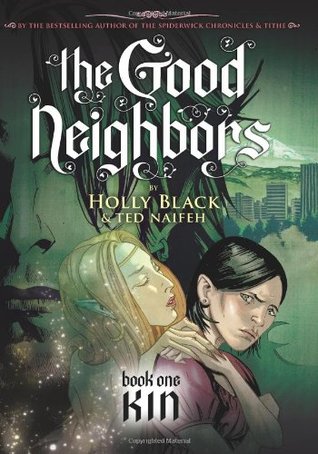
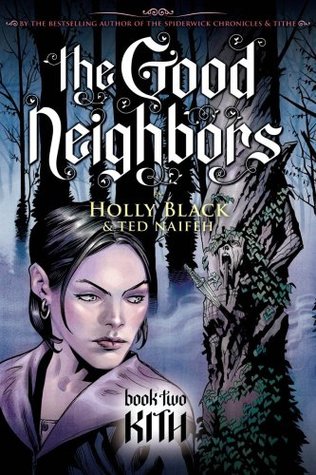
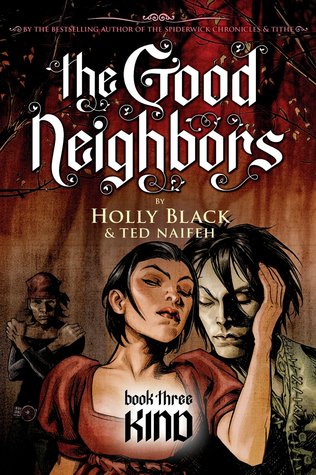
Graphic Reaction: The Good Neighbors series by Holly Black

Let’s talk about the terrific trilogy I just read! Presenting…

KinKith 0-439-85564-0

Holly Black excels at creating beautiful yet dangerous faerie worlds in her novels, and here she does so in graphic novel format.

Kin, Kith, and Kind tell the story of Rue Silver, a seemingly normal high school student whose life starts falling apart when her mother disappears. When her father, a folklore professor at the local university, is accused of murdering a student, things gets decidedly weirder.

Rue sees odd visions — people with horns or wings, a creature in the tree outside her house — and remembers all the slightly bizarre things about her mother. Like, for example, how her beautiful mother never seems to age, and how she hangs out naked in the garden, and how the flowers seem to respond to her.

The truth is slowly revealed: Rue’s mother is a faerie, making Rue only half-mortal. And it turns out there’s a plot afoot: Rue’s grandfather Aubrey is a faerie king, and wants to claim the entire city as a world for his people.

These books are such fun! There’s drama and danger, romantic love, passionate encounters, and familial love and loyalty at stake. The story builds, with Rue evolving into a force to be reckoned with, the more she claims her birthright and power.

I really liked the illustrations, which are in black and white throughout the three books. Rue and her friends are all distinct and well-drawn, and I love Rue’s depiction as a cool, funky, rebellious girl, in looks as well as in actions. The inhabitants of the faerie world are visually wonderful, with wings or fangs or talons, beautiful and menacing, and each one different and unusual. The details are terrific, and I particularly love the pages with crowd scenes, where all the various denizens of faerie (or the human world) appear as individuals, even when the page is teeming with them.

The story starts small, focusing on Rue and her personal dilemmas, and grows to a much wider scale, culminating in a fight for survival between the human and faerie worlds.

These books are a quick read, and ideally should be read right in a row for peak enjoyment. I found the Good Neighbors trilogy a really nice treat after a lot of heavier reading, and recommend them as a (dare I say it?) magical diversion when you’re looking for something a bit different to spend your time with.

_________________________________________

The details:

Title: Kin (book 1), Kith (book 2), Kind (book 3)
Author: Holly Black
Illustrator: Ted Naifeh
Publisher: Graphix
Publication date: 2008 – 2010
Length: 128 – 144 pages
Genre: Graphic novel
Source: Library

Blog Tour & Giveaway: The Last Summer at Chelsea Beach by Pam Jenoff

Thank you for joining me for my stop on the blog tour for Pam Jenoff’s new historical romance, The Last Summer at Chelsea Beach! And don’t forget to check out my giveaway — scroll down to enter… and good luck!

Last Summer

Synopsis:

Summer 1941  

Young Adelia Monteforte flees fascist Italy for America, where she is whisked away to the shore by her well-meaning aunt and uncle. Here, she meets and falls for Charlie Connally, the eldest of the four Irish-Catholic boys next door. But all hopes for a future together are soon throttled by the war and a tragedy that hits much closer to home.

Grief-stricken, Addie flees—first to Washington and then to war-torn London—and finds a position at a prestigious newspaper, as well as a chance to redeem lost time, lost family…and lost love. But the past always nips at her heels, demanding to be reckoned with. And in a final, fateful choice, Addie discovers that the way home may be a path she never suspected.

My Thoughts:

I have really mixed feelings about this book. First, the positive: I thought the author did a great job conveying the feel of Philadelphia and the Jersey beaches in the 1940s. The street scenes and depictions of life in a summer beach town were very convincing. I really enjoyed seeing Adelia’s unofficial adoption into the Connally clan. This big, noisy Irish family just opened their hearts and home to her, and it was heartwarming to see this lonely, frightened immigrant girl find a place to fit in.

Likewise, the scenes set in wartime London were stirring, especially seeing the devastation of the Blitz and the danger of simply walking down a street, as well as the sad plight of war orphans and the courage of the war correspondents and soldiers setting off on secret missions. The risks and uncertainty add a sense of breathlessness to every interaction, and I liked seeing Addie find a place amidst the chaos and confusion, seeming to discover a calling of her own.

What worked less well for me was the romance, or rather, romances, that are at the heart of the story. To put it bluntly, I just didn’t buy any of Addie’s love interests. I found her actions and decisions confusing, and even by the very end of the story, I wasn’t convinced by her supposed motivations or feelings. Part of the problem may have been the condensed time frame of the story, covering about four years starting from when Addie is sixteen. An awful lot happens in that amount of time, including romantic entanglements that spring up almost instantly and some that seem to dissolve just as quickly.

For me, The Last Summer at Chelsea Beach seemed over-plotted, and I didn’t feel that the emotional arcs built, but rather jumped from point A to point B (or even C). The romantic aspects of this book just didn’t gel, but I did enjoy the historical setting and the way the descriptions evoke a real sense of a by-gone era.

Find out more:


Add to Goodreads badge

Purchase Links

Amazon | Books-A-Million | Barnes & Noble

About the Author:

Pam-Jenoff-credit-Dominic-Episcopo-200x300Pam Jenoff is the Quill-nominated internationally bestselling author of The Kommadant’s Girl. She holds a bachelor’s degree in international affairs from George Washington University and a master’s degree in history from Cambridge, and she received her Juris Doctor from the University of Pennsylvania. Jenoff’s novels are based on her experiences working at the Pentagon and also as a diplomat for the State Department handling Holocaust issues in Poland. She lives with her husband and three children near Philadelphia where, in addition to writing, she teaches law school.

Connect with Pam:

Website | Facebook | Twitter

_________________________________________

The details:

Title: The Last Summer at Chelsea Beach
Author: Pam Jenoff
Publisher: Mira
Publication date: July 28, 2015
Length: 384 pages
Genre: Historical fiction
Source: Review copy courtesy of TLC Book Tours

tlc logoFor further information, stop by TLC Book Tours to view other blog tour hosts.


GIVEAWAY!

I’m excited to be giving away a bookbag and finished copy of the book! Want to win? No fancy footwork required — just leave a comment below answering any one of these questions:

– What’s the best book you’ve read set during wartime?
– What beach holds special memories for you, and why?
– If you could live in a different period in history, what would you choose?

Extra credit: Do you follow Bookshelf Fantasies? Let me know in the comments if you follow me and how (email, Twitter, WordPress, etc), and you get an extra entry in the giveaway!

That’s it! I’ll do a random drawing on September 1st to pick a winner. Thanks for playing along!

(Sorry — US/Canada only this time around)

Take A Peek Book Review: I Am Princess X by Cherie Priest

“Take a Peek” book reviews are short and (possibly) sweet, keeping the commentary brief and providing a little peek at what the book’s about and what I thought.

I Am Princess X

Synopsis:

(via Goodreads)

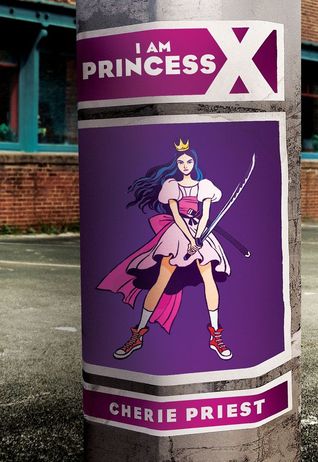
Best friends, big fans, a mysterious webcomic, and a long-lost girl collide in this riveting novel, perfect for fans of both Cory Doctorow and Sarah Dessen; illustrated throughout with comics.

Once upon a time, two best friends created a princess together. Libby drew the pictures, May wrote the tales, and their heroine, Princess X, slayed all the dragons and scaled all the mountains their imaginations could conjure.

Once upon a few years later, Libby was in the car with her mom, driving across the Ballard Bridge on a rainy night. When the car went over the side, Libby passed away, and Princess X died with her.

Once upon a now: May is sixteen and lonely, wandering the streets of Seattle, when she sees a sticker slapped in a corner window.

Princess X?

When May looks around, she sees the Princess everywhere: Stickers. Patches. Graffiti. There’s an entire underground culture, focused around a webcomic at IAmPrincessX.com. The more May explores the webcomic, the more she sees disturbing similarities between Libby’s story and Princess X online. And that means that only one person could have started this phenomenon—her best friend, Libby, who lives.


My Thoughts:

What a treat! I Am Princess X is a smart, well-written, imaginative odyssey focused on girl power and the bonds of friendship. May and Libby are deeply connected, and their true devotion to one another is what drives the search for answers forward.

Fast-paced, clever, pulse-pounding, and funny, I Am Princess X is a great story of friendship and determination, with plenty of adventure and geeky clue-chasing mixed in. The web comic that becomes a piece of the puzzle is terrific, and I really enjoyed the way the comic provides a map to the secrets of the story.

It’s nice to read a young adult novel where romance, for once, is not a factor at all. There’s lots of tech talk and references to gadgets, devices, screens, and tablets (which makes me wonder if this book will feel dated in 10 years). The plot involves hacking and spyware and questionable internet conduct — but that’s about all that could even possibly raise an eyebrow about inappropriate behavior. Otherwise, it’s practically squeaky clean, so a parent could be comfortable sharing this with mature middle school readers as well as the book’s target teen audience. (I say mature, simply because there is danger and a scary bad guy, with the main characters in serious peril. The bad guy is really creepy and threatening — deadly too.)

Overall, I found I Am Princess X to be fun, memorable and exciting. It’s got a fresh and unusual feel to it, and the narrative-plus-graphics format is very engaging. Check it out!

_________________________________________

The details:

Title: I Am Princess X
Author: Cherie Priest
Publisher: Arthur A. Levine Books
Publication date: May 26, 2015
Length: 240 pages
Genre: Young adult fiction
Source: Library

Audiobook Review: The Invention of Wings by Sue Monk Kidd

Invention of Wings 2My book group chose The Invention of Wings by Sue Monk Kidd for our August discussion book, and I was in absolute despair over how impossible it would be to find enough time to read it, when it dawned on me that I needed a new audiobook to listen to and this might be the perfect choice.

Guess what? I was right.

Almost immediately, I became totally wrapped up in this beautiful and powerful story. On top of the quality of the writing and plot, the audiobook narration seemed to suit the characters perfectly, and I was absolutely hooked.

What’s it all about? In short, The Invention of Wings is the story of two women whose lives are joined from childhood onward. One is Sarah Grimke, the daughter of a wealthy planter-class, slave-owning family in Charleston, South Carolina in the early 1800s. The other is Hetty, known as Handful, the slave girl given to Sarah as a present for her 11th birthday.

Sarah is horrified by the idea of owning a person, and her first action is to steal into her father’s library and copy a document of manumission from his law books, setting Handful free. Of course, Sarah’s parents rip up the document on the spot, but from this moment forward, Sarah and Handful’s lives are tied together.

Sarah Grimke is a historical figure, who became a famous (and infamous) public speaker and writer as an adult, as she and her sister Angelina became outspoken, ardent abolitionists and advocates for women’s rights. Handful, though, is a fictional invention, although her life and experiences could easily have been real in the American South.

In alternating voices and chapters, Sarah and Handful narrate their lives. Each presents the world around herself as she experiences it. Sarah is a prisoner of her family’s expectations and society’s beliefs and prejudices, trapped by her gender and by societal norms into a life that torments her. Handful, of course, is literally a prisoner, enslaved for life and forced to experience and witness one degradation after another, despite her mother Charlotte’s best efforts to shield her and give her strength.

The audiobook has two narrators, Jenna Lamia and Adepero Oduye, who alternately voice Sarah and Handful. It’s hard to explain how wonderful this is. Sarah speaks as a young girl at the beginning, and her voice strengthens and matures as she grows into womanhood. Sarah has a speech impediment, which we hear whenever Sarah talks, but not during the narration itself, which is as fluent as her thoughts. The narrator for the Sarah chapters also marvelously captures the upper-class Southern drawl of Sarah’s parents and siblings. Meanwhile, Handful’s chapters are told through Handful’s own speech patterns, with a deep and sorrowful musicality that is really lovely and heartbreaking to listen to.

The story itself is absolutely engrossing. The author does not shy away from the brutality of slavery, and we see the daily degradations as well as the more egregious acts of violence and cruelty. Likewise, we witness the painful journey of a girl breaking free and finding her own voice in a world where speaking out can cost you everything.

The two stories contrast nicely with each other, with themes of family and a search for freedom running through both. I didn’t always buy the idea of the parallels between the two characters’ stories. Handful says to Sarah at one point:

My body might be a slave, but not my mind. For you, it’s the other way round.

While it’s an interesting concept, there isn’t really an equivalency. Sarah may be bound by society’s strictures, but she’s still free and does not have to worry about staying alive and physically whole on a daily basis. Still, it’s worth thinking about the ways in which each woman has her life defined by forces outside her own control, and by the many small steps and defiant acts each takes to carve out her own place in a world that doesn’t value her or even deem her worthy of notice.

Both halves of the story are quite interesting, although Handful’s chapters have a much more urgent and visceral feel to them, and these are the parts of the story that affected me most deeply. Not to say that Sarah’s story isn’t compelling as well: She’s a quiet but strong presence throughout the book, with a deep moral core that propels her forward and has her constantly seeking her purpose in life.

The book ends with an afterward by the author in which she explains the origins of the novel and her research, and gives an overview of the real Sarah Grimke’s life. It’s fascinating to learn more about this historical figure, and to get a glimpse inside the novelist’s writing process, learning which parts of the story are based on real events and which are woven together from imagination and research into 19th century life.

I strongly recommend The Invention of Wings. This feels like the kind of book I’ll be pushing all of my friends and family members to read. The story itself is engrossing, but it’s the characters — deep, well-developed, and sensitively portrayed — who are the heart and soul of this important book.

_________________________________________

The details:

Title: The Invention of Wings
Author: Sue Monk Kidd
Publisher: Viking
Publication date: January 7, 2014
Audiobook length: 13 hours, 46 minutes
Printed book length: 384 pages
Genre: Historical fiction
Source: Purchased (Audible download)