
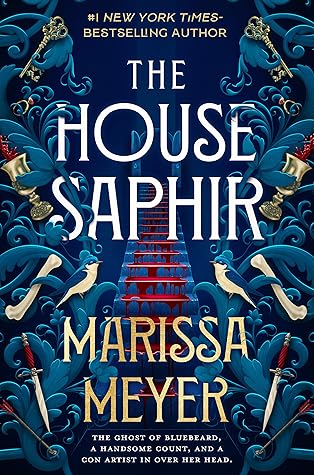
Title: The House Saphir
Author: Marissa Meyer
Publisher: Faber & Faber
Publication date: November 4, 2025
Length: 432 pages
Genre: Young adult fantasy
Source: Library
Rating:
This is the tale of Bluebeard as it’s never been told before–a romantasy murder mystery.
Mallory Fontaine is a fraud. Though she comes from a long line of witches, the only magic she possesses is the ability to see ghosts, which is rarely as useful as one would think. She and her sister have maintained the family business, eking out a paltry living by selling bogus spells to gullible buyers and conducting tours of the infamous mansion where the first of the Saphir murders took place.
Mallory is a self-proclaimed expert on Count Bastien Saphir—otherwise known as Monsieur Le Bleu—who brutally killed three of his wives more than a century ago. But she never expected to meet Bastien’s great-great grandson and heir to the Saphir estate. Armand is handsome, wealthy, and convinced that the Fontaine Sisters are as talented as they claim. The perfect mark. When he offers Mallory a large sum of money to rid his ancestral home of Le Bleu’s ghost, she can’t resist. A paid vacation at Armand’s country manor? It’s practically a dream come true, never mind the ghosts of murdered wives and the monsters that are as common as household pests.
But when murder again comes to the House Saphir, Mallory finds herself at the center of the investigation—and she is almost certain the killer is mortal. If she has any hope of cashing in on the payment she was promised, she’ll have to solve the murder and banish the ghost, all while upholding the illusion of witchcraft.
But that all sounds relatively easy compared to her biggest challenge: learning to trust her heart. Especially when the person her heart wants the most might be a murderer himself.
I had high hopes for The House Saphir — I’m always up for a good fairy tale retelling, and I loved this author’s Lunar Chronicles series. Unfortunately, weak world-building, odd word choices, and an unconvincing plot all resulted in a reading experience that was squarely so-so.
The story revolves around Mallory, a con artist from a line a witches who lost her own powers due to a spell gone wrong during her youth. Now, she and her sister support themselves through fake card readings and unauthorized tours of a supposedly haunted house (complete with cheap knock-off heirlooms that they sell to their gullible customers). Not everything is fake, however; the one magical gift that Mallory still has left is the ability to see and communicate with ghosts. At the Saphir mansion, home of the notorious murderer known as Monsieur Le Bleu, Mallory communicates with Trephine, the first of his three murdered wives.
After a botched tour, Mallory and her sister end up hired by Armand Saphir, descendent of the murderer, to rid his country estate of the evil spirit of Le Bleu. And despite having no actual ability to carry out an exorcism, they take the job. After all, money is tight, and they’ve been threatened with arrest for fraud. So… take the job, fake it for a while, get paid, and take off.
All sorts of complications ensue. The world of The House Saphir include an array of monsters, who’ve apparently reentered the mortal realm once the veil fell years earlier. There’s a religion that worships the seven gods, and witches and magic are quite real. But it all is rather muddled. The religion, the monsters, the common beliefs, the reasons for why things are as they are — nothing gets much explanation, and feels like the thinnest of plot scaffolding, only there to explain Mallory’s actions.
I was baffled by the setting. This is a fictional world, European-esque but not actually Europe or countries that exist in our world — but characters have French names and speak French, and a visiting magician named Constantino speaks Italian (“buona sera!”). Why?
One relatively minor thing that bugged me throughout — the author’s use of the word “boy” when talking about a young man. When Mallory pounces on someone coming up behind her, she’s startled to see a “boy”, which made me assume this was someone in the 10 -12 year old range. Nope — the various “boys” Mallory encounters all appear to be upwards of 18 or thereabouts. Annoying, and this took me right out of the story each time.
Overall, I was underwhelmed by the plot and character development, and found the action sequences pretty messy as well. On a positive note, I enjoyed the ghost wives quite a bit, and appreciated that their scenes tended to add a touch of humor to otherwise grim events.
The House Saphir appears to be a stand-alone, although I could imagine a spin-off involving the monster hunters. Perhaps future books might provide more substance for the world-building.

Purchase links: Amazon – Audible audiobook – Bookshop.org – Libro.fm
Disclaimer: When you make a purchase through one of these affiliate links, I may earn a small commission, at no additional cost to you.
 Bookshelf Fantasies
Hmm this does sound a little confusing, with too many elements maybe? Too bad, I have loved some of her earlier books.
Me too, I loved the Lunar Chronicles! You’re right, there really was just too much going on — the monsters weren’t necessary and didn’t seem important relevant to the evil ghost!
It’s a pity that this one didn’t live up to expectations. I can definitely see how the use of ‘boy’ would be misleading. It’s so easy for the misuse of words to wrench you out of the story.
Absolutely — and it tripped me up more than once! Especially when she meets two people that she refers to as boys… and then remembers that they’re the “gentlemen” she passed on the street. Are they men or boys? Writing inconsistencies like this bother me, especially when it’s not just a one-time fluke.
It makes it feel as though the author hasn’t really got a grip on who her characters are. And then there’s no chance for the poor reader😀
Since this book is marketed as YA, I wonder if the author felt that “boy” would be more relatable for younger readers? Still feels kind of shoddy to me.
Noooo, I loved this book!
LOL, I guess we have very different reactions for this one!!
haven’t read her other books, but sorry that this one didn’t grab you. for me i can look past some things but world building is huge, i don’t think this book will be for me! i’m already a bit picky with books that mix mystery and fantasy so was already on the fence about this one! 😅
I do think her Lunar Chronicles books are excellent, but this one was just too muddled and unclear.
I didn’t actually absolutely love this book, but I am kind of confused by your review. The author’s mentioned a lot that it’s not a standalone? It’s the first in a trilogy of fairytale retellings that will follow a different couple while also expanding the overarching plot and world. The next one is about Constantino and Anais. The chapter at the end with author’s notes (hardcover copy bought in most locations came with it) talks about it some.
There is a why to the reason language from our world is used here and there. It’s fine to not like the stylistic choice, but it’s there as a nod to where the tales are from. Basically an easter egg to catch and go oh right it’s a fairytale from here! Gilded was Germanic. Bluebeard was French. Constantino uses Italian as a hint to what the next book is going to be and what fairytale he’s based off of. It’s a pretty well known Italian tale.
I thought it was kind of fun, especially with trying to take the clues for what the other books could include. And it makes sense for what she’s doing. She wants to have her own world to be less restricted so she’s not just doing a beat by beat retelling, but she also wants you to remember it IS a retelling of a well known fairytale.
It’s also set in the same world as her other duology Gilded. A place in it is referenced in Saphir and she mentions it in the anotated chapter at the end.
Maybe I missed something but I didn’t think Constantino was ever mentioned as a magician. They were a traveling troupe of monster hunters. His ‘power’ came from being god blessed? I didn’t think you could have both.
Thanks for sharing your thoughts. I think my issue is that a reader might only know or appreciate some of this if they follow the author, keep up with their interviews, etc. Picking up this book on a whim, there’s nothing to indicate that it’s not a standalone (and at least as of now, the Goodreads page doesn’t indicate that either). The audiobook didn’t include the author notes (which is how I read this, since a hard copy wasn’t available), so there’d be no way to get that additional information (which, in general is one of my pet peeves about audiobooks… but that’s another topic).
As for the languages, I see what you’re saying — but still, for me anyway, it didn’t work and felt awkward. You may be right about Constantino, but that’s part of what I mean about the world-building feeling muddled.
Anyway, I’m glad this book worked for you so much better than it did for me!