
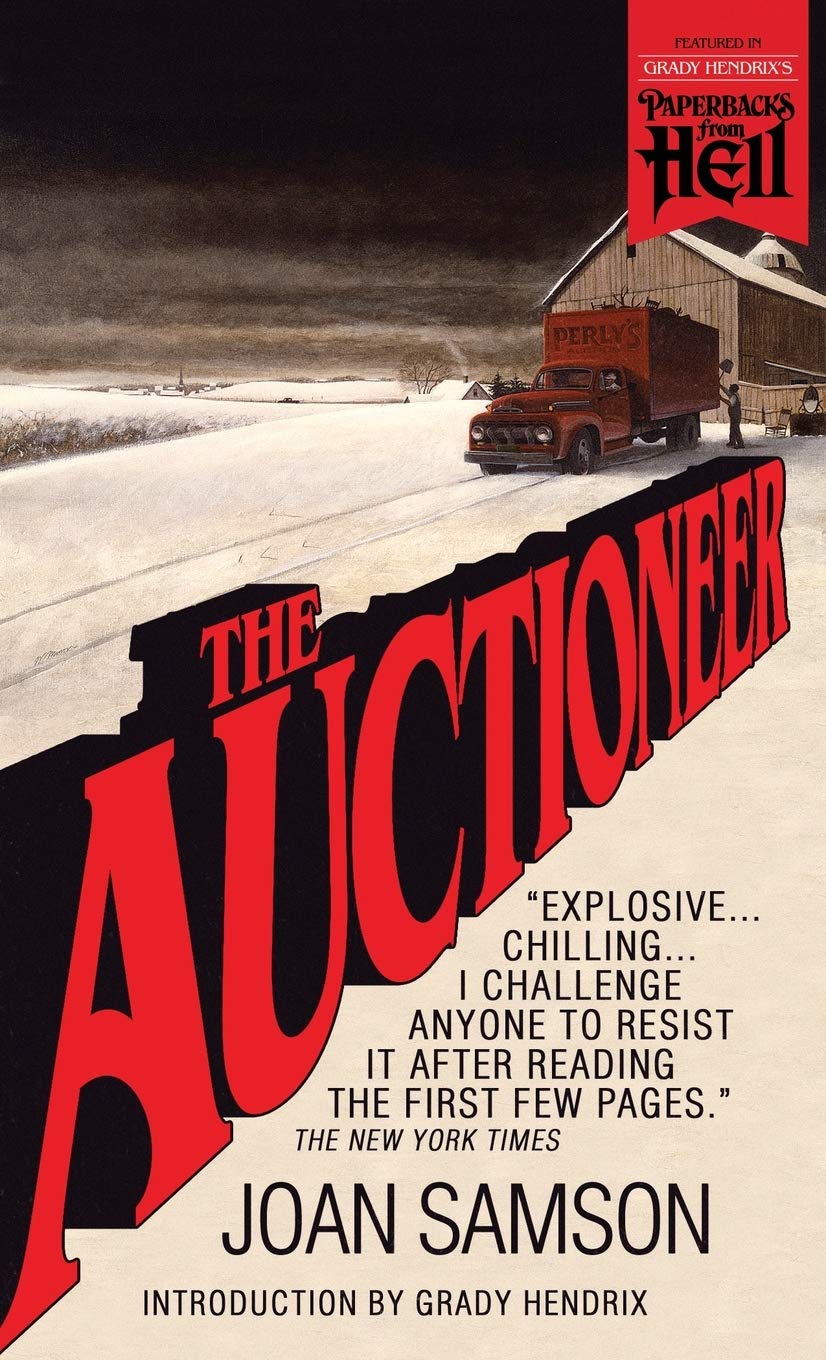
Title: The Auctioneer
Author: Joan Samson
Publisher: Valancourt Books
Publication date: 1976
Length: 235 pages
Genre: Thriller/horror
Source: Purchased
Rating:
One of the finest and best-selling horror novels of the 1970s returns at last to chill a new generation of readers.
In the isolated farming community of Harlowe, New Hampshire, where life has changed little over the past several decades, John Moore and his wife Mim work the land that has been in his family for generations. But from the moment the charismatic Perly Dunsmore arrives in town and starts soliciting donations for his auctions, things begin slowly and insidiously to change in Harlowe. As the auctioneer carries out his terrible, inscrutable plan, the Moores and their neighbors will find themselves gradually but inexorably stripped of their possessions, their freedom, and perhaps even their lives…
A chilling masterpiece of terror whose sense of creeping menace and dread increases page by page, Joan Samson’s The Auctioneer (1975) is a rediscovered classic of 20th-century fiction. With echoes of Shirley Jackson’s ‘The Lottery’ and Stephen King’s Needful Things, Samson’s novel returns to print at last in this long-awaited new edition, which features an introduction by Grady Hendrix (Horrorstör, Paperbacks from Hell).
The Auctioneer is a 1970s horror classic — perhaps forgotten by most, but seemingly gaining yet another round of readers thanks to its inclusion in Grady Hendrix’s excellent non-fiction book Paperbacks from Hell. I seem to remember seeing a copy of The Auctioneer in my parents’ house as a child, and though I’d never read it, that sinister cover image has always stayed with me.
Finally, at least partially motivated by my 20th Century Decades Challenge, I decided to pick up The Auctioneer and see why it’s remained a horror touchstone for so many years. And I’m so glad I did.
The Auctioneer is set in the rural New Hampshire town of Harlowe, populated by old-time farming families who collectively exemplify small-town life. Sure, you could go 30 miles or so down the road to find a big-box outlet for your essentials, but why do that when you can visit the local general store, a messy jumble of odds and ends where you can buy what you need and catch up on the local gossip?
Perhaps more tourists from Boston and other cities have shown up in recent years for summer getaways in the country, but life more or less goes on as it always has, until Perly Dunsmore shows up in Harlowe. He’s a charismatic man in his 40s, full of charm and friendliness, who suggests holding a country auction to raise money for the sheriff’s department, a one-man operation that has almost nothing to do most of the time. The town is eager to show support, and Perly and the sheriff make their way from house to house, farm to farm, collecting donations for items to be auctioned.
The auction is a success, with city folk coming from miles away to bid on country collectibles and antiques. With the proceeds of the auction, the town is able to add a deputy. But it doesn’t stop there: Each Thursday, Perly or one of his representatives — a growing number, as Harlowe hires more and more deputies — makes the rounds to collect more items to donate.
Our point-of-view characters are the members of the Moore household, John, Mim, their young daughter Hildie, and Jim’s mother, called Ma by the family. The Moores have farmed their lovely piece of land for generations. At first, it’s easy to part with an unneeded chair or spare wagon wheels collecting dust in the barn. But the collections and auctions keep going, and John and Mim quickly come to dread the Thursday visits. Soon, they’re giving up cookware, furniture, tools — even the water pump eventually goes — and the family is left living in a way reminiscent of earlier days, with no heat, electricity, telephones, or running water.
Why don’t the families refuse? Those who do are threatened. The deputies who show up are armed, and rumors begin to fly about families who’ve left town in the dead of night, or suffered serious injuries, or ended up accidentally shot in a hunting incident. The violence is not explicit: No one physically attacks John or Mim — instead, there’s an insidious undertone of what terrible things could happen to those who oppose the auctions.
Meanwhile, in an almost allegorical thread throughout the book, we see the city dwellers flocking to Harlowe for a taste of country living, yearning to capture something they’ve never had, dreaming of old-time values and quality of life that they imagine a town like Harlowe might provide. These interlopers show up week after week, spending money to buy pieces of this dream, but never stopping to wonder where these wonderful finds are coming from.
The sinister nature of Perly’s auctions creeps up on the reader.
“Just remember this,” he said in a deep voice that cut neatly through the confusion. “Whatever I’ve done, you’ve let me do.”
This isn’t out-and-out horror with blood on the page. Instead, it’s a slowly building dread, fueled by fear and distrust and complacency. John and Mim talk of fleeing, yet never quite bring themselves to do it, even when they have nothing left to lose but the lives of their family members. In a community turned against itself, where neighbors are complicit in the darkness dismantling their town, individuals can’t quite bring themselves to separate from the crowd and take action.
It’s hard to describe why The Auctioneer works as well as it does. Readers may stop and question why the town goes along with Perly so willingly; why no one objects for far too long; why people give up what matters to them rather than fighting back. A sense of isolation and helplessness pervades the story — there’s no place to turn for help, so the entire town becomes easy prey for one man with the power of persuasion.
The Auctioneer is a disturbing read, one that will keep readers awake at night pondering how it all could happen — but the story is built so carefully that we can see it all unfold and believe that it’s all possible. This is a gem from the past that should certainly be read by horror fans today — it’s a fascinating look at an earlier age of the genre, as well as an outstanding story in its own right.
Interested in learning more?
For a fascinating look at how the novel was received back when it was first published, check out this review from the New York Times archive.

About the author:

Joan Samson
Joan Samson (1938-1976) is the author of the bestselling novel, The Auctioneer. It is Samson’s first and only novel, published just before her death in 1976 at the age of 38.
Purchase links: Amazon – Bookshop.org
Disclaimer: When you make a purchase through one of these affiliate links, I may earn a small commission, at no additional cost to you.
 Bookshelf Fantasies
Is it weird that it’s making me think of where this country is at right now? Or maybe that’s the point. Strange how prophetic the book is but maybe it’s simply the acknowledgment of how history repeats itself over and over because we never actually learn en masse.
Exactly. The power of persuasion, the willingness to go along, the ability of someone to get people to act against their own interests… seems like the cycle repeats and repeats.
I have never heard of this book or the author, lol. Which is sad I guess? You’ve definitely piqued my interest, and I might need to track down a copy😁
It’s definitely worth checking out, especially in the context of 70s horror!
I’ve never even heard of this book! It does sound quietly disturbing. Awesome review. 😀
Thank you! The author died soon after publication, so unfortunately, it’s her only book. Well worth checking out!
Clicking through from your TTT post on occupations, as this book caught my eye. I don’t read much horror, but I don’t mind a good bit of creepy. So I think I could tackle this. The book is new to me, I’ve not heard of it before.
It’s really an oldie! I remember seeing it in my parents’ house way back when, and I’m so glad I finally read it!