
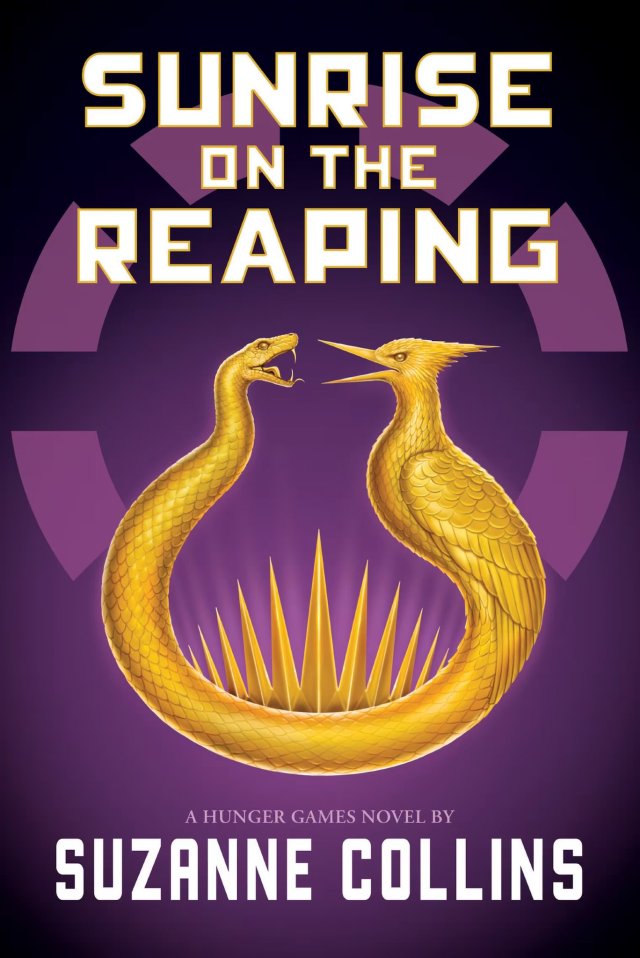
Title: Sunrise on the Reaping
Author: Suzanne Collins
Publisher: Scholastic
Publication date: May 18, 2025
Length: 382 pages
Genre: Young adult
Source: Purchased
Rating:
When you’ve been set up to lose everything you love, what is there left to fight for?
As the day dawns on the fiftieth annual Hunger Games, fear grips the districts of Panem. This year, in honor of the Quarter Quell, twice as many tributes will be taken from their homes.
Back in District 12, Haymitch Abernathy is trying not to think too hard about his chances. All he cares about is making it through the day and being with the girl he loves.
When Haymitch’s name is called, he can feel all his dreams break. He’s torn from his family and his love, shuttled to the Capitol with the three other District 12 tributes: a young friend who’s nearly a sister to him, a compulsive oddsmaker, and the most stuck-up girl in town. As the Games begin, Haymitch understands he’s been set up to fail. But there’s something in him that wants to fight . . . and have that fight reverberate far beyond the deadly arena.
We all know about the District uprisings that finally overthrew the Capital and freed Panem of the horrors of the Hunger Games… but 25 years earlier, a tribute named Haymitch Abernathy did his best to break the Games. He failed… but as author Suzanne Collins shows us in Sunrise on the Reaping, his story is worth telling.
I was skeptical, to be honest. Do we need another Hunger Games book? About Haymitch, of all people? When we meet Haymitch in the very first book in the series, he’s the District 12 drunkard, a pathetic former victor of the Hunger Games who’s lived alone in his Victor’s Village house all these years, failing each year to keep to keep any of the tributes he mentors alive, and doing his best to drink himself to death.
Eventually, he gets his act together enough to actually be of use to Katniss and Peeta, and later plays a role in the rebellion… but that’s all later. How did Haymitch, seemingly so pathetic when we meet him, manage to win his Hunger Games in the first place?
We never, none of us, had any choices.
In Sunrise on the Reaping, we find out. At age 16, Haymitch works hard to support his widowed mother and younger brother by doing odd jobs for the local bootlegger. He’s strong, devoted to his family, and madly in love with his Covey girlfriend, Lenore Dove. His birthday is never a happy one, as it coincides with the day of the reaping, and this year’s reaping promises to be especially bad: It’s the 50th Hunger Games, the Quarter Quell, and to mark the significant anniversary, the reaping will select not two tributes per District, but four. Haymitch knows he has a high chance of being selected, but initially he appears to have been spared — until an unpredictable event at the reaping forces him into the games anyway.
Haymitch knows he’s doomed. Only one person from District 12 has ever won the Hunger Games, although no one actually knows who this was — all records have disappeared. (We know, of course, that this was Lucy Gray Baird, victor of the 10th Hunger Games, as depicted in The Ballad of Songbirds and Snakes). As Haymitch leaves his family, friends, and District, Lenore Dove asks him to do whatever he can to put an end to the Games, once and for all.
“And that’s part of our trouble. Thinking things are inevitable. Not believing change is possible.”
“I guess. But I can’t really imagine the sun not rising tomorrow.”
A crease forms between her eyebrows as she puzzles out a response. “Can you imagine it rising on a world without a reaping?”
The best outcome Haymitch had envisioned was a quick death, to spare his family the agony of watching him die in some prolonged, awful way, and then a reunion with Lenore Dove in the afterlife — but now, he’s determined to fulfill the mission she’s set for him. If he can’t survive, at least he can try his best to break everything before his death. Maybe, just maybe, he can find a way to be disruptive enough to end the Hunger Games for good.
(We know he can’t, since we know the Games continue for another 25 years… )
As we follow Haymitch from District 12 to the Capital and then into the arena, we see a young man who’s very different than the bitter, ruined adult we know from the earlier books. Haymitch is determined but realistic. He knows he has no chance against the Careers, the tributes from the wealthier districts who train all their lives for a shot at Hunger Games glory. But Haymitch is not without skills of his own, and he’s caring to a fault: As he meets the weaker, more vulnerable tributes, he takes on the role of protector, and becomes desperate to find a way to shield his band of allies for as long as possible.
Alas, as we all know, the Hunger Games only ends with death for all but one of the tributes. As the Games in Sunrise on the Reaping get underway, the violence and death toll mount at a speed that’s inevitable. Here’s where the book feels a bit weak: Sure, it’s compelling and there are bursts of intensity and action — but, while the window dressing is different from the version of the Games we saw in The Hunger Games and Catching Fire, it’s still ultimately an arena full of traps, an environment designed to kill in horrific ways, and teens who can only survive by murdering one another. It’s certainly not boring… but it’s also not new.
Sunrise on the Reaping does fill in some blanks for devoted Hunger Games fans. It finally allows us to connect the dots and understand who Haymitch was before the main trilogy of books, because that’s always been a bit hard to fathom — we know he’s the only identified victor from District 12, but it’s impossible to picture him as anything but the wreck he is when we meet him. How could he possibly have won?
The Haymitch we meet here is someone to be admired and pitied. We see the cruelty to which he’s subjected as everything and everyone he loves is taken from him — but also the mission which Lenore Dove assigns to him, which he can’t fully abandon even after everything is lost.
With that, she condemns me to life.
It is fascinating to see the origins of certain elements of the later versions of the Games, as well as earlier generations of main characters’ families. On the other hand, seeing what’s become of Coriolanus Snow, now fully embodying the cruel, murderous persona of the Panem President as we first met him in the original trilogy, has its own impact. We knew, of course, how Snow would end up — but for brief glimmers in Ballad, we also got to see a hint of what else he might have been, had the world been just a bit different.
Adding to the depth of Sunrise on the Reaping is its exploration of propaganda and how authoritarianism thrives in the absence of a free press. Haymitch has several big moments of defiance that he expects to be captured for the rest of Panem to see, but of course, President Snow’s approved versions show nothing of the sort. Adding to the horror of all of Haymitch’s tragic losses is the way the televised record twists his actions and shreds his dignity and honor. When the media is under the tight control of the rulers, rebellion can be squashed simply by not showing it.
Lastly, I’ll mention the bonds among the tributes. When the weaker, non-Career districts recognize that individually, they don’t stand a chance, they form an alliance based on strength in numbers. Tactically, this is smart — and it also gives readers the opportunity to see a different way of surviving in the Games, not by murdering every single person you meet, but by protecting the people you care about and forming genuine connections. Sure, they’re still all doomed, knowing the Gamemakers will only let one person out alive, but meanwhile, they’re able to compete with some sense of purpose and dignity.
Ultimately, I’m glad to have read Sunrise on the Reaping, but I still question how effective a prequel can ever really be. The book gives us insight into a chapter of Panem’s history that we hadn’t seen before, and lets us see a character’s tragic backstory, which helps make sense of his later trajectory. Still, the problem with prequels remains that the outcome is predetermined: We know Haymitch will be the victor, so any dangers are easy to discount. Others may die (and do) — but he won’t, and we know it.
I wonder whether this is it for the world of The Hunger Games, or if the author will continue to add prequels to fill in the blanks. The original trilogy’s ending wraps up the characters’ stories neatly, so I can’t see there being sequels taking place later in their lives… but who knows? I feel like the stories of Panem have been told, and told well, and don’t feel a need for more. Then again, that’s what I said prior to reading both Ballad and Sunrise, and ended up enjoying both quite a lot.
All in all, I’d say that if you’re a fan of The Hunger Games, it’s worth reading Sunrise on the Reaping. Despite my hesitation (and the problem of knowing the big-picture ending all along), it’s well worth the time to dive in and explore Haymitch’s story. And having read Sunrise, I’m tempted to go back and do a full re-read of the original books too.
The snow may fall, but the sun also rises.

Purchase links: Amazon – Bookshop.org
Disclaimer: When you make a purchase through one of these affiliate links, I may earn a small commission, at no additional cost to you.
 Bookshelf Fantasies
Hi Lisa, I’ve been hoping you would review this one! I didn’t know until recently that there was a new Hunger Games book. I haven’t read it yet, but I have read all the others and now I’m intrigued. Thanks for the review!
Thanks, Barbara! If you’ve read all the others, then I’d recommend this one too! It adds yet another layer to the overall story, and is a fast read!
A dad at the library last night checked out all the Hunger Games books for one of his kids – it made me thing they were going to read them before the new one!
Oh, how fun! I love when parents get involved with their kids’ reading.
I’m skeptical of this one too but must admit that the reviews I’ve seen (just 2, which includes yours) have made me curious about it. Still I do hope this is it for the prequels.
I’m glad to have read this one, but overall, I still feel that that’s enough for the prequels… although maybe more of a history about the initial rebellion would be interesting to see?
Great review. I wasn’t going to read this but I keep seeing such great reviews of it that I think I just have to. And then prequels always make me want to go back and reread the originals 😀
I’m definitely thinking about going back to the originals! I don’t particularly feel a need to reread the first book (I’ve read it more than once), but I’m fuzzy on some details from books 2 and 3, and wouldn’t mind revisiting them.
I would like to catch up with these prequels at some point, but I feel like I would need to reread the trilogy first. From your rating it looks like you enjoyed this, even with the repetition of the games element.
Oh, definitely — I really wasn’t at all sure going into it whether there’d be enough that was new to justify yet another prequel, but it ended up being a really fast and absorbing read.
I’m on the fence about this one. I wouldn’t mind reading Haymitch’s story, but it feels like a repeat of The Hunger Games with nothing really new to add. Plus, I’m still a bit annoyed with the way Collins ended things in Mockinjay. But I might pick this one up. Great review btw. 😀
I barely remember Mockingjay, to be honest! I think I need to reread it (and Catching Fire too). I am glad that I read Sunrise, even though I don’t think we really need to read more stories about what happens in the arenas.
I’m glad you enjoyed this overall. It definitely helped me understand Haymitch better and I loved getting to see some of the characters from the later books when they were younger. I also love that you highlighted the propaganda depiction here too as it certainly felt like a prominent focus within this one. I also have to say that I’m glad you enjoyed Ballad as well. Before picking it up I’d seen mixed reviews so I was nervous. In the end I loved it though. I love seeing how the world and games have changed over time.
I think seeing the evolution of the games (from Ballad to Sunrise to Hunger Games) is one of the most fascinating aspects of the books! And the character of Snow is so interesting to see, in light of getting to know him in Ballad.
Pingback: “Sunrise on the Reaping” – A Dystopian Dawn of Resistance - Your Wise Blogger
Honestly, I feel this book was done just so they can make a film out of it. So many scenes, characters and even deaths are so hastily done; they don’t develope or explore the charscters, but the way they are written becomes more understandable since they don’t matter in the movie in a same way.
I also don’t know why this book was even needed or why the fandom wanted to see it so much since we’ve already seen it. Katniss watched the 50th games from the tape in the 2nd book, you don’t need an entire book just to show us the Capitol didn’t show us everything… which was the point already made in BOSBAS in a more sinister way since Lucy Gray’s games were erased from the history books.
Also, things like Haymitch and Katniss’ father being bffs is definitely something Katniss should’ve known from her father, mother or any other person D12 casually mentioning it (Is almost every single character and/or their family connected through Haymitch? What is the population of this world?). Same goes for Beetee, Plutarch and Haymitch having the EXACT same plan to break arena like they will 25 years later.
Also, Lenore Dove was so deeply dehumanized, just a typical Manic Pixie Dream Girl who even in the face of death drops the tittle and Haymitch’s idealization of seemed really weird for someone who supposedly has known her since they were kids. Even Snow’s view on Lucy Gray was more realistic and humanized than this.