Book Review: Love Letters to the Dead by Ava Dellaira

Book Review: Love Letters to the Dead by Ava Dellaira

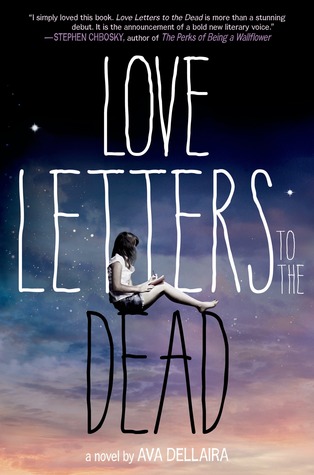
Love Letters to the Dead

In Love Letters to the Dead, main character Laurel starts high school six months after the death of her sister May, and is still deeply grieving her loss. Wanting a fresh start away from sympathetic comments and intrusive stares, Laurel transfers to the school on the other side of town where she knows no one and no one knows her. Friendless and alone, she tries to figure out where, if at all, she fits in, while dealing with her loss and pain as she puzzles through the events leading to May’s death.

At the start of the school year, Laurel’s English teacher gives the class a strange first assignment: Write a letter to someone who’s dead. Laurel doesn’t turn in the assignment, but she does write the letter — to Kurt Cobain — and then, finding it an outlet for her inner turmoil, she keeps writing. Letters follow letters, and Laurel fills up a notebook with letters to dead people: She writes not just to Kurt Cobain, but also to River Phoenix, Judy Garland, Janis Joplin, Amelia Earhart, and more.

Meanwhile, Laurel slowly finds her way, making two good friends, Hannah and Natalie, and attracting the eye of the cute boy she’s noticed. Sky is a junior, cool enough that everyone seems to like him, but not interested in being part of the popular crowd. Sky seems to be wounded in some way as well, and bit by bit the two are drawn together. But Laurel keeps the story of her loss to herself, and by keeping her pain separate, also keeps a big chunk of herself from the people who care about her. Meanwhile, her home life is silent and painful, as her mother has moved away, her father is withdrawn and depressed, and her aunt, with whom she lives part-time, is a lonely religious nut with a Mr. Ed obsession. Laurel blames herself for her family’s disintegration, but through the power of her new-found friendships and her self-expression via her letters to the dead, she finally starts to come to terms with what happened and to realize that in order to move forward, she has to let go of the past.

Love Letters to the Dead is almost unbearably sad. Laurel’s pain blazes off the page, and her self-loathing and blame are awful yet totally believable. As readers, we don’t know at first exactly what happened to May or how she died — but as the pieces come together, we come to realize that there are layers upon layers of contributing factors, and that while each family member blames him or herself in some way, the sad fact remains that May’s death was simply a terrible accident capping off a long period of unfortunate events.

Meanwhile, no one here gets by unscathed. The supporting characters also go through tremendous challenges and pain. Secret love, public shame, an abusive home life, mental health challenges, and simple neglect factor into the characters’ lives. They skip school, they drink, they make poor choices and take dangerous risks — so that the fact that they all emerge at the end of the year in relatively good shape, and better off than they started, is rather remarkable. Bad things happen — a lot — and while the characters are all interesting, well-drawn, and sympathetic, it does start to feel like an overdose of trauma after a while.

Laurel’s voice is interesting, as she wades through the jumbled mess of her thoughts and emotions and tries to make sense of all that has happened. It’s moving and melancholy to see her reflections on her relationship with May and how her worship of her big sister prevents her from facing the truth. Laurel adored her big sister all her life, and always thought of May as magical, with a perfect life, completely happy, enchanting everyone who came into her orbit. Over the course of the year covered in Love Letters to the Dead, Laurel confronts the truth about May’s life and challenges, how May’s actions led to tragic consequences for each of them, and comes to a place where she can remember May with love and regret, but freed from the need to idolize or over-glamorize her poor lost sister.

In many ways, this book succeeds in showing one girl’s transformative year, and the power of self-expression to free oneself from the walls created within. But at the same time, I did feel that the construct of the book is flawed, and takes away from the ring of authenticity for which the author seems to be striving.

Writing letters to famous dead people just doesn’t really work as an overarching concept. The portions of the letters addressed to the individuals don’t ring true,  and are actually a distraction from the character’s journey. Do we need to see her lecturing Kurt Cobain on what his suicide would have meant to his daughter? Or telling River Phoenix why she thinks his life turned out the way it did? For these two and several others, Laurel’s writing sounds presumptuous and like a stretch outside of what the character might do or say. Each time this happened, I felt pulled out of the narrative of Laurel’s story and reminded of the fact that I was reading about a fictional character, rather than continuing to be absorbed by the events and emotions of the book.

So my reaction to this book is truly 50/50: It’s powerful and sad, and conveys a great deal about loss and healing, friendship and honesty, pain and love. At the same time, the tone of the book is uneven, and ultimately a good and moving story is weighed down by the structure used to tell it.

_________________________________________

The details:

Title: Love Letters to the Dead
Author: Ava Dellaira
Publisher: Farrar, Straus and Giroux
Publication date: April 1, 2014
Length: 323 pages
Genre: Young adult
Source: Review copy courtesy of Farrar, Straus and Giroux via NetGalley

Blog Tour, Author Q&A, & Giveaway: The Summer I Wasn’t Me by Jessica Verdi

Thank you, Sourcebooks Fire, for inviting me to be a part of the blog tour celebrating the release of The Summer I Wasn’t Me!

(And psssst — don’t miss the link for the giveaway at the bottom of the page!)
summeriwasn't

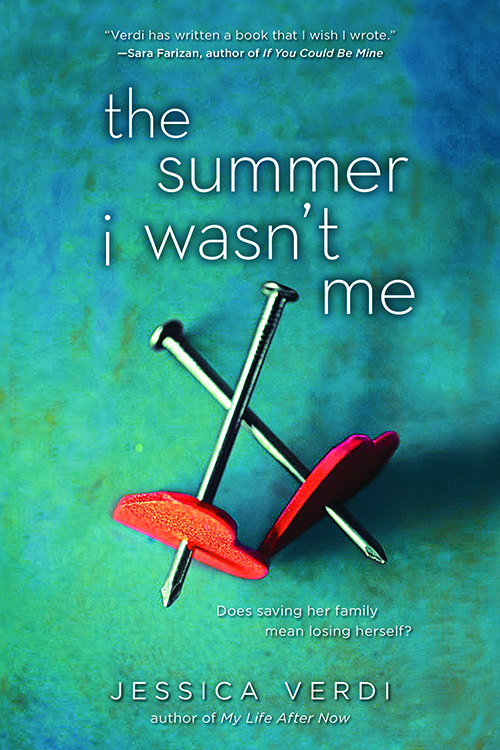
The Summer I Wasn’t Me
By Jessica Verdi
Sourcebooks Fire
Release date: April 1, 2014

Lexi has a secret…

Ever since her mom found out she was in love with a girl, seventeen-year-old Lexi’s afraid that what’s left of her family is going to fall apart for good.

You are on the road to truth. Help is on the way.

The road signs leading to New Horizons summer camp promise a new life for Lexi—she swears she can change. She can learn to like boys. But denying her feelings is harder than she thinks. And when she falls heads over heels for one of her fellow campers, Lexi will have to risk her mother’s approval for the one person who might love her no matter what.

I’m thrilled to be participating in the blog tour for this terrific young adult novel! Author Jessica Verdi was kind enough to answer my rambling questions for a Q&A:

What inspired you to write this particular story?

When I was toying with ideas for the topic of my second novel, this story really called out to me. I’ve always been fascinated by these so-called conversion camps, places where religious leaders claim they can turn gay kids straight. There is no doubt in my mind that they’re claiming to do the impossible, and that telling LGBTQ kids there’s something wrong with them is nothing short of abuse, but the root behind these camps actually, in a twisted way, stems from a good place. The parents who send their kids to these programs truly believe their children are on the wrong path in life and that they will go to hell if they don’t make a change. These parents are desperate to “save” their kids, in their own misguided way. This is something that has long intrigued me, and a world I knew I wanted to explore in the book.

But it all came together for me when, funnily enough, I was listening to Lady Gaga’s song “Hair.” The chorus of that song goes, “I just want to be myself and I want you to love me for who I am.” And I started thinking about all the kids who aren’t loved for who they are, and that made me so sad. And I knew I had to tell Lexi’s story.

How did you come up with the concept for New Horizons?

Sadly, New Horizons isn’t a concept I came up with on my own. These camps do exist, and have for quite some time. Every single “exercise” or “technique” they use in the book (the role playing, the Father Wound discussions, the gender teachings…) is a real method that came from my research. California and New Jersey have recently outlawed the use of reparative therapy on youths, but there are still 48 states (in our own country alone) to go.

What message would you hope your readers would take from this story?

On a very basic level, I hope Lexi’s story will help readers to know that they are perfect the way they are. And if someone is telling you otherwise (whether they’re criticizing your sexuality, your appearance, your disability, your hobbies and interests, or anything else) they’re the ones who have to take a long, hard look at themselves, and maybe start to make some new choices, not you.

A few about writing:

When did you first realize you wanted to be a writer?

It actually took me a little while before I knew I wanted to be a writer. When I was 27 (5 years ago) I got the idea for a novel. I was pursuing an acting career in New York at the time, and once I started putting the story in my head down on paper, it all clicked for me—this was the way I was really meant to be using my creativity. There’s something so personal and free about writing that you don’t get in acting. When you’re an actor, you have to audition for roles, you have to wait for someone to cast you in something in order for you to even get permission to start. But when you’re writing, you can still be creative, a storyteller, an entertainer, but you get to do it on your own terms.

How did you get started?

After I finished that first novel, I knew it wasn’t quite good enough and I needed to learn more, so I applied for graduate school. In 2010 I started the MFA program in Writing for Children at The New School, and by graduation in 2012 I had an agent and a book deal!

What advice would you give teens who are interested in writing?

Just do it. I think we all get better with each book we write, and the only way to really develop your skills is to just keep writing and writing. I was also once given a great piece of advice that I’ll pass on here: Finish what you start. You often don’t know what a story really is until you get to the end of the first draft and can step away from it, look at it, and see the pieces fall together. Then you go back and revise, and it almost always ends up working better (and usually much differently) than you could have imagined when you started. But you won’t really know until you get to the end, so keep going! If it’s a project you’re really interested in and excited about, don’t give up at page 40 when it gets hard. You might be giving up on something amazing.

And on a lighter note:

What book(s) influenced you the most as a teen?

I’ll never forget the first time I read Wicked by Gregory Maguire. I was in high school, and thought it was a masterpiece (I still do). The writing is stunning, the story is dark and political and raw, and I was so inspired by how Maguire was able to take something so concretely ingrained in the collective consciousness and turn it into something new, making us all question what we thought we knew about Oz all along. I think everyone should read this book—and no, seeing the musical won’t suffice. Sure, the songs are great, but the story has been so drastically altered it barely resembles the book.

Which part of the New Horizons dress code would you have the most trouble with?

Hahaha great question! Um, all of it? 🙂 I’m not a huge fan of pink, and nightgowns are just the worst. But most of all, I’d hate someone telling me what I have to wear. Uniforms, dress codes, black tie events… those things have never exactly gelled well with me. Like Lexi, I like having freedom in how I present myself to the world.

What’s your Monopoly strategy?

Play eagerly for ten minutes and then get super bored and wish someone would just win already so the game can end. Hahaha

Thank you, Jessica, for taking the time to answer my questions!

♦♦♦♦♦♦♦♦♦♦

My thoughts:

The Summer I Wasn’t Me takes a surprisingly nuanced approach to a topic that could easily have been handled in a judgmental or even scornful way.

After all, who here thinks a “degayifying” camp is a good idea? The thought of sending a bunch of teens to spend a summer “learning” to be straight, learning how to deny their own feelings and sublimate everything they want into a bizarrely old-fashioned view of “normal” is really abhorrent (well, certainly to me it is).

And yet, in The Summer I Wasn’t Me, it’s not that simple.

Main character Lexi has a very good reason for wanting to attend New Horizons. For her, it’s a last-ditch chance to reconnect with her mother and salvage what’s left of her family. After her father’s death, Lexi watched and suffered as her mother drowned in grief, and discovering that Lexi is gay has sent her over the edge. Misguided or not, Lexi firmly believes that if she can turn herself into the daughter her mother needs, they can be close again and rebuild their relationship.

But as we progress up the mountain, hints that this place is not quite as natural as it first seemed begin to emerge. The tree branches above us have been pruned back from the road. The narrow strip of grass that buffers the road from the tree line has been cropped. Flowers sprout in patterns too perfect to be accidental.

Someone has gone to a lot of trouble to manipulate the raw landscape into some preconceived idea of what nature should look like. Goosebumps trickle across the back of my neck as I realize that’s exactly what they’re going to do to me too.

Others have their own reasons for being at New Horizons as well. Carolyn came out to her family a while ago, and her parents are totally supportive — but after getting her heart not just broken but positively mauled by the girl she loved, Carolyn is convinced that if she allows herself to become involved only with boys, she’ll never risk getting hurt that way ever again. For Matthew, who is happily involved in a great relationship with a boy and completely comfortable in his own skin, attending New Horizons is part of an ultimatum from his father: Complete the program, or don’t bother coming home.

The camp program itself is awful, with its emphasis on traditional gender roles so over the top that girls are required to dress in pink and boys in blue. A camper’s gayness is attributed to the fact that her mother dresses in a “mannish” style and her father didn’t assert himself enough as the head of the household, resulting in the girl’s “confusion” about what men and women are supposed to be.

But as author Jessica Verdi shows, it’s too simplistic to laugh at the teens who come to New Horizons, either hoping to change their lives or being forced into going through the program. They all have wounds to heal, they all have something at stake, and they’re all trying to make the best of a bad situation.

I loved the view into Lexi’s psyche, as we see her struggles and come to understand why this girl from a small Southern town would feel the need to at least try to be straight — even while knowing deep-down that she’ll be lying to herself and everyone around her if she succeeds. Lexi is smart and caring, yearning for love yet also desperate to do whatever it takes to help her mother, even if it means completely denying herself.

The further we get into the book, the more we come to understand the characters, their needs, and how they ended up in this place. Even for those we might feel are misguided, it’s hard not to empathize and to feel indignant on their behalf.

The only discordant note for me in The Summer I Wasn’t Me is the introduction of a plot thread concerning corruption and sexual coercion among the camp administration. In my opinion, this just muddies the waters. While an interesting twist, it felt a bit tangential to the main point of the story. The emphasis of the book is on the teens participating in the program and what they get out of it — which may not have anything to do with what the program is designed to do. I felt that the point about the futility of the program and the needless humiliations it imposes is made strongly just by means of seeing how the summer is managed and the types of activities that the campers are required to engage in; it’s not necessary to have a sexual predator involved in order to show that the camp is a bad idea and does not have a chance of achieving its goals.

But that’s a minor quibble in a book that overall is spot-on in its message and absolutely full of heart.

I found The Summer I Wasn’t Me to be moving, well-constructed and nicely paced, with fully fleshed-out characters facing unique and varied challenges. I came to care for them all a great deal, and the subject matter is dealt with honestly and compassionately. I certainly recommend this book highly, for adult and teen readers, and hope that it will have great success in inspiring conversations and sensitivity amongst its readers. Most of all, I hope this fine book lands in the hands of a teen who really needs it, to see that life is full of options and that love and acceptance starts with loving and accepting oneself.


Giveaway time!

To enter the giveaway for a copy of The Summer I Wasn’t Me, click on the link below:

a Rafflecopter giveaway

____________________________________________

About the Author:

jessica verdiJessica Verdi lives in Brooklyn, NY, and received her MFA in Writing for Children from The New School. She loves seltzer, Tabasco sauce, TV, vegetarian soup, flip-flops, tattoos, and her dog. Jessica is also the author of My Life After Now.

Book Review: Grasshopper Jungle by Andrew Smith

Book Review: Grasshopper Jungle by Andrew Smith

Grasshopper JungleWell, this is certainly one of the oddest books I’ve read in a long time.

In Grasshopper Jungle, we meet 16-year-old Austin Szerba, who lives in Ealing, Iowa and is very much in love with his girlfriend Shann… and with his best friend Robby. Austin spends much of his time either confused or horny, or both. Ealing is a dead-end town that dried up after its major business, McKeon Industries, shut its doors and left most of the Ealing residents unemployed — as a result of which, stores have shut down, people are constantly being foreclosed or evicted, and the entire town has a feeling of hopelessness.

And then one day, things take a decided turn for the apocalyptic. In a weird confluence of events, Austin and Robby get beaten up, some nasty boys steal a McKeon Industries artifact that contains a lethal mold, and a chain of events starts that leads to the end of the world as we know it. This particular end of the world takes the form of 6-foot-tall praying mantises with exoskeletons strong as armor who only want to do two things…

It’s up to Austin, Shann, and Robby to save the world — or not, maybe. Or possibly just figure out what the heck is going on and salvage what they can. Oh, and also figure out what their own little triangle means, and whether anything good can possibly come of it. And yeah, maybe repopulate the planet, if necessary.

Along the way, we get Austin’s family history, all the way back to his great-great-many times great-grandfather in Poland, his descendants and their twisted history, and all the little turns of fate or coincidence that lead them to Ealing, Iowa and a plague of unstoppable, lethal, giant insects.

Austin is an historian, recording everything in his notebooks with a commitment to honesty, while at the same time noting that all written history is, of necessity, an abbreviation. No one can ever record every single thing, so what we end up learning is the bits and pieces that the recorders felt most important, but not necessarily the entire truth.

In Austin’s version of history, we read about Presidents and testicles, agricultural experiments and cave paintings, the Rolling Stones and skateboards. We also learn about love and devotion, confusion and yearning, friendship and bravery, and how dangerous a crazy person with a science lab can be.

The writing is funny, random, and rather Vonnegut-like in places. Odd facts and figures are inserted here and there in Austin’s narrative, and he returns over and over again to repeat certain phrases and thoughts throughout the book. Chief among these:

It was not a good idea.

You know what I mean.

Nobody knew anything about it.

And then there’s the word used by Austin and Robby more than any other in the book, “uh”, followed by the closely related “um”, which are all-purpose responses appropriate for almost all occasions:

Shann squirmed in her seat. She said, “Uh. Am I wrong about something, or do you two boys actually know something more than I do about what he’s talking about?

I said, “Uh.”

Robby said, “Uh.”

Grasshopper Jungle is strange and hilarious, often disgusting, completely rambling, with odd flights of free association and bizarre facts, and a connect-the-dots feel to it that shows either that all life is connected and that the smallest moments may have huge meaning and consequences… or that everything is random and trivial, and that nothing we do matters in the long run. But not really — even in the midst of giant bugs destroying humankind and chowing down on everyone they encounter, there’s a sense of joyous celebration of life that keeps Grasshopper Jungle flying along despite the body parts and cataclysmic events.

Grasshopper Jungle is weird and wild, but utterly wonderful — in its own bug-infested, sex-obsessed, end-of-the-world way.

_________________________________________

The details:

Title: Grasshopper Jungle
Author: Andrew Smith
Publisher: Dutton Books
Publication date: February 11, 2014
Length: 388 pages
Genre: Young adult/science fiction
Source: Library

Blog Tour, Author Q&A, & Review: 16 Things I Thought Were True by Janet Gurtler

Thank you, Sourcebooks, for inviting me to be a part of the blog tour celebrating the release of 16 Things I Thought Were True!

16things

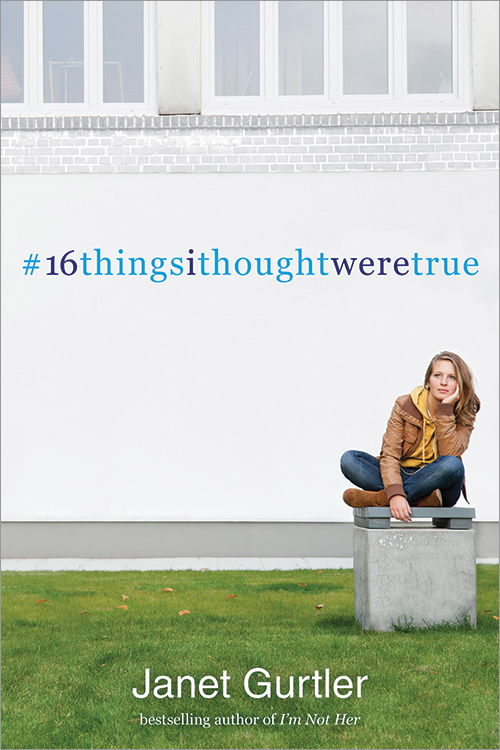
16 Things I Thought Were True
By Janet Gurtler
Sourcebooks Fire
Release date: March 4, 2014

Heart attacks happen to other people #thingsIthoughtweretrue
When Morgan’s mom gets sick, it’s hard not to panic. Without her mother, she would have no one—until she finds out the dad who walked out on her as a baby isn’t as far away as she thought…

Adam is a stuck-up, uptight jerk #thingsIthoughtweretrue
Now that they have a summer job together, Morgan’s getting to know the real Adam, and he’s actually pretty sweet…in a nerdy-hot kind of way. He even offers to go with her to find her dad. Road trip, anyone?

5000 Twitter followers are all the friends I need #thingsIthoughtweretrue
With Adam in the back seat, a hyper chatterbox named Amy behind the wheel, and plenty of Cheetos to fuel their trip, Morgan feels ready for anything. She’s not expecting a flat tire, a missed ferry, a fake girlfriend…and that these two people she barely knew before the summer started will become the people she can’t imagine living without.

I’m thrilled to be participating in the blog tour for this terrific young adult novel! Author Janet Gurtler was kind enough to play along for a brief Q&A:

Did you have an “Amy” in your life as a teen?

I didn’t really have an Amy in my life as a teen, but I met an Amy when I was traveling a while ago. She was this great kid, a teen girl, who had no filter and she was so adorable and cracked me up and I knew I had to fictionalize her.  Amy was really fun to write.

What can you tell us about your best friend from your teen years? How did you meet? What qualities made him/her so special?
Well, I moved in grade 7 and then again in grade 11 so I had a few different best friends. My best friend in high school was a girl named Rosalyn. We met at high school, but became close when we started working together (kind of like Amy and Morgan) We used to laugh. Oh how we could laugh. We were both kind of insecure dorky kids who wanted to be much more popular than we were. We had unrequited crushes on boys together too. I mostly loved her loyalty and the way we could gab for hours about anything. And the laughing!

Morgan spends so much of this book glued to her phone and tracking her Twitter followers. Do you think teens in earlier generations had anything equivalent? Did you?

Oh man, if I was a teen in today’s world I would have LOVED social media. I was really quite shy, though I tried hard to hide it and I think it’s much easier to be a little bolder online.  I don’t really feel like I had anything like that. I was a teen in the 80’s so that was before cell phones were even around!!!

What was your inspiration for 16 Things?
Mainly I wanted to tell the story of a girl who was finding more comfort from her online world than the real world.  I wanted to show how being overexposed online could send someone into hiding, and ironically one of the best places to hide….is online.

Did you always know you wanted to write? How did you get started?
I’ve loved writing since I was in the sixth grade. It’s always been my passion and the way I love to express myself.  I started writing books after my son was born. I’d always wanted to do that (write a book) and I did it while he napped. And then I was hooked. He’s 13 now!

What advice would you give to girls today who are interested in writing?

Keep writing! Read a lot and write a lot. Write stories, and journals and letters and whatever else you want to write. And the reading. That’s important too, because it teaches you what resonates with you and what you might feel best about writing.

What are you working on now? What will we see next from you?

I am currently writing my sixth Sourcebooks Fire book! It’s called THE TRUTH ABOUT US. It’s more of a YA romance, about a girl and a boy she’s forbidden to be with. She comes from a family with money and is forced to work at a soup kitchen for the summer  (for her bad behavior) and he is a guest at the soup kitchen.  Of course, no one wants them to be together.

And just for fun: If you were going on a road trip and you were in charge of snacks, what are the must-haves?

Caramel popcorn. Diet coke. And chewing gum. And then we’re good to go!!!!

Thank you, Janet, for taking the time to answer my questions!

♦♦♦♦♦♦♦♦♦♦

My thoughts:

16 Things I Thought Were True is a funny, engaging young adult novel that throws in a wrenching twist toward the end that was a real punch in the guts for me. A book that starts out with a girl obsessing over her number of Twitter followers while cringing at the thought of the awful viral video her friend posted — of her dancing in her underwear — sounds pretty light and fluffy, doesn’t it?

As they say, don’t judge a book by its cover… or in this case, by its use of hashtags.

Morgan’s story seems straightforward: As her mother prepares for heart surgery, she finally reveals to Morgan the name of her biological father, whom Morgan believes to have abandoned her before she was even born. Meanwhile, Morgan is deeply embarrassed by her online notoriety, and faces social ostracism by the teens she works with at the amusement park over summer break. But two of her coworkers seem to see more in her than she does herself: Bubbly, quirky Amy, who talks non-stop and seems to never get embarrassed about anything, and nerdy cute Adam, a manager at work who’s the same age as Morgan… and who’s actually kinda hot once she takes a closer look.

With Amy and Adam pushing and pulling, Morgan puts into motion a plan to find her bio-dad and confront him for walking out on her all those years ago. Thus ensues an epic road trip, filled with junk food, a flat tire, whales, scary cows, and sweet old ladies who (inexplicably) are staying at the same hostel. Amy and Adam push Morgan to rethink the things she always believed, face and share some hard truths, open up a bit, and do the things she’s been afraid to do. Oh, and also? Maybe put down the phone once in a while, stop worrying about her number of followers, and dare to be the kind of person she wants to be in real life, not just with her anonymous internet friends.

Amy is probably the loveliest character I’ve encountered in fiction in quite some time. Her constantly chipper, no-filters personality seems potentially annoying at first, but you just can’t help falling in love with her bubbliness and her absolute commitment to embracing everything life throws in her path. Don’t we all wish we had a friend like Amy? She’s simply adorable. Adam ends up being quite a great guy as well, not just in terms of boyfriend-worthiness, but also as a decent person, a caring individual, and a devoted friend.

The ending seemed to come out of nowhere and totally caught me by surprise. Wow. I won’t say more about it, except that it’s powerful and unforgettable.

What I initially thought might be just a teen romp with cautionary warnings about living life online ends up being a story with a more serious message about true friendship, being honest with yourself and with others, and looking beyond the surface to find the real value of the people in your life. I truly enjoyed Morgan’s journey throughout 16 Things I Thought Were True, and look forward to reading more by this author.

____________________________________________

About the Author:

jgurtlerJanet Gurtler lives in Calgary Alberta, near the Canadian Rockies, with her husband and son and a chubby Chihuahua named Bruce. She does not live in an Igloo or play hockey, but she does love maple syrup and says “eh” a lot. (From the author’s website: http://www.janet-gurtler.com)

Book Review: See Jane Run by Hannah Jayne

Book Review: See Jane Run by Hannah Jayne

See Jane Run17-year-old Riley lives a comfortable life with her loving (although stiflingly overprotective) parents, until the day she accidentally discovers a birth certificate for a girl named Jane tucked away inside her own baby book — a baby book that seems to start when Riley is three years old. Riley and her best friend Shelby laugh it off at first, coming up with goofy, ridiculous explanations, but as weird coincidences and creepy occurrences start to pile up, Riley becomes more and more convinced that her parents are hiding a secret.

With the help of the school bad boy, J. D. (who is, of course, hot but misunderstood), Riley sets off to find out more about Jane O’Leary — but comes up blank. There are no records, and an Internet search comes up with no results. But someone seems to know that Riley is searching, and what started out as a puzzle takes on a much more sinister tone. Is Riley being watched? Are her parents lying? Are they even really her parents? Who can be trusted? With each clue, Riley’s seemingly safe world crumbles a bit more, until real danger intrudes and threatens not just Riley, but everyone she cares about.

See Jane Run in many ways feels like a throwback to the late 1980s/early 1990s. Adult readers who grew up in those years will instantly be reminded of Caroline B. Cooney’s A Face on the Milk Carton (which is referenced in promotional materials for See Jane Run), as well as Lois Duncan’s Don’t Look Behind You. As in both of these books, the main character in See Jane Run finds herself forced to confront questions about her own identity, where she belongs, and whether she can rely on her parents — either for safety or for the truth.

The clues in See Jane Run mount quickly, and it’s not too difficult to see where the story is going — or so we’re led to believe, until a last-minute twist changes the outcome and makes the ending both more surprising and more disturbing than we might have expected.

Riley herself is not all that inspiring a main character. She flips back and forth between taking an active approach and letting events wash over her, and she seems to be oddly inexperienced for a girl of 17. Her parents keep her isolated, but this doesn’t entirely make sense. They live in a remote new neighborhood that’s still under development, perhaps in an effort to avoid the prying eyes of neighbors — yet Riley attends public school, has a best friend, and goes about her life during the day, so she’s not exactly unknown either. Riley’s mother gives her an anti-anxiety pill each morning, but Riley isn’t allowed to see the bottle. But why? And why does she not think twice about this and all the other weirdness about her parents until the events in this book?

Then there’s the issue of J.D. He’s got a reputation as a juvenile delinquent, but Riley sees something special in him and he seems to really like Riley. Or is there something darker and creepier going on? As with many other YA novels, the Riley/J.D. plot thread feels somewhat like an obligatory attempt to squeeze a romance into a story that doesn’t really need one.

See Jane Run is a fast read, although the pacing is a bit uneven. Scenes of great excitement and danger move along well, but there are also chapters that feel like a slog through malls, diners, and endless car or train rides. Overall, the book held my interest, despite explanations that felt rushed and unsatisfying and a not-quite-convincing wrap-up.

I suppose you could write a whole essay on why teen girls are drawn to books about false identities and parents hiding the truth from their children. Is it the danger? The sense that parents can’t be trusted? Maybe it’s the need to remake oneself during the teen years that makes the idea of a secret other life so appealing. In any case, it seems that this type of story will always be intriguing to young adult readers, and See Jane Run fits nicely on the shelf with those earlier thrillers.

_________________________________________

The details:

Title: See Jane Run
Author: Hannah Jayne
Publisher: Sourcebooks Fire
Publication date: January 7, 2014
Length: 288 pages
Genre: Young adult contemporary
Source: Review copy courtesy of Sourcebooks Fire via NetGalley

Book Review: Heartbeat by Elizabeth Scott

Book Review: Heartbeat by Elizabeth Scott

Heartbeat

Grief and anger explode off the page in Heartbeat, a young adult novel that fairly sizzles with its main character’s rage. 17-year-old Emma is consumed by pain over the loss of her mother, who is brain-dead but being kept alive by machines for the sake of her unborn baby. Emma’s stepfather Dan brings Emma to the hospital each day to visit her mother, but Emma can barely control her hatred and resentment toward Dan and toward the baby. Once completely devoted to her studies and determined to be top of the class, Emma now goes through the motions and can’t be botheredwith schoolwork. Once happy and in a loving relationship with her kind stepfather, Emma now blames him for her mother’s death, and literally locks him out of her room and her life.

The sole link to her former happy life is Emma’s best friend Olivia, who provides her with daily chitchat and distraction. And then Emma meets Caleb, the only person at her school who’s anywhere near as messed up as she is, and Emma gradually learns that pain and grief come in all different forms — but so does love.

Heartbeat is painfully sad to read, and yet it’s also quite beautiful in many ways. In learning the depths of Emma’s loss, we see her memories of the time before, and just how happy a family full of love can be. By peeling back layer after layer of family memories and experiences, the author shows us how devastating all of this is for Emma — not just the loss of her mother, but the loss of the love and safety she she once felt in her home and with her family.

Emma’s rage is the flip side of that love and is the way that she channels the grief that overwhelms her. Emma’s memories of her relationship with her mother are lovely and wistful, and the suddenness and senselessness of her loss come across with a visceral impact. Emma will never get her mother back, but by the end of Heartbeat, she’s beginning to find glimmers of hope for a future that might still have meaning and even love in it.

Heartbeat shows us the anger of a someone who’s lost the person at the center of her life. I read Heartbeat with tears in my eyes — but despite the pain and loss, there’s an honesty and fierceness in the writing that makes this an important and emotionally compelling book. I recommend Heartbeat for anyone who appreciates young adult fiction that doesn’t shy away from difficult subjects. It is not an easy book to read, but it is strong and memorable, moving and definitely thought-provoking.

_________________________________________

The details:

Title: Heartbeat
Author: Elizabeth Scott
Publisher: Harlequin Teen
Publication date: January 28, 2014
Length: 304 pages
Genre: Young adult contemporary
Source: Review copy courtesy of Harlequin Teen via NetGalley

Book Review: How To Save A Life by Sara Zarr

Book Review: How To Save A Life by Sara Zarr

How to Save a LifeLove and loss, belonging and alienation — these weighty topics are the backbone of How To Save A Life, a moving but never oppressive young adult novel by talented author Sara Zarr.

Jill, a high school senior, is so choked by grief over her father’s death ten months prior that she’s practically consumed by the anger she carries with her. Having pushed all of her friends away and barely hanging onto her on-again, off-again boyfriend Dylan, Jill lives with her mother Robin in their lovely Denver home, struggling to make it through each day without having to confront her loss all over again. Meanwhile, Robin has so much love to give that she decides to adopt a baby — a spur of the moment decision that sends Jill around the bend.

Mandy is the pregnant 19-year-old, almost too naive for words, who comes into Robin and Jill’s lives, carrying a burden of secrets and lies and desperate need. Mandy’s life has been a horror, with a mother incapable of mothering, who has subjected Mandy to a string of her awful boyfriends and filled Mandy’s head with constant lectures on how to attract a man, how to catch a man, how to keep a man. Mandy insists on an open adoption — but no lawyers or social workers — and when Robin eagerly agrees, Mandy catches a train from Omaha to Denver and moves in with Robin and Jill.

As we see events unfold in alternating chapters narrated by Jill and Mandy, we are privy to each girl’s slightly skewed and unhealthy view of their worlds. Jill’s sad truth is that as much as she loves her mother, her father was the one she was closest to, the one who taught her everything, was her champion and idol, and she is only half of herself without him. Mandy has nothing, and as she settles into what is intended to be a temporary arrangement with Robin and Jill, she realizes that she’s never felt a sense of home before in her life, and realizes how very much she wants that — not just for her unborn baby, but for herself.

Jill is initially aghast at what she sees as a poorly thought-out, spontaneous decision by Robin, and she is hostile and suspicious around Mandy. But little by little, Jill and Mandy start to connect, and Jill realizes that maybe she can help Mandy as well as her mother, and who knows? maybe even herself.

The voices of the two girls are distinct and authentic, and although Mandy struck me as too odd to be real at first, it quickly becomes clear that there are reasons why she acts and thinks the way she does. Robin is wonderful and supportive — in fact, she may be slightly too ideal to be true, but that’s hardly important here. What matters is that the author gives each girl a strong foundation and believable character growth. Jill and Mandy bring much needed change to each others’ lives, and in a way force each other to snap out of their unhealthy or isolating behaviors and mindsets and start thinking about the future.

The narrative flows quickly, and we come to care deeply about all three of the women involved: Jill, Mandy, and Robin. There’s heartbreak and pain, but also tentative steps forward, the easing of sorrow, and the creation of new lines of connection and belonging.

I found How To Save A Life moving and engaging, emotionally rich yet not without moments of humor and fun as well. I read Sara Zarr’s recently published Roomies (written with coauthor Tara Altebrando) last month, and loved it as well. Based on these two wonderful novels, I’m eager to read more by this author as soon as I can.

_________________________________________

The details:

Title: How To Save A Life
Author: Sara Zarr
Publisher: Little, Brown and Company
Publication date: 2011
Genre: Young adult contemporary fiction
Source: Library

Book Review: Roomies by Sara Zarr & Tara Altebrando

Book Review: Roomies by Sara Zarr & Tara Altebrando

Roomies

Before I dig into my review of Roomies, a personal aside. And if you’re not interested in my rambling thoughts of yesteryear, jump ahead two paragraphs! Really, I won’t mind.

It seems like eons ago that I received my freshman roommate assignment from campus housing, way back when as I was graduating from high school and looking forward to the next chapter in my life. My roomie-to-be had a name that made me think of someone upbeat and friendly: Juliet, from somewhere in Pennsylvania. We exchanged brief letters (I found out she preferred to go by Julie), and it seemed like we’d hit it off, or at the very least, like each other enough to live together successfully.

But then, a few weeks later, another letter: Julie and her friend from home had decided to live together after all. Bummer. I was then assigned a new roommate, Joanne from Brooklyn, daughter of a cardiologist, who spent most of her initial letter to me telling me all about her boyfriend Henry (but call him Henri), who was gorgeous and a model. Uh oh. Alarm bells ringing. And for good reason: the term “roommate from hell” could have been coined especially for Joanne. I won’t bore you with the agony of a year’s worth of horrible incidents. And to add insult to injury, I later met my almost-roommate Julie in chemistry class, and she was sweet as could be. Meanwhile, the best thing I can say about Joanne is that she was so despicable that I spent almost zero time in my dorm room, which led to my becoming close with someone in the next dorm, who in turn introduced me to another of her friends… and those two became lifelong friends of mine. So, happy outcome, I suppose, but still… drama! Freshman year turmoil! Dorm dismay!

It’s been a long time since I thought about the saga of Julie and Joanne — but it all came back to me in vivid color as soon as I started reading Roomies.

In this delightful new young adult novel, two girls from opposite worlds meet through the magic of the UC Berkeley housing office. Over the course of the summer between high school and college, Elizabeth and Lauren get to know each other through emails, exchanging greetings tentatively at first and slowly building up trust and connection until they’re practically soulmates — but is it real? How much can you really get to know someone by way of a computer screen? How do you know what someone’s like if you’ve never met them, never even heard their voice?

From the outset, the girls seem too dissimilar to seem likely as friends. Elizabeth is a middle class girl from New Jersey, who loves the beach, loves gardening, has a boyfriend she’s not crazy about, and has lived alone with her mom ever since her dad came out and moved (stereotype of stereotypes) to San Francisco. Now EB, as she’s known to her friends, is left counting the days until she sets off on her big move cross-country, dealing with her unable-to-face-reality mom and wishing she weren’t so alone. Lauren, on the other hand, is never alone. Lauren has five younger siblings, all under the age of six, and this huge mess of a family lives in a cramped house in San Francisco, always tight on money, always chaotic. Lauren works two jobs and got a full scholarship to Berkeley to study biochem, and dreams of having quiet time to herself. She did not want a roommate at all, and is not best pleased to hear from EB (whom she thinks of as Ebb) with a “hi, roomie!” email.

Told in alternating chapters and with alternating voices, Roomies takes us along for the ride as Lauren and Elizabeth slowly open up to one another while dealing with the myriad of challenges, frustrations, joys, and sorrows of the eventful summer between high school and college. Both girls navigate a relationship with a hometown best friend, unsure of how that friendship will change or even if it will last. And both girls find romance when least expected, only further complicating the delicate and difficult business of saying good-bye to home and childhood and moving into the next phase of their lives.

The summer navigated in Roomies is wonderful in many ways, but each girl faces her own set of worries and doubts as the college days loom. Will she be able to stand on her own feet? Will the family left behind manage without her? How will she know she’s ready? And what if she’s not?

He leads me out the other side of the house, and there is something about his pulling me forward that feels so incredible. Because I wish that I were being guided a bit more through life, that I didn’t always feel as if I were drifting, like an untied balloon that someone didn’t even realize was slipping away.

The writing is terrific and genuine. I was completely convinced that I was getting to know two very different girls, and I appreciated how the authors made each voice unique and recognizable. Using the motif of first-person narration punctuated by emails, each chapter gives us a view into the girls’ inner lives and deepest thoughts. The email is a brilliant device for showing just how easy it is to misunderstand, and how imperfect a medium the written word can be. Throughout the summer, each girl misinterprets the emails of the other, so as they take baby steps forward in their relationship, a simple phrase or comment can start a chain reaction of anger or hurt. How could she say that? Why would she rub her happiness in my face? Why doesn’t she sympathize? Why is it all about her? Each girl writes with the best of intentions, but as the move-in date nears, their communication spirals out of control, with hurt layered upon hurt, until each is left to contemplate requesting a rooming reassignment before they even get to Berkeley.

Little details really work. While Lauren and Elizabeth each embark on a new and exciting romance, this isn’t a glossy, fake ultra-swoony story. Even in the midst of describing a romantic moment, we’re reminded that teen moments are often snuck into the most awkward of places:

I snuggle against Keyon, with the emergency brake in my lower ribs, and we’re quiet a long time.

Sweet? Yes. Kind of uncomfortable, too, and isn’t that how it usually works?

Lauren and Elizabeth each work through their personal baggage, their family issues, their expectations, their fears. They correspond, they fight, they reconcile, and by the end of the summer, it’s time. Time to leave home, time to figure out to to hold on while at the same time marching forward. There’s a lovely moment that really encapsulates the conflicting urges to stay where it’s comfortable and familiar and to rush forward into a new exciting chapter:

…[W]e go to a booth for tickets, queue up with some others, and then find two swings side by side, close enough where we can hold hands. I kick off my flip-flops and in a minute we’re spinning. We start slowly, going round and round, but I can feel it, somewhere deep in my gut, when some new force starts to propel us out into the sky. Mark and I hold hands as long as we can but then the force is too strong and he laughs and I scream and we have no choice but to let go.

Roomies succeeds on so many levels — as a story of the beginning of a friendship, a look at family and all the different types of bonds that can exist, and an exploration of that big step from childhood to adulthood. Anyone who has ever left home to embark on a new adventure will be able to relate to the mingled excitement and fear. I’d consider this a great book for young adults approaching their own journeys, as well as for adults who made that transition themselves, whether recently or far in the past — or even from the perspective of a parent trying to support their own children as they find their way.

For myself, reading Roomies made me think of my own semi-disastrous entry into my college life — and remember how even the worst of situations ultimately led to incredibly wonderful experiences. Seeing Lauren and Elizabeth and their messy, sometimes awful and sometimes spectacular journey, I wanted to tell them to just hang in there. It’s all a part of growing up, and as Roomies illustrates so well, endings and beginnings can both contain truly amazing moments.

_________________________________________

The details:

Title: Roomies
Author: Sara Zarr & Tara Altebrando
Publisher: Little, Brown Books for Young Readers
Publication date: To be released December 24, 2013
Genre: Young adult
Source: Review copy courtesy of Little, Brown via NetGalley

Book Review: Two Boys Kissing by David Levithan

Book Review: Two Boys Kissing by David Levithan

Two Boys KissingTo call Two Boys Kissing a young adult novel is to set limits on a book that truly transcends categories of genre and target demographics. You may as well describe Two Boys Kissing as poetry with a plot or a love song transcribed with paper and ink.

Two Boys Kissing is an ode to today’s generation of gay youth, narrated from beyond by a “Greek chorus” (as all the blurbs put it) composed of the voices of the generation of gay men lost to the plague years of the AIDS epidemic. Written throughout in the first-person plural voice, the narrative describes the hopes and fears of the people who came before — and expresses their love and good wishes for the youth of today.

The book is loosely constructed around the events that occur over the course of a weekend, as teens Harry and Craig decide to challenge the record for the world’s longest kiss. As these two boys attempt to kiss for 32 hours straight, with no breaks, no sitting down, no “propping” by any others, their friends gather round to cheer and support them — and bit by bit, they become a world-wide media sensation. Meanwhile, we also follow the story of five other boys who explore first love, family acceptance, fitting in and giving up, speaking up and knowing when to listen.

The writing here is lyrical and absolutely beautiful. I could open to pretty much any page and find a moving moment or a passage that just begs to be read out loud.

Sample #1:

We were once like you, only our world wasn’t like yours.

You have no idea how close to death you came. A generation or two earlier, you might be here with us.

We resent you. You astonish us.

Sample #2:

Around the world, screens light up. Around the world, words are flown through wires. Around the world, images are reduced to particles and, moments later, are perfectly reassembled. Around the world, people see these two boys kissing and find something there.

Sample #3:

Maybe this is why we like watching you so much. Everything is still new to you. We are long past the experience, although we witness new things all the time. But you. New is not just a fact. New can be an emotion.

I could go on and on, because everywhere in Two Boys Kissing are moments of beauty, perfect expressions of pain and loss, hope and love. This is a slim book, less than 200 pages, but every page has meaning and depth. There are no chapter breaks — it’s one long meditation and celebration, and as surprising and unconventional as it is, it truly works.

I believe that Two Boys Kissing will quickly become a very important book for teens. It confronts today’s climate head-on, provides a context for how we got to where we are today, and conveys it all with passion, compassion, and an unwillingness to back down or look away. I can easily see another and different audience for Two Boys Kissing as well — the older generation, gay and straight, that remembers the awful, early years of the AIDS epidemic and hears the voices of friends and loved ones, lost but never forgotten, in the words of the book’s chorus.

On top of all this, Two Boys Kissing tells a sweet and lovely story about a group of individuals. The named characters are finely drawn, with personalities and backstories that make them each unique and yet easily identifiable as real people going through real challenges.

You may read it for the events, for the love stories, for the heartbreak, for the elegance of the writing, or for the memories it evokes. Just read it.

__________________________________________

The details:

Title: Two Boys Kissing
Author: David Levithan
Publisher: Alfred A. Knopf
Publication date: 2013
Genre: Young Adult
Source: Library

Book Review: Tumble & Fall by Alexandra Coutts

Book Review: Tumble & Fall by Alexandra Coutts

Tumble & Fall

I was pleasantly surprised by this lovely young adult novel, given that the premise sounds like a sure recipe for a depressing, coming-of-the-apocalypse tale.

In Tumble & Fall, the world is heading toward disaster on a global scale. The mile-wide Persephone asteroid is on a collision course with planet Earth, and unless a last-ditch effort to blow it to smithereens is effective, Earth as we know it will be no more.

With a week to go until the asteroid hits, we witness events through the eyes of three teen narrators, all of whom spend what may be their final week on Earth on the island of Martha’s Vineyard. Sienna is newly released from a lengthy stay in mental-health home for teens after a desperate suicide attempt; Caden is edgy and sick of spending his life cleaning up after his alcoholic mother; Zan is mourning the loss of her boyfriend Leo in a tragic accident 10 months earlier. All three find themselves, in this final week, assessing their relationships, their families, and their own sense of purpose and self. As the clock winds down, they test themselves, test their limits, and figure out where they want to be — and by whose side — when the last moments come.

Here’s what the book is NOT about: Politics. Panic. Scientific intervention. Space missions. Global destruction. Building shelters. Selection of a chosen few to survive. In other words, this is not an apocalypse book along the lines of others we’ve seen before. While the basic premise immediately made me think of the two 1990s-era movies about death-by-asteroid, Deep Impact and Armageddon, there are no space cowboys and mad, so-crazy-it-just-might-work missions to (sound the trumpets, please!) SAVE PLANET EARTH!

Instead, Tumble & Fall is a strangely moving, introspective story about people and their connections. Some parts were funny, in a wry sort of way: All three of the characters, for different reasons, spend at least one night away from home without telling anyone, and while they worry about what their parents will think, there’s still a sense of “C’mon, the world is ending in a few days — drop the curfew!” Parents are forced to accept that they can’t protect their children; children are forced to acknowledge that parental love isn’t a one-way street. The characters on this island act out their love and commitment in so many ways — small acts of caring, coming home when they might feel like staying away, letting someone else be nurturing even when they themselves don’t need to be nurtured.

It’s hard to describe the sense of quiet doom lurking in the shadows. All of the characters know that there really isn’t any hope that the asteroid will miss. No one truly expects a miracle. As the clock winds down, the community gathers together, in sorrow and in love, because there really isn’t any other option. The end will come; it’s how they choose to spend the remaining time that matters.

Filled with lovely prose and vivid descriptions of the characters’ inner lives, this book moves at a fast pace and, once started, is really difficult to stop reading before the end. People who pick up Tumble & Fall expecting a big, flashy disaster book may be disappointed. But if you’re someone who appreciates reading about honest emotions, difficult choices, and people figuring out how to be when it really counts, then I strongly recommend Tumble & Fall.