
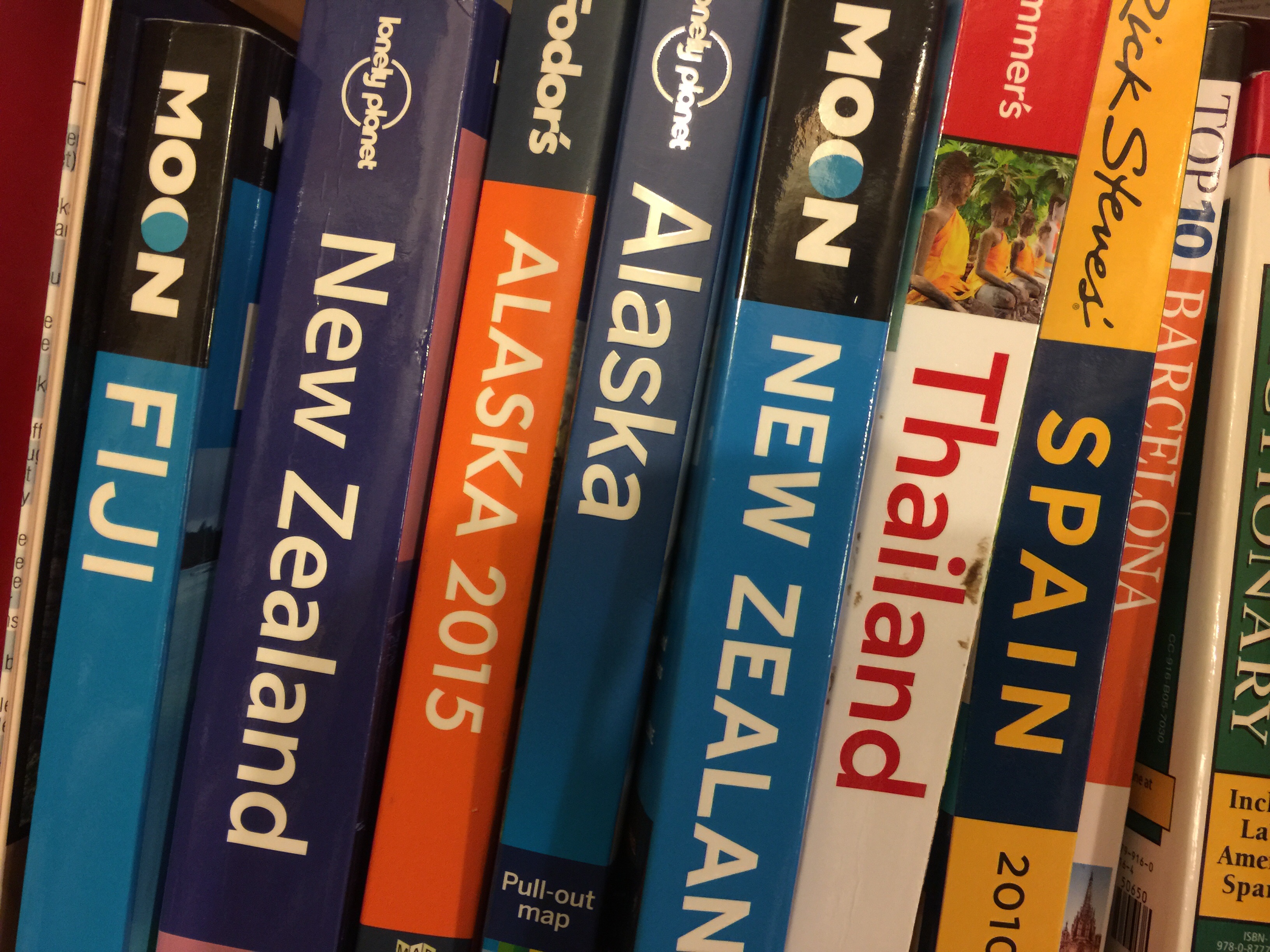
I seem to have done a lot of travel planning this year, between a mother-daughter trip to Alaska, a fun trip with kids to Orlando, and a grown-ups only trip (coming up next week!) to Canada with my hubby.
I still use travel books, but I wonder if they’re becoming relics of ye olden days.
Because on the one hand, anything and everything can be looked up online, right? For hotels, I usually got to TripAdvisor before anywhere else. Flights? Kayak. Cars? AAA, but I shop around. In terms of attractions, museums, sightseeing, etc, going straight to Google yields a ton of links. And then there are the travel publishers themselves, all of whom seem to have some sort of online version of their printed books.
So why do I bother scooping up travel books?
For starters, I like getting a picture of the scope of my travel plans. Online, I flit from one link to another, mostly by whim, ending up in random places for brief snippets of time. When I sit down with a travel guidebook, I slow down and take my time. I look at the maps to get an overview, and check out the table of contents to see what the major areas to consider are. I use my handy-dandy post-it flags to mark off anything that catches my eye, and then flip back and forth between maps and listings to see how much I can do in a day. My first time through, I’ll usually read the intro sections, which generally talk about peak experiences, best times to visit, and give sample itineraries. Once I have a general sense of what I think I want to do, then I go back and start getting more details on the must-sees and must-dos.
I tend not to go by the books for hotel and restaurants, although I do use their recommendations as a general guidepost for what areas of a city offer what type of accommodations, what neighborhoods to aim for depending on what type of trip it is, and to get a sense of what the overall feel of a given city or area is. (For actual bookings, it’s definitely time to use the various online travel booking sites — Booking.com has really been coming through for me lately!)
What books to use? To a certain extent, they all tend to cover the same ground. I mean, no one is going to publish a travel guide to Alaska and not devote a lot of pages to Denali. But different books have slightly different flavors. Of the ones I’ve used lately:
Frommer’s: I’ve found these a bit dull. Sure, they’ve got all the basics, but the few I’ve looked at recently haven’t been particularly eye-catching, and I didn’t find them fun to use.
Fodor’s: I’d been thinking of Fodors as pretty drab, but on my recent trip to Alaska, Fodors was the only book I could get before my trip that had a 2015 revised edition. I ended up liking it a lot. Lots of maps, color pictures throughout, interesting and well-written background pieces on history, native cultures, and nature, and well thought out features such as “Quintessential Alaska”, “If You Like”, and “Great Itineraries”. The planning sections were really helpful, and we found that their restaurant and lodging recommendations were very good choices that helped us narrow down our options quite well. Two thumbs up!
Lonely Planet: Most of the time, my favorite. If there’s a new-ish Lonely Planet available for a trip I’m planning, I’ll grab it. I like their sample itineraries, color maps, detailed guides to sights and itineraries, and overall find their attitude and suggestions very much in line with my style of travel. I like to go, try, see, and do — less emphasis on shopping and tourist crowds, more emphasis on being outdoors, trying local experiences, and exploring sites and neighborhoods to get a true feel of a destination.
Moon Guides: These are fun! They have a low-budget feel, being all black and white except for the intro pages, but they also have a slightly funky, adventurous tone that I like. Their guide to Yosemite was a real favorite, especially useful for figuring out which trails would be great experiences but also appropriate for the various family members in my group and their different preferences and abilities.
DK: I haven’t used these much, and tend to see them as too photo-heavy and too light on text, but I did really like their skinny little volume that I took on a trip to Barcelona (Top 10 Barcelona). The book is organized around top 10 lists, making it super easy to use and really helpful for planning, especially with a limited number of days.
Of course, there are reasons both for and against using travel guide books:
Pros:
- All in one resource
- Always accessible, even without a wifi connection
- Can be highlighted, dog-eared, and bookmarked to your heart’s content
- Usually organized in an easy to use way
- Handy sample itineraries
- Generally pretty easy to carry around
- I like the random factor: Flipping through the pages may happen to reveal a roadside stop or small-town attraction that you’d never hear of otherwise.
Cons:
- Another book to lug around
- Limited to the contents, versus the endless links online
- Still need online resources to make reservations, get directions, etc
- Travel books tend to be pricey
- Can become outdated quickly, especially for information like museum hours, prices, restaurants, and other variables that can change from year to year
There are work-arounds to some of the cons — for example, at my library’s big sale each year, there’s always a huge table full of used travel guides. If you don’t mind one that’s 5 – 10 years old, you can scoop ’em up for a dollar or two. Or for a free option, the library itself seems to have a huge selection. My library allows an initial check-out period of 3 weeks, so for short trips, that’s plenty of time to borrow a book, use it on the trip, and return it when I’m done.
For me, the books still win out over relying on electronic resources. Besides liking the tactile experiences of flipping pages, opening at random, and using bookmarks, there are a couple of other key factors. One crucial point in favor of physical books is the constant (and free) access — no need to worry about being near a wifi hub, or running up expensive data roaming charges when you’re traveling overseas. As a secondary notion, I think there’s a potential safety factor as well, although I haven’t really dealt with this much: Would you feel safer consulting a guidebook on a street corner in a foreign city, or pulling out your tablet or smartphone to look up information? It could make a big difference if you’re traveling in an area known for opportunistic pickpockets.
I’ll continue carrying travel books in my backpack as I roam the world… and I hope I’ll have many more opportunities to travel in all the years to come!
How about you? Do you use hard-copy travel books, or do you rely on Kindles or smartphones to guide you on your way? And if you like using travel books, do you have any particular favorites? Share your thoughts and recommendations, please!
 Bookshelf Fantasies