
Retail Therapy: Sun protection with style!

This is going to be a rare non-bookish post… because I just have to share a new find that I’m a little bit in love with.

Note: See discount code and purchase links at the bottom of this post!

This past week, I treated myself to this adorable hooded top from Farmers Defense:

This lightweight UV hoodie comes in men’s and women’s sizes, with a variety of colors. I couldn’t resist the monarch butterflies!

Their website has this description:

✔ UPF 50+ Sun Protection – Blocks 98% of harmful UV rays, keeping your skin safe from sun damage.
✔ Scratch & Rash Defense – Shields your arms from scrapes, thorns, and skin irritants while outdoors.
✔ Recycled Fabric – Made from REPREVE® eco-dynamic material, designed to wick away moisture and keep you cool.
✔ Sorbtek Catch-Move-Release Tech – The moisture control technology that actively wicks sweat and keeps your cool

How is it in reality? Short answer: Wonderful! I hate having to layer on sunscreen every time I step outdoors. This hoodie is comfy and light, not at all bulky, so it’s suitable even for warm days. I ordered a women’s XL, because I like my tops big and roomy, but I think a slimmer, tighter fit would be cute too.

Farmers Defense has lots of products geared toward garden enthusiasts, including gardening sleeves, aprons, gloves, and hats. I’m not a gardener myself, but I could see the sleeves and hats as being good choices for any sort of outdoor time where you want protection (and a bit of flowery flair).

Purchase info:

Want a discount? If you purchase through my affiliate link, you get a 10% discount!

Or, visit the site (Farmers Defense) and use my code (LISA11425) for 10% off your purchase.

Farmers Defense products are also available on Amazon.

Note: Links above are affiliate links. When you click through a link and make a purchase, I may earn a small commission at no cost to you.

Another option:

I’ve worn (and loved) items from REI’s Sahara Shade hoodie collection, which you can find here, with lots of color options and in men’s and women’s sizes. (I’ve found these occasionally on EBay/Poshmark as well!)

I’m looking forward to wearing my butterflies on lots of upcoming outdoor adventures! If you find something you like via Farmers Defense (or have other recommendations for tops with UV protection), please let me know!
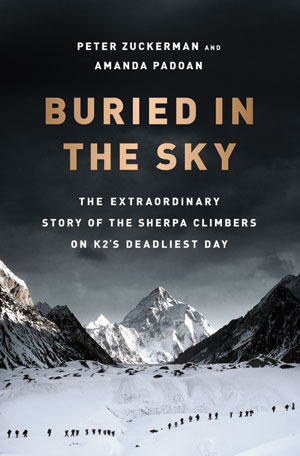
Book Review: Buried in the Sky by Peter Zuckerman and Amanda Padoan

Title: Buried in the Sky: The Extraordinary Story of the Sherpa Climbers on K2’s Deadliest Day
Author: Peter Zuckerman and Amanda Padoan
Publisher: W. W. Norton
Publication date: June 11, 2012
Length: 286 pages
Genre: Non-fiction
Source: Gift
Rating:

Rating: 3.5 out of 5.

When Edmund Hillary first conquered Mt. Everest, Sherpa Tenzing Norgay was at his side. Indeed, for as long as Westerners have been climbing the Himalaya, Sherpas have been the unsung heroes in the background. In August 2008, when eleven climbers lost their lives on K2, the world’s most dangerous peak, two Sherpas survived. They had emerged from poverty and political turmoil to become two of the most skillful mountaineers on earth. Based on unprecedented access and interviews, Buried in the Sky reveals their astonishing story for the first time.

Peter Zuckerman and Amanda Padoan explore the intersecting lives of Chhiring Dorje Sherpa and Pasang Lama, following them from their villages high in the Himalaya to the slums of Kathmandu, across the glaciers of Pakistan to K2 Base Camp. When disaster strikes in the Death Zone, Chhiring finds Pasang stranded on an ice wall, without an axe, waiting to die. The rescue that follows has become the stuff of mountaineering legend.

At once a gripping, white-knuckled adventure and a rich exploration of Sherpa customs and culture, Buried in the Sky re-creates one of the most dramatic catastrophes in alpine history from a fascinating new perspective.
 

Buried in the Sky: The Extraordinary Story of the Sherpa Climbers on K2’s Deadliest Day really is, well, an extraordinary story.

If you’re at all like me, the idea of climbing huge mountains seems utterly ridiculous. What drives people to need to reach the summit of these forbidding peaks, risking their lives and making enormous investment of time and money to do so?

Many mountaineering adventure books follow the climbers, their backgrounds, and their experiences. Buried in the Sky focuses instead on the Sherpas, the people who make other people’s climbs possible. The wealthy foreigners with their corporate sponsors and fancy equipment may get the spotlight, but what about the indigenous people who ascend on climb after climb, lugging gear, setting ropes, and enabling foreign climbers to pursue their dreams?

I learned so much from reading Buried in the Sky. “Sherpa” is commonly used as a word to describe the people who work on climbs and carry equipment, but the word Sherpa actually denotes an ethnicity. Among the people of Tibet, Nepal, and Pakistan, there is fierce competition and resentment among the different ethnic groups who seek the lucrative jobs that come with high altitude climbing support. 

The book clearly illustrates how attractive these jobs are, providing an income that exceeds by far anything the local villagers can expect to earn in their lifetimes, enabling the high altitude porters to support their families to such an extent that the extreme risks seems worthwhile.

The story of the 2008 K2 climb is harrowing, as we get to know the Sherpa climbers and their backstories, as well as the paying climbers who hire them. There are so many factors working against a successful climb. It’s really mind-boggling to me that anyone would even attempt this or see this type of climb as a goal, but hey, I’ve never claimed to be an outdoor adventurer!

I do wish the book had provided more details on K2 itself. While there are some photos of the sherpas and climbers from the expedition, there are only a handful of maps scattered throughout the book. Even though the focus of the books is on the sherpas and their lives, more information on the mountain itself would have been helpful. It was hard for me to fully visualize the various challenges and dangers of each step of the climb.

There seems almost to be an assumption of basic familiarity with K2 on the part of the authors, so I often felt that I was thrown in the middle and expected to understand.

This is a case where a book should perhaps have been longer. While Buried in the Sky is a relatively quick read, I feel it would have benefited by going more in-depth on the mountain itself and the climbing process.

Still, Buried in the Sky is a fascinating story, showing the mistakes and miscommunications that contributed to the 2008 disaster — and yet, even a perfectly executed climb could likely end in death. It’s a scary, interesting, engrossing read — I just wish there had been a bit more.