Art for book lovers

Just had to share this fabulous blog post from Tor.com, focusing on books in paintings. What an amazing collection!

Check out all the pretty, cool, surreal, and fantastical here.

Here are a few of my favorites:

Artist: Gerard Dubois

Artist: Paul Serusier

And finally… quite possibly my favorite of all…

Artist: Shaun Tan

Seriously, check out the full selection over at on the Tor website, which includes links to info on all of the artists.

Now I’m off to daydream about living in a house with all of these on the walls. Heaven!

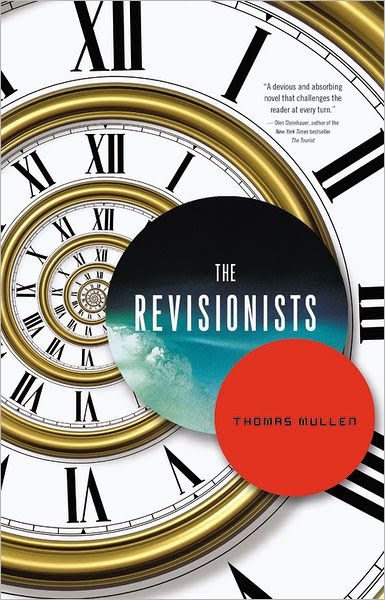
Book Review: The Revisionists by Thomas Mullen

Book Review: The Revisionists by Thomas Mullen

(Hardcover edition published September 2011; paperback due out in October 2012)

Maybe you could drive yourself crazy trying to chart backward all the causes and effects, all the ends and means, tracing everything to some original sin that may or may not have actually occurred but that people accepted as true, or true enough. Maybe staring into the eyes of all that history was a dangerous thing to do, as her mother had calmly warned her. Maybe you were supposed to move forward armed with just enough history to help you figure out the present without obsessing over the past. But how much was enough? Where was the gray area between ignorance and obsession?

The Revisionists was not at all what I’d expected, yet I couldn’t put it down.

I have a soft spot for all things time-travel, and the basic synopses I’d read of this book seemed to put it squarely into that genre: Main character Zed works for a post-disaster society at some point in time several centuries from now. In the “Perfect Present”, there is no war, no racial tension, no hate. Zed’s government agency works to keep the perfect present perfect, by sending agents into the past to thwart “hags” — historical agitators — whose mission is to stop disasters (think 9/11, concentration camps, etc) before they can happen, on the assumption that all these calamities were a necessary step in history in order for the perfect present to come to be.

Confusing? You bet.

And strangely, that’s not at all what this book is really about. Much more than anything else, I’d describe The Revisionists as an espionage-thriller set in DC, filled with intrigue, shadowy quasi-governmental intelligence outfits working against one another, multiple layers of pawns and spymasters, and a reality that slips and shifts from chapter to chapter.

This is not a sci-fi book, when you get right down to it. Zed’s mission is the driving narrative, yet we get no information whatsoever about the mechanics of his time travel and only the barest of descriptions of some futuristic technology. Without saying anything that might inadvertently be a spoiler, I will say that the entire time travel premise is not necessarily what it appears to be, depending on how you choose to interpret certain events and passages.

I was fascinated by this book, and it will probably take me some time to mull over all the twists and turns and come to terms with what may or may not have happened. I do recommend The Revisionists, although I worry that its perfect target audience — people who enjoy a good spy thriller — won’t ever discover it if it continues to be described as a time-travel novel.

My shelves runneth over (a bookish sort of survey)

My piles of books are having babies overnight, I swear. The stacks keep growing. My shelves are all double-layered, with a few extra paperbacks squeezed in on top of all the neat, orderly books. I have bags of books on my office floor, which will remain where they are until I get some more shelves or until the magic book fairy turns my living room into a Tardis-style library that’s bigger on the inside.

I do take books out of the library. I lend my books (reluctantly, and only after extracting severe promises to maintain my books’ pristine conditions). I sell the books I can live without back to my local friendly used book dealers — although I often walk away from these transactions with more used books to take back home with me. I give away the books I really don’t want any more, and sometimes the ones I’ve picked up but then never really felt like reading. And yet… my shelves runneth over, my house is filled to bursting with books, and I keep getting more.

So what’s a book lover to do? What do you do with your books after you’ve read them?

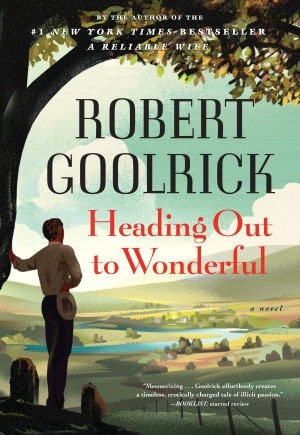
Book Review: Heading Out To Wonderful by Robert Goolrick

Book Review: Heading Out To Wonderful by Robert Goolrick


I’m struggling to figure out just what I want to say about Heading Out To Wonderful. The writing is lovely, and I became involved enough in the plot that I stayed up way past my bedtime to finish the book. On the other hand, I’m not sure that the whole is greater than the sum of its parts.

Heading Out To Wonderful is set in the sleepy rural town of Brownsburg, Virginia in 1948, post-war years when life in America was on the cusp of change. The author lovingly describes the quality of life in Brownsburg:

Brownsburg, Virginia, 1948, the kind of town that existed in the years right after the war, where the terrible American wanting hadn’t touched yet, where most people lived a simple life without yearning for things they couldn’t have…

And also:

A particular town, then, Brownsburg, in a particular time and place. The notion of being happy didn’t occur to most people, it just wasn’t something they thought about, and life treated them pretty well… the notion of being unhappy didn’t occur much either.

Into this small town arrives Charlie Beale, an attractive and pleasant man who appears in his truck one day, bringing nothing but two suitcases, one filled with butcher knives and one filled with cash. Charlie seeks out work with the local butcher, buys a plot of land out by the river, and settles in.

Charlie remains something of an enigma throughout the book. He is 39 years old, athletic and graceful, skilled with his hands and his knives. He served in Europe in the war, but doing what exactly, we never find out. The only clue we get about his wartime experiences is that his butcher knives are German; we can only speculate as to where or how he acquired them.

Charlie doesn’t speak about his childhood or background except in vague generalities. Where did all that cash come from? We don’t know. Charlie is full of yearning, for a place, for land, for connections, and for goodness. Somehow along the way, Charlie lost his sense of hope, and so he set out traveling, looking for “something wonderful”. His new friend and employer Will tries to reset Charlie’s expectations:

Let me tell you something, son. When you’re young, and you head out to wonderful, everything is fresh and bright as a brand-new penny, but before you get to wonderful you’re going to have to pass through all right. And when you get to all right, stop and take a good, long look, because that may be as far as you’re ever going to go. Brownsburg ain’t heaven, by any means. But it’s perfectly fine. It’s all right.

Charlie seems to have found “all right” in Brownsburg. He earns the friendship of the townspeople, and is the adored companion of Will’s young son Sam. Charlie might even have been content at last, until he meets Sylvan Glass, a 17-year-old “hillbilly” girl, bought and paid for by the richest man in town, now a trophy wife who dreams of glamour and Hollywood. What follows is a year-long affair which consumes Charlie and disrupts the lives of everyone in town. Reading about Charlie and Sylvan, we know that something disastrous has been set in motion; I could only wait to see what shape the disaster would ultimately take.

A sense of foreboding hangs over the story from the outset. It’s clear that nothing good can come out of the affair. By the time I reached the half-way mark in the book, it became very difficult to put down, and I had to keep reading to see which way it would go. To avoid spoilers, I won’t say anything about the book’s climax, other than to say that events unfold that are at the same time tragic yet not unexpected.

At the conclusion, I was disturbed by the lack of overall coherence. Many plot elements that are compelling are introduced, but I didn’t see the follow-through. The black and white communities live completely separate lives in Brownsburg. Both Charlie and Sylvan develop relationships that reach out across the color lines, yet I didn’t feel that this part of the story particularly went anywhere. Concepts of sin and salvation are introduced as Charlie struggles to fit into the spiritual life of the community, but again, I didn’t feel the points were carried through as the plot unfolded.

Ultimately, dramatic as the story is, Heading Out To Wonderful left me a bit puzzled at the end, wondering about the point of it all. Robert Goolrick is a terrific and thoughtful writer – I loved his previous novel, A Reliable Wife, with its dark secrets and twisty-turny plot developments. Unfortunately, despite the lovely prose, Heading Out To Wonderful doesn’t quite deliver.

I pre-ordered The Casual Vacancy. I’m just not sure I want to read it.

Let’s be honest, shall we? If you came across this description of a soon-to-be-released book, would you want to read it?

When Barry Fairweather dies unexpectedly in his early forties, the little town of Pagford is left in shock. Pagford is, seemingly, an English idyll, with a cobbled market square and an ancient abbey, but what lies behind the pretty façade is a town at war. Rich at war with poor, teenagers at war with their parents, wives at war with their husbands, teachers at war with their pupils…. Pagford is not what it first seems. And the empty seat left by Barry on the town’s council soon becomes the catalyst for the biggest war the town has yet seen. Who will triumph in an election fraught with passion, duplicity and unexpected revelations?

(book description lifted from the nice people at Amazon)

Sounds okay, but it wouldn’t rise to the top of my to-read pile (which I swear grows a few inches taller every time my back is turned, but that’s another story for another day). I tend toward the dark, the weird, the magical or mysterious, the slightly off-kilter in my must-reads. A story about small town politics? Well, maybe when I have nothing else to do… and when I’ve run out of Stephen King or Christopher Moore to fill in the slow moments.

BUT… and it’s a very big but (ha! I can hear my 9-year-old saying, “Mom! You just said ‘big butt’!”), this is no ordinary, run-of-the-mill tale of life in a charming English town. This is The Casual Vacancy, the debut adult novel by J.K. Rowling! Changes the picture a bit, doesn’t it?

According to Amazon’s stats as of today, The Casual Vacancy is currently #223 in their sales ranking, with still two months to go until its release date in late September. If this wasn’t a book by J. K. Rowling but rather by some unknown author, I’d imagine that the preorders on this would be non-existent. BUT (again with the big but…) this is the queen of bestsellers, the creator of Harry Potter! Who doesn’t want to read whatever she writes next?

I can only imagine the conversations between J. K. and her agent and her publisher. “Well done, you’ve finished the most successful book series in the history of the universe! What are you going to do next?” “Ummmm….”

I suppose it would have been easiest for J. K. to coast for a bit, write more tales set in the Potter ‘verse. C’mon, don’t we all want to know more about Neville? That Teddy Lupin seems like an interesting guy, right?

And too, she doesn’t actually have to do anything for the rest  of her life, and she’ll still be more or less a gazillionaire forever, thanks to Harry.

It takes a certain amount of courage to go off in a new direction, to say to her legions of fans, “Hey, I know you lot want more wizards and magic — but I’m over it. Moving on, here!” And no matter what she writes next, there’s certain to be an intense amount of scrutiny and incredibly high expectations. The schadenfreude crowd would love, I’m sure, to be able to say, “Oh, J. K. Rowling? One-trick pony. She has nothing else to say after Harry Potter.”

So, onward to The Casual Vacancy. I wonder — is this a story she was dying to tell? Did she have a sudden burst of inspiration, see whole new worlds opening up before her? Has she always wanted to explore small-town English politics?

Or, perhaps, is The Casual Vacancy just a first tentative step toward moving into a post-Harry Potter writing life? Get that first book out there, like throwing a bone to a hungry dog, let all the people salivating over her next work see that she’s capable of writing something outside the HP world. If The Casual Vacancy is released to big fanfare and the world reads it, shrugs its collective shoulders, and realizes that J. K. Rowling is a novelist who will be around for a while writing lots of different books, then maybe the pressure will be off.

Who knows, maybe it’s the next book after The Casual Vacancy that ‘s the one that she’s just dying to write, and The Casual Vacancy is just a test balloon to get us all to back off and ease up on the expectations.

As for me, I’m sure I will read it. I love Harry Potter, world without end, and I’m willing to give J. K. the benefit the doubt, even if it means reading a book about Muggles.

Although it would definitely be cool if a dementor or two showed up in Pagford.

♦♦♦♦♦♦♦♦

What about you? Are you planning to read The Casual Vacancy?

Women who run, and the readers who resent them

During my recent re-read of A Discovery of Witches, Deborah Harkness’s huge bestseller from 2011, I noticed something that hadn’t struck me as forcefully the first time around.

Man, that Diana Bishop runs a lot.

Oh, to be sure, there’s an explanation for why her fanatical running routines get such prominence in the story. Diana’s a spell-bound witch, you see, which means that she has a huge store of power inside her that she can’t access and use via magic. All that back-up  results in an excess of adrenaline, and to release it, Diana runs. Constantly. And rows. Up and down the river, in the fog, occasionally with her eyes closed, but you get the point. That woman MOVES.

Earlier this year, I read Ocean’s Touch, an erotic story by Denise Townsend centered on a lonely widow and the sexy selkie who reawakens her to the possibilities of life and love. (Yes, I said sexy selkie. Deal with it.)  Meredith is smart, sad, responsible… and she runs. A lot. Miles at a time.

And there’s more. It seems like every other book I read lately features a strong, sexy, intelligent woman with an intense, highly demanding fitness routine. A couple months back, I read the Mercy Thompson series by Patricia Briggs, in which the heroine is a car mechanic, a shape-shifter, and a highly trained expert in a specialized martial arts discipline.

Even in the supremely silly Austenland by Shannon Hale, the Darcy-obsessed main character is so stymied by her faux-Regency immersion vacation that she must sneak outside for an early morning run in the gardens, corset and all. (Lesson learned: Corsets are not appropriate activewear. Invest in yoga pants instead).

Leaving aside Austenland, whose lead character simply cannot be taken seriously, the running and exercise habits of fictional women seem to be a sort of short-hand to denote certain character traits: intensity, intelligence, fierce independence, determination to go it alone. In the first three examples I mentioned, Diana, Meredith and Mercy start their stories as talented women who are walled off from their passions. When I read about a woman who’s a serious runner or other type of athlete, I generally know what to expect — this is a woman to be reckoned with, and often someone with issues to work out.

And where does that leave all of us, we the readers? If you’re like me, a low-to-moderate achiever on the scale of devotion to fitness, it’s a bit tough to take sometimes. Not only is Diana Bishop a Yale professor and a powerful witch, but she runs ten miles a day! Not only can Mercy fix a VW with her eyes closed, she can also kick your butt! Thank you, dear authors, for yet another reason to feel inadequate.

Perhaps this factors into why I love Jane True so very much. Jane is the creation of Nicole Peeler, and is the hilarious heroine of Tempest Rising and four other books (so far). Jane reads, works in a bookstore, and her appetite for hot sex is matched only by her appetite for delicious food. (Okay, to be fair, Jane also swims in the ocean on a daily basis, but that’s just to recharge her magical mojo… too much to explain here, but in Jane’s case, the exercise is part of her magic, not just a piece of her perfect fitness regimen.) Besides the fact that end I up laughing out loud whenever I read these books, I think I love Jane because if I met her in real life, I wouldn’t be intimidated by her perfectly toned abs and her runner’s legs — I’d be too busy pouring the hot chocolate and cutting up some pie to go with.

A final glimpse of the world of Jane True, in which our heroine finds herself confronting some hard choices in a diner with her would-be lover:

I wanted them all, but I also knew I was being greedy. Then Anyan’s deep voice rumbled from next to me.

“Why don’t I get the three-sausages and mash with the special sausages, and you get the same thing with the traditional ones, and the vegetarian, and we can share?”

At his words, I nearly choked on my emotions. You’re perfect, I thought…

When worlds collide, part 2

What’s on my mind this week? The two book-ish happenings that really got me thinking in the past couple of days were:

  1. Finished reading Shadow of Night by Deborah Harkness
  2. Jumped up and down after hearing that Outlander might, just might, be made into a TV series or mini-series.

… which led me to this:

Outlander vs Shadow of Night — compare and contrast!

Teensy disclaimer: I’m not taking this too seriously, and neither should you. But just for fun, I started my own little list of the various ways SON made me think of OL. (Keep up with the acronyms, OK? We’re too busy here to keep typing out the full book titles.) I started meandering down this random path early on in SON, when I began chuckling over Diana’s soul-deep shock over discovering what being a woman in the 16th century really felt like. As a historian professor, she thought she was prepared, but boy, is there a difference between knowing information and living it!

Diana’s experiences made me think immediately of Claire Beauchamp Randall of Outlander, who was rudely thrust back in time and just had to deal with it, no warning, no preparation, no nothing.

With that in mind, here goes — a quick OL/SON primer (minor spoilers, so beware!):

Claire (Outlander)
Diana (Shadow of Night)
Degree MD PhD
Belongs in 1946 2009
Travels back in time About 200 years About 400 years
Anything fishy? Accused of being a witch Actually is a witch
Challenges Learning how to dress appropriately Ditto
Learning a woman’s place Ditto
Being criticized for speaking her mind Ditto
Treated with respect by those she meets? Relevant quote: “There seemed to be some question as whether the lady was or was not a whore.” Relevant quote: “I had no idea there was a brothel in Woodstock that specialized in over-tall women. Most of your whores are more delicate and appealing.”
Love interest Taller than average, remarkably good-looking Scot Taller than average, remarkably good-looking vampire
Lover’s talents Leader of men, warrior, has a gift for languages Leader of men, warrior, has a gift for languages
Lover’s connections Historical connections include Bonnie Prince Charlie, King Louis, Governor Tryon, and many more Historical connections include William Raleigh, Christopher Marlowe, Queen Elizabeth, and many more
Royal interest Bedded by Louis XV, King of France Pursued by Rudolf II of Prague, Holy Roman Emperor
Ability to time travel Genetic inheritance Genetic inheritance
Ease of time travel Painful and scary, but it can be done Difficult and requires great concentration, but it can be done
Scary witches? Geillis Duncan, murderous and crazy Satu, Peter Knox, and a host of others, murderous and fanatical
Must stand up to Colum MacKenzie, clan chieftain, a fearsome and exceedingly smart leader Phillipe de Clermont, patriarch, a fearsome and exceedingly smart leader
Endures time displacement in order to be with the love of her life? Anything for Jamie! Anything for Matthew!

There you have it in a nutshell, the trials and tribulations of Claire and Diana, two well-educated modern women who move through time, endure hardships galore and suffer countless fashion outrages, all in the name of love.

What did I miss? Add your thoughts!

PS – I seem to be formatting-challenged today. Don’t know why my cute little table has weird shading, and can’t make it go away. Yikes. Will try to be prettier next time.

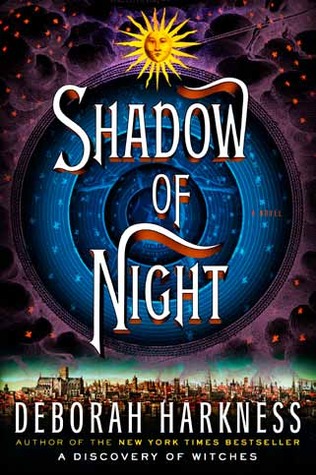
Book Review: Shadow of Night by Deborah Harkness

Shadow of NightShadow of Night is book #2 in Deborah Harkness’s All Soul’s Trilogy, which kicked off last year with bestseller A Discovery of Witches. At the time ADOW was published, I remember scads of reviews referring to it as “Twilight for grown-ups”, which is and isn’t a fair comparison.

True, ADOW has as its focal point a forbidden romance between a witch and a vampire… and we all know that LOVE + VAMPIRE = TWILIGHT, right? Calm down, I’m just kidding. ADOW is much more than a romance, and the intelligence and emotional truth at its core elevate it far above the standard, popular, seemingly endless supply of vampire fiction.

I loved the heck out of ADOW for its combination of smarts (Oxford professors! Secret manuscripts! Alchemy! Mitochondrial DNA!), supernatural beings (the aforementioned witch and vampire, plus their various and assorted family members, clans, secret societies, etc. Oh, and did I mention daemons?), and yes – be still my heart – passionate, forbidden love. Also, yoga, running, and rowing, for those who get hot and bothered by reading about exercise freaks.

ADOW ended with a plot point that left us hanging off the proverbial cliff, and Shadow of Night picks up the narrative mere moments after the conclusion of the first book. Witchy Diana Bishop and gorgeous vampire Matthew Clairmont have just timewalked back to Elizabethan England in the year 1590. Their goal is two-fold: to find a remedial witchcraft teacher for Diana, who never learned to use her talents, and to find the mysterious manuscript before the rest of the supernatural world gets to it.

First, bigger challenges await. Diana must learn to dress in awkward clothing, write with a quill, and speak with an accent that doesn’t scream “hello, I’m a time-traveler!” in order to fit in with the locals. And such locals! 1500-year-old Matthew has always been an important guy, and in the 1590s, he is a spy for Queen Elizabeth, a member of the powerful supernatural ruling body, the Congregation, and a member of the School of Night, a group of influential men which includes Sir Walter Raleigh, playwright Christopher Marlowe, and various other scholars and scientists of the time. A bit of a problem for me: I didn’t know who all of these historical figures actually were, so I had to sidetrack a bit in order to figure it out. Thank you, Wikipedia!

The plot moves from Oxford to London, France, and Prague. There are a ton of new characters introduced, some of whom matter more than others. How thoughtful of the publisher to give us a list of characters at the end – seriously, after a while I really needed it.

This is a dense, long book. At nearly 600 pages, there’s a lot to keep track of. I found it a bit slow-going for the first 75 – 100 pages, with too much time spent on Diana adjusting to life in 1590, and not enough emphasis on her relationship with Matthew. In addition, during the early sections, Diana and Matthew are surrounded by an entirely new cast of characters, and I thought the mood and urgency of the book suffered from the lack of the other people we’d come to care about in book one.

The pace definitely picks up once the couple travels to Sept-Tours in France, where Matthew reconnects with his family and he and Diana take the final steps toward formalizing and cementing their bonds. I was surprised by how moving I found this section. I won’t go into spoilers, but suffice it to say that Matthew’s reunion and reconciliation with one particular family member brought tears to my eyes.

Quibbles (there are always quibbles): Besides the enormous cast and the seemingly endless amount of period detail, there are two main items that bothered me about SON, and they’re significant plot points.

One, I still don’t fully buy the author’s concept of time travel. In these books, when Diana and Matthew step into the past, the 21st century version of Matthew essentially takes the place of the 16th century Matthew… so when they get to 1590, the Matthew who’d been there disappears (much to the consternation of his associates) and the new Matthew steps in, picking up his social life, his work connections, his obligations and his loyalties. When they leave, the old Matthew will presumably reappear and pick up where he left off, but can’t know what the new Matthew did during that time for fear of changing the future. Huh? Yeah, it all works, more or less, but I never really got on board with this presto-change-o business.

Secondly, the whole point of the timewalking was to find a teacher for Diana. They spend about two-thirds of the book searching for a witch to teach Diana how to be a witch (at a time when witch hunts are rampant, so this doesn’t necessarily sound like a smart plan, IMHO). When they finally find a witch mentor, however, I felt a bit short-changed; the story actually spends very little time on her lessons, so it felt to me that Diana made big leaps in her mastery of her powers without us seeing it happen.

Perhaps this makes it sound as though I didn’t care for the book, and that’s simply not the case. Let me make it clear: I loved Shadow of Night! I really couldn’t put it down, stayed up too late at night to read it, and even skipped TV nights so I could finish. (Now that’s devotion!). The author does a marvelous job with the love story, and I found Matthew and Diana’s trajectory through SON both captivating and electrifying. There are so many beautiful moments throughout the book, as well as moments of fear, tragedy, betrayal, and adventure. Ms. Harkness’s love of history shines through, and she clearly had a ball recreating life in Elizabeth’s England, from the clothing to the coins to the “latest” in scientific developments.

SON ends at a key turning point, and once I realized it was approaching, I found myself slowing down as I got nearer to the end of the book, not wanting to face the fact that this installment was done. I eagerly await the third and final book in the trilogy, and just hate not knowing THIS INSTANT how it all turns out. If you loved ADOW, then you simply have to read SON. And if you didn’t read ADOW, what are you waiting for? Read these books now!

Hello world!

So. Here I am. Doing what I’ve been threatening to do for years. Starting a blog.

Because the world needs another blog, right? Especially another blog about books — not nearly enough of those, am I right again?

Why Bookshelf Fantasies? Because I have been fantasizing about owning the bookshelves of my dreams for longer than I can say, and perhaps, just perhaps, it’ll happen in the near future. My house is filled to bursting with piles, bags, heaps, mountains, stacks of books. I buy them when I feel the impulse, when I stumble across a used copy of something I’ve always wanted, when a new book comes out that I just can’t wait to read… and they accumulate and accumulate, without end.

In my dreams, I have built-in, wall-to-wall, floor-to-ceiling shelves, and I spend countless hours arranging my books, changing my methodology to suit my latest inspiration. In reality? Still in bags and piles. And they keep coming.

The purpose of Bookshelf Fantasies is two-fold:

1) To chronicle my never-ending struggle to create order out of chaos. In other words, let’s get those damned shelves finally!

2) To chat about what I’m reading, what I’m excited about reading, and all topics book-related in general.

So, join me! Let me know what you’re reading and what’s up next.

As for me:

I’m about 200 pages into Shadow of Night by Deborah Harkness (sequel to A Discovery of Witches). A bit of a slow start, but now I’m hooked. I’ll be back with more to say once I’ve finished.

Up next: Talulla Rising by Glen Duncan.

Witches, vampires, and werewolves! It’s gonna be a good week.