Discussion: Should bloggers do research before posting book reviews?

A question came up for me this week: Should book bloggers do research before posting reviews?

What got me thinking about this topic was a comment I received on a book review I posted several weeks ago. I didn’t love the book, and explained why.

In the review, I stated that the book is apparently a stand-alone. A commenter informed me that they found my statement confusing, because the author had stated in interviews that this book was intended to have follow-ups involving some of the supporting characters. Additionally, I mentioned some elements of the setting and world-building that I found odd or muddled. The commenter again referred to author interviews, which explain why she chose to include some of the elements that I found out of place, and also mentioned that some of this was addressed in the author’s notes at the end of the book.

Note: Because I’d read the book via audiobook, I did not have access to the author’s notes — which is a pet peeve of mine when it comes to audiobooks, but that’s a topic for another day!

All this is fine. I appreciate hearing more information and getting other perspectives, and it was good to know that this author’s fans seem to enjoy the book more than I did.

What puzzles me, though, is the implication that I should have known these pieces of information prior to posting a review. This raises a few questions for me:

Do book bloggers have an obligation — to the author or to other readers — to track down answers to questions, Google facts about their books, check out author posts, etc before sharing a review, especially one that might not be 4- or 5-stars? Essentially, is it a reasonable expectation that bloggers do more than “just” read the book before posting a review?

In the case of this particular book, it was by an author I’d read before, but not recently. I thought it sounded interesting, so I grabbed the audiobook when it became available. This isn’t an author I follow on social media or elsewhere.

Before writing my review, I checked out the available information on Goodreads. There was no indication that this is part of a series. I looked at the book’s description on retail sites. Again, nothing to indicate that this is anything but a standalone. Without going out looking for more information, all I could go by was what was in front of me — and to me, that appeared to indicate that this book was a stand-alone.

Could I have learned more if I’d searched for interviews and profiles of the author, or checked out their social feeds? Sure. But should these additional steps be an obligation before writing a review? I think not.

My stance is that the reading experience should speak for itself. Sure, it’s fun to follow authors and dig deeper, especially when it comes to our favorites — to understand inspiration, to learn about what might be next, to get more details on the plot and characters, to get insight into intention, writing process, and more.

But also — that shouldn’t be necessary in order to share my feelings about a book. As a casual reviewer, I see my book reviews as expressions of my reactions and thoughts. I don’t pretend to be a journalist or a literary critic! I certainly don’t claim to have any expertise in regard to any particular book, beyond being an avid reader. In general, my reviews are simply my way of sharing my responses to books I’ve read. And with that approach, a deeper dive isn’t always needed.

What I like to focus on is how I felt while reading: Was I interested? Emotionally invested? Compelled to keep going? Or perhaps, confused or bored, or not blown away? Did the book itself make me want to know more about its subject or author? Or was I content to finish the book, whether I loved it or not, and then put it away?

Personally, I don’t feel obligated to look at media coverage or author reviews before posting a review. I share reviews to express my reactions to the books I read. Sometimes I’ll dig deeper or go looking for more information, especially if a book blows me away or sparks my interest in a new or unusual topic — but more often, I write my reviews based on the actual book content, and nothing else. This may not be everyone’s approach, but it works for me.

What do you think? Do you feel obligated to go beyond the book before writing a review? Why or why not?

Please share your thoughts!

Taking a break… see you in a week!

My husband and I leave tomorrow for a one-week getaway… looking forward to blue skies, white sand, and refreshing ocean breezes. Plus, you know, lots of time to site on the beach and read, preferably with a fruity, blended, icy drink in hand.

I don’t expect to be online much (or at all) while away, so this space will be pretty quiet until I return. I’ve scheduled a Top Ten Tuesday post for this week — it’s the fall TBR topic, and I always enjoy those — and if you happen to stop by to check out my post, please do share a link to your TBR post as well! I’ll look forward to catching up once I’m home.

Got my pre-trip mani, so I’m ready to go!

Meanwhile, I’m packing my bags, making sure I have sunscreen, and double-checking that my Kindle is fully loaded!

Wishing everyone a great week! See you soon!

Late summer clean-up: ARCs, subscriptions, and TBRs (oh, my!)

Image generated via Microsoft Copilot

It’s that time of year again… the point, close to the end of summer, when I look at all my reading plans and commitments, and feel entirely overwhelmed.

And so, I’m doing something about it.

I know we book bloggers and avid readers say this constantly — it’s so easy to get bogged down by ARCs and other reading obligations, and not make time for reading on a whim (which is my favorite way to read).

I’m not a huge fan of reading challenges, simply because I don’t like the pressure of structuring my reading around checking off prompts on a list. I know people LOVE reading challenges… but they’re generally just not for me, other than some very loose challenges around the number of books read in a year, or my current reading challenges on Storygraph (20th Century Decades Challenge and a challenge shared with my daughter focused on a bookish calendar we both own).

As for ARCs… it’s the eternal struggle! It’s wonderful to get early (free!) access to new and upcoming books, but they come with strings attached — namely, to read them and review them relatively near to their release dates. It’s easy to click that NetGalley request button every time some shiny new book catches our eyes… but then we need to find time to read them all!

I keep a spreadsheet of my ARCs, sorted by release date and with subtotals by month. (Yes, I’m an Excel nerd, and proud of it!) Despite trying to restrict my requests to no more than a few books per release month, somehow it’s all gotten away from me recently. So, I decided to take action.

I just went back to my NetGalley shelf, looked at all my upcoming ARCs, and put a cold, hard question to myself: How much do I really want to read each of these books? Are these books that would call to me if I were browsing in a library or bookstore? And, maybe most importantly, do I want to read these particular books more than all the other books already on my shelves?

I was able to identify about five books that didn’t feel all that important to me. Maybe something had caught my eye in the first place, but in going back through the list, I could honestly admit that I wouldn’t feel sorry to let them go. And that’s what I did: I went to the feedback page for each book, and clicked on the “I will not be giving feedback for this book” option. And lo and behold, the books are no longer on my active shelf. Instant sense of relief!

I’ve gotten myself down to 10 ARCs left for the remainder of 2025, plus 2 for 2026 releases… and that feels manageable. Of the ARCs I’m still planning to read, I can sincerely say that I’d read these books even if I didn’t have ARCs. And of course, if I start one and find it’s not grabbing me, I’m going to use that “not giving feedback” option. (Try it! It’s really freeing!)

Going forward, I plan to be much more restrictive with myself in terms of requesting ARCs. For certain authors and series, absolutely yes — but for new-to-me authors or books that look cute or fun or interesting but aren’t yet on my radar, I’m going to make my best effort to hold off on hitting the request button. If I still want to read a certain book by the time it’s released, well… there’s always the library!

I do hesitate a bit to acknowledge both cutting back and pruning my NetGalley shelf — does this mean I’ll be less likely to get approved for future ARCs that I really want? But you know what? That’s a risk I’m willing to take! Again… libraries!!

My other clean-up projects are a little simpler (I hope!). First, I get way too many book-related emails — I’m on so many lists about price deals and new releases and publisher spotlights, and I end up just deleting most of them anyway. (A lot of these can probably be traced back to entering giveaways… so hard to resist!). Anyway, one of my goals for these new few weeks is to get a little ruthless and click on the unsubscribe option as often as possible.

As for the TBR clean-up… well, this is a never-ending goal, but it’s nice to make a little dent. I tend to mark books as to-read on Goodreads every time a new title catches my eye, whether from reading a review or seeing an article about the author or stumbling across an interesting social media blurb. It needs to stop! My TBR on Goodreads is well and truly out of control, and I could probably stand to delete hundreds of books that I’m clearly never going to actually read! I started tinkering with this a bit over the weekend, and have gotten my Goodreads to-read shelf down from 856 books to 696 so far!

My physical shelves at home are another story, and I’ve been working on these all year. I started selling on Pango Books last year, and it’s helping me cull the books I don’t really need to keep. I haven’t done a tremendous amount in terms of actual sales, but even just listing the books is helping me separate out the ones I don’t need to keep and move them into storage bags. As a result, I’m able to free up some shelf space, which lets me make things a bit tidier and easier to enjoy.

This week, I’ve been adding more books to my Pango listings and dropping the prices on books that have been listed for a while, just to see if that helps move more books out of my house. Hint: If you’re new to Pango and use the discount code in my sidebar, you get a discount!

I’m also shuffling off a bunch of older, shabbier books that aren’t quite in sellable shape (or might be so old that no one would be interested), using them to restock my Little Free Library whenever the space empties out.

The goal, of course, is to improve my reading life! To me, that means free myself from reading obligations and deadlines, and basking in the luxury of reading whatever suits my mood in any given moment.

Here’s to reading on a whim!

Has anyone else considered getting off the ARC merry-go-round? How are you feeling about your reading commitments these days? And do you have any tried-and-true approaches for making sure you can read according to your whims? Please share your thoughts!
Affiliate programs: Worth the effort?

Affiliate programs: An affiliate program is a marketing arrangement where an individual or website (the “affiliate”) earns a commission by promoting another company’s products or services. The affiliate earns a percentage of each sale made through their unique affiliate link, effectively outsourcing sales efforts

Years ago, when I first started blogging regularly, I jumped at the idea of signing up for affiliate programs.

The general concept is this: You enroll or set up an an affiliate account with an online retailer, provide links to products on your blog (or whatever platform you use for sharing content), and when someone clicks through from your link and makes a purchase, you make a certain percentage of the price as a commission.

Ah yes, the illusive idea of actually earning a bit of money through blogging. Ha.

I enrolled in Amazon’s affiliate program, as well as Barnes & Noble, Bookshop.org, and (the dearly departed) Book Depository. Amazon dropped me because I failed to meet their quota, which was something like three purchases via affiliate links in the first three months. (I had zero). In all, I made a whopping $0.80 through my various affiliate accounts!

Woo hoo! Eighty cents! I’m rich!

After keeping the other non-Amazon programs going for a bit, I dropped the idea entirely and stopped including purchase links in my posts. But lately, I’ve been toying with the idea again. If people are stopping by my blog to check out my reviews or other book-related posts, and want to go from there to a purchasing site to buy one of the books I mentioned, why not try to get a teeny bit of a benefit out of it?

So, a couple of weeks ago, I signed up once again for the Amazon affiliate program, reactivated my Bookshop.org account as well, and have started including purchase links at the end of my book review posts.

I’m on the fence about it all. I don’t actually think I get enough traffic to make the links worthwhile, especially since most of the people I engage with are also book bloggers — so why would they use my links when they probably (maybe) have links through their own blogs?

And let’s be clear, I by no means consider myself (or would ever want to be) an influencer! I’m just a reader, who loves books, and likes to chat with other people who love books too.

My point in all of this is to put some questions out there to my fellow book bloggers:

  • Do you participate in any affiliate programs?
  • If so, which ones? Are there any you find especially worthwhile?
  • Have you actually earned anything through affiliate programs?
  • If you’re not in an affiliate program, have you considered it?

I’m interested in hearing about other people’s experiences, as I debate whether to bother with it all. I’m guessing that without a lot more effort than I’m willing or interested in investing, my connection to affiliate programs will go nowhere. I’m curious to hear whether anyone else has actually seen their links pay off in any sort of way.

The topic of monetizing blogging comes up quite a bit in the blogosphere, and in general, it’s never been of interest to me. As I’ve said in so many different contexts, I blog because it’s fun and I enjoy it. It’s not a job, it’s not an obligation, and I don’t expect to make a dime from it. This is why I’m so on the fence about affiliate programs: Sure, it’d be nice to get a few dollars back from time to time (which would go right back into buying more books), but I’ve never expected a financial payoff from blogging, so why start now?

So… affiliate programs: Yea or Nay? Please chime in and share your thoughts!

It’s a giveaway!

Guess what?

It’s a Saturday, just an ordinary weekend, nothing in particular to celebrate… except I feel like giving away some books!

I’m working on downsizing my stacks (and stacks and stacks) of books and getting my shelves in order. In addition to setting up a Pango store to try selling some of my used books, I thought I’d spread the joy around a bit by giving away some books too!

I have a stack of ARCs that have piled up over the years — some I’ve read, some not; some were Goodreads giveaway books, some came through other sources. In any case, I’m ready to part with them, and what could be better than passing them along to another reader?

Here are the books up for grabs:

  • The Light of the Midnight Stars by Rena Rossner
  • The Girl Explorers by Jayne Zanglein
  • Hench by Natalie Zina Walschots
  • Nona the Ninth by Tamsyn Muir
  • Darling Girls by Sally Hepworth
  • The Magician’s Daughter by H. G. Parry
  • Beyond That, the Sea by Laura Spence-Ash

The giveaway closed September 15, 2024.

One lucky winner will be chosen! The winner will have their choice of one of the books shown.

Restrictions: Open to US entries only. No overseas/international shipping available.

To enter, simply participate at the Rafflecopter link below!

Click here to enter!

Good luck, and thanks for playing!

Quick, get me a thesaurus! Or, playing word games with ChatGPT

On a whim, I asked ChatGPT to tell me what adjectives I use most often in my book reviews. And lo and behold, I got an answer within seconds.

Photo by Boys in Bristol Photography on Pexels.com

The initial response was this:

On the website Bookshelf Fantasies, some of the most frequently used adjectives in book reviews include:

  • Engaging: Reviews often describe books as engaging, highlighting the reader’s involvement and interest in the story.
  • Enjoyable: Books that were liked or appreciated are often described as enjoyable.
  • Great: This is commonly used to express high praise for the quality of the book or specific aspects like characters or plot.
  • Interesting: Often used to describe intriguing plots or unique story elements that capture the reader’s attention.
  • Memorable: Applied to characters or storylines that leave a lasting impression.

Then I expanded my request, and asked for the top 20 adjectives used, which yielded this response:

To determine the top 20 adjectives used in book reviews at Bookshelf Fantasies, I would need to analyze a large number of their posts in detail. However, I can provide a list based on the most common adjectives observed from the reviews I’ve analyzed so far:

  1. Engaging
  2. Enjoyable
  3. Great
  4. Interesting
  5. Memorable
  6. Gripping
  7. Fascinating
  8. Captivating
  9. Well-written
  10. Absorbing
  11. Intriguing
  12. Charming
  13. Exciting
  14. Thrilling
  15. Powerful
  16. Compelling
  17. Emotional
  18. Satisfying
  19. Thought-provoking
  20. Suspenseful

When I asked for the verbs I use most often in book reviews, the top few answers were not surprising:

  • Enjoy
  • Love
  • Like
  • Recommend

These don’t surprise me — I was already feeling like I use “enjoy” too often, although I haven’t come up with an alternative that works quite as well. Again, per ChatGPT…

Here are some thesaurus synonyms for the verb “enjoy”:

  1. Appreciate
  2. Relish
  3. Savor
  4. Delight in
  5. Revel in
  6. Take pleasure in
  7. Like
  8. Love
  9. Admire
  10. Fancy

These synonyms capture various nuances of the word “enjoy,” ranging from simply liking something to taking deep pleasure or satisfaction in it.

I can’t imagine using most of these… would I ever say that I “fancied” a book or “reveled in” a story?

Back to my adjectives…

“Enjoyable” pops up in the #2 position — I’m surprised to see that I use “engaging” even more. “Great” and “interesting” show up as numbers 3 and 4, and I don’t find that particularly “memorable” (#5).

“Great” feels especially mediocre to me, as far as language use goes. What am I trying to say when I describe something as “great”? There’s a lesson here for me, to be sure. I’d like to be more thoughtful about my descriptions. If something is “great”… well, why? What grabbed me? What made it special or noteworthy?

I have definitely not jumped on the ChatGPT bandwagon, and haven’t been a fan of the type of information I’ve received when I have played around with it. But for the purpose of looking at my word usage in recent posts, I have to admit that it’s pretty nifty! (“Nifty!” Now there’s a good alternative to “great”!)

Sure, I could pull a thesaurus off my (virtual) bookshelf. (I do still own a hardcover dictionary, but sadly, no physical editions of a thesaursus.) I could (and often do) turn to online thesaurus sites for help when I get stuck and need a good synonym.

I’m not committing to eliminating, or even just reducing, my use of the words on these lists, but it was an interesting exercise for me to see if some of what I believed about my recurring word usage was accurate. And as a takeaway, I’ll at least be more thoughtful in the future before describing something as “great”!

Photo by energepic.com on Pexels.com

Early, late, or right on time: When do you post your book reviews?

I finished a book I absolutely loved this week… and I think I’ll probably hold off for another four to six weeks or so before I share a review.

Why?

Because it’s a new release scheduled for publication in early September. And while, I’d normally want to share my rave review immediately (because who doesn’t love shouting about how amazing a book is?), it also got me thinking about the timing of reviews and what might be the best approach.

The general rule of thumb for sharing reviews based on ARCs seems to be to hold reviews until close to the release date. Based on NetGalley confirmation emails, most publishers seem to request not posting far in advance, and some state that reviews should be posted no more than two weeks (or at most, a month) before the publication date.

And yet, when I go on Goodreads, I see reviews posted months in advance of publication (which Goodreads allows, although retail sites like Amazon do not).

There’s something to be said for pre-release buzz, and authors I’ve followed have explained more than once that all preorders add to their release weeks stats. The higher the sales that week, the more likely it is that they’ll continue to be promoted, or even that a sequel might be greenlit. Given that, it would seem like early reviews (especially super positive ones) can only help a book. On the other hand, if someone is hyping a book three months before anyone can even get it, will that actually make an impact on sales? Sure, other bloggers/reviewiers may go request the book on NetGalley as a result — but while that boosts exposure, it doesn’t necessarily translate into people making purchases.

From the blogger/reviewer perspective, I get wanting to share thoughts while they’re fresh, and I suppose some readers/reviewers like the idea of being first, even if that means reviewing a book that the general reader audience won’t be able to access for many months.

For me, my target review window is right on time, occasionally a little early (a week or maybe two in advance), and (accepting that life is not perfect) late when it can’t be helped.

In general, I try to time my reviews right around the week a book is released, or possibly a week ahead of time. It mostly comes down to simple logistics for me — no matter how hard I try to keep my ARC commitments within reasonable limits, I still always find myself with a pretty hefty schedule to keep up with, and it usually just isn’t possible for me to get out ahead of the publication dates — even if I wanted to.

Another reason I prefer “just on time” reviews is wanting to be able to talk about a book. Read too far in advance and share a review, and no one will be available to discuss it with. Sure, it’s nice to get reactions along the lines of “sounds great!” or “hey, I’ll check it out”, but it’s even better to find other readers’ reviews, share ideas, and bounce reactions back and forth.

Beyond that, I suppose I just see it as courteous to follow publisher guidelines whenever possible. Receiving access to ARCs is a privilege, after all, so I think it’s reasonable to be expected to stick to the publishers’ preferences when posting reviews.

As for late reviews… well, I try, but life gets in the way! With ARCs, I always aim to post by the week that a book comes out, but sometimes it just doesn’t work. A late review is better than no review! I’m much more forgiving of myself than I was when I first starting blogging and reviewing. Bottom line, I read for myself and my own enjoyment first and foremost. ARCs can be wonderful to have, but they’re not the only books I read, and if I need to delay reading or reviewing a book because I’m busy with other things or other books I want to read… that’s okay too.

I found myself in the unusual situation this summer of not having a ton of ARCs in June, so I got through a few of my July books early, and even read one of my August books. For the August book, I was so happy to have read it that I lost sight of the release date and went ahead and posted a review right away. Only after it was posted did I stop and realize how early it was, but at that point, there were already comments posted, so I decided to leave it as is.

Which brings me back to the book I just finished — the 17th book in the October Daye series by Seanan McGuire… which just happens to be my very favorite fantasy series. I would absolutely love to share some thoughts, but it’s just too soon — the book will be released in early September. I know if I hadn’t read it already and stumbled across someone’s review of it, I’d be pretty peeved at this point.

Friends, the book is SO good! And what’s more, there’s another installment coming in October — a first in this series, to have two new books released just one month apart. Will I read #18 right away? You betcha.

But as for the reviews, I think I’m going to hold off. I mean, I’ll go ahead and draft the reviews while my thoughts and feelings are fresh… but I’ll wait to post until the release date is much, much closer.

How do you approach early reviews? Do you time reviews to release dates, or post reviews whenever you finish a book, regardless of dates? Do you have some other approach entirely?

I’d love to know what other people do when it comes to the timing of ARC reviews — especially when you love a book and you’re dying to talk about it.

Please share your thoughts!

Sexy, steamy, or downright raunchy — how do you rate THOSE scenes?

Has this happened to you?

You’re reading a pleasantly romantic book, eagerly turning pages, enjoying the building chemistry… and WHAM! Suddenly, you feel like you’re either in (a) an anatomy classroom or (b) the gynecologist’s office? So many body parts. So much fluid (ick). So many, many, many specifics.

Now, granted, tastes vary GREATLY by reader. The moaning and slipperiness that send me running for the hills are absolutely what other readers look for in their romance fiction. All tastes are valid! I’m body-positive, I swear!!

I just prefer my reading to leave certain things more to the imagination, ya know?

When I write reviews of romance fiction, I’ve struggled to find a clear way to let readers know what to expect. And that’s key for me actually — just tell me what to expect!! If I know a certain book has sex scenes that are way more graphic than I prefer, then I can decide for myself ahead of time if I want to read it. (And sometimes I will anyway, because the story or characters interest me enough to give it a try — but at least that way, I’m going into it fully aware of what I’m reading).

I did a bit of Googling, and haven’t found too many consistent approaches. Some of what I’ve found:

Open door/closed door: Pretty much what it sounds like. The door in question is the bedroom door, of course! Open door means the scene will show everything — the metaphorical door is wide open and we’re welcome to watch it all, in technicolor details. Closed door, on the other hand, means we may see some build-up, but once the action really kicks in, we’re left to imagine for ourselves what’s happening on the other side of the door.

Clean: When people talk about clean books, sometimes they’re talking about sex (i.e., nothing more than mild kissing at most), and sometimes the implication goes beyond that, to include everything from swearing to smoking to drinking. My spidey-senses tell me that readers looking for “clean” books often have a more religious standard in mind than I’m comfortable with, so this isn’t a descriptor I’d ever use on my own.

Movie ratings: I’ve seen some book reviews that use the MPAA rating systems as a guideline — G, PG, PG-13, R, NC-17. In some ways, that’s fairly clear and easy to understand… but as a tool for distinguishing between different ways sex is portrayed in fiction, I’m not sure it’s all that helpful. X-rated or NC-17 makes it sound like porn, which isn’t what I’m talking about.

A few other variations I’ve come across:

All About Romance’s sensuality rating system — ranging from N/A to Burning.

Book Cave’s rating system — All Ages, Mild, Mild+, Moderate, Moderate+, Adult, and Adult+. (Interesting, but their system factors in alcohol, violence, profanity, and horror, as well as sexual content, and that’s well beyond the scope of what I care about)

Here’s a raunch rating scale I found on Reddit, which seems pretty practical.

I’m still unsure.

But… I’m thinking something along these lines:

Sweet: Kissing, cuddling, clothes on. Think Hallmark movie dating scene — cute, innocent, lightly flirty.

Suggestive: The flirtation becomes more physical — make-out scenes, caresses, breathlessness, mostly clothed action, driving each other crazy. Getting hot, but not seriously heavy.

Steamy: Bedroom scenes, but from a more zoomed out perspective. We know enough to know what’s going on — actions, positions, interactions, clothing removal — but no camera lens up close and personal.

Graphic: The aforementioned anatomy class / gynecologist’s office scenario. Everything is shown. Lots of fluids, lots of sounds, lots of swollen… well, everything.

What do you think? What am I missing? Would have a ratings scale for these type of scenes be helpful to you as a reader?

As I’ve said, I’m not a prude, I think sex is a good and positive thing when it’s between enthusiastically consenting people, and I believe strongly that people should read whatever appeals to them. I fervently oppose censorship! And I think “smutty” books and erotica are perfectly valid forms of expression, and I support people’s right to read whatever appeals to them.

And yet… I know my own tastes when it comes to what I do and do not want to read — and at this stage in my life, I’d rather know ahead of time that that cute-looking romance I was about to pick up is actually on the graphic end of the scale, thank you very much.

Do you have a scale you use or have come across to describe this kind of content? Do you see a value in it?

I’d love to hear other opinions on this!!

Blogging: Any favorite WordPress themes?

I’m thinking about themes.

I’ve been using the same WordPress theme (Adelle) on my blog for several years now, and while I like it, I think my eyes are just getting a little tired of looking at it!

I’m thinking that it’s time to select a new theme, but it’s not as easy as I thought it would be. There are so many to choose from!

Here’s what I’m looking for:

  • A simple, clean layout
  • Being able to keep my header image without any words superimposed over them
  • Keeping the widgets in a right-hand column
  • A simple menu bar
  • No borders — I think it’s the black background on my current theme that bugging me right now, but when I experiment with making it white or a different color, I don’t like it. I’d like a format that’s the width of the page (if that makes sense — I’m not up on layout terminology!)

Here’s what I don’t want:

  • Excerpts with a “read more” link. I like to see full posts displayed on the home page.
  • Magazine style layout — an image grid on the home page that you have to click through to read the content.
  • Lots of fuss. No built-in images or graphics that can’t be changed.

WordPress used to display the theme name at the bottom of a blog’s home page, but I notice that’s not displayed any more, which is frustrating. When I visit other folks’ blogs, I’m always on the lookout for great layouts and themes!

So, for all you WordPress bloggers — any suggestions? Any particular themes you especially like? Do you know of any that might suit what I’m looking for?

I’ve spent a bunch of hours so far this week playing around with demos of different themes, but I’m just not finding anything (yet) that makes me happy.

Any recommendations would be much appreciated!

Oh my stars! Part 2 – Yes, I’m adding a ratings system.

Twinkle, twinkle little star. NOW I’ve decided to include you when I write book reviews…

Following up from my post last weekend, I think I’m going to give using a ratings system a whirl. Can’t hurt, right? Thank you to all who took the time to share thoughts and offer insights and encouragement — it’s been so helpful.

So…

I’m just quietly going to start using stars when I post book reviews. And if I like it, I’ll keep it going!

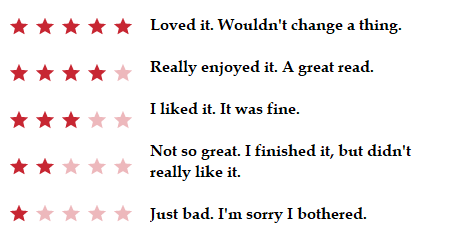
Here’s a quick look at what my ratings mean:

And now, off to put my stars into action! Let me know what you think!