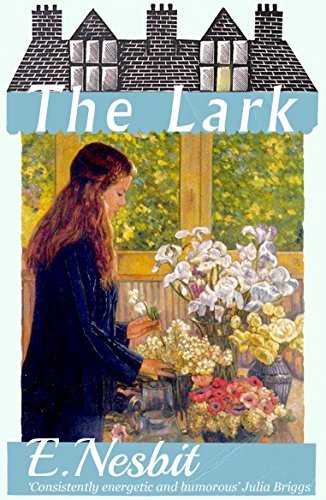
Title: The Lark
Author: E. Nesbit
Publisher: Dean Street Press
Publication date: 1922
Length: 269 pages
Genre: Fiction
Source: Purchased
Rating:
“Everything that’s happening to us—yes, everything—is to be regarded as a lark. See? This is my last word. This. Is. Going. To. Be. A. Lark.”
It’s 1919, and Jane Quested and her cousin Lucilla are pulled suddenly from school by their guardian, who sets them up in a cottage on the fringes of London and informs them (by letter, since he’s already fled) that he’s gambled away their inheritance but is leaving them the house and £500 to carry on with. Lucilla is disheartened, but Jane is certain it will be a lark.
With the help of a handsome man, a classic example of a “capable woman”, and a war veteran with a green thumb, the two unflappable young women set up a market garden, which develops into a guest house, which develops into—well, you’ll have to read and see. It’s true they have some difficulties as businesswomen, not to mention with housekeeping, but this is ultimately a tale fully living up to its title.
Forgotten for decades, despite Nesbit’s fame as a children’s author, her final novel for adults, first published in 1922, is a delight that’s ripe for rediscovery.
The audiobook synopsis (Audible):
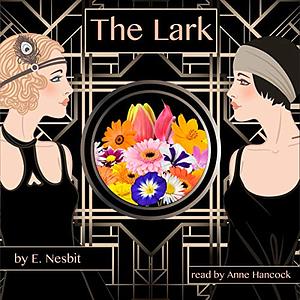
E. Nesbit (The Railway Children; Five Children and It) is best known for her children’s classics. In 1922, she published The Lark, a story for adults that writer Penelope Lively calls “[A] charming and brilliantly entertaining novel…shot through with the light-hearted Nesbit touch”.
Orphaned cousins Jane and Lucilla, both 19, receive the exciting news that their guardian is at last allowing them to leave boarding school. But their rosy future is thwarted when they find he has made some bad investments and fled, leaving them with a cottage in the English countryside and a modest bank account.
Finding a way to earn their living is daunting, but Jane insists that instead of worrying, they must regard their new situation as a lark: “When did two girls of our age have such a chance as we’ve got – to have a lark entirely on our own? No chaperone, no rules, no…” “No present income or future prospects,” said Lucilla.
The plucky girls begin by selling flowers, but when they deplete their own garden, they look for more opportunities. Good luck arrives along with a cast of characters who provide help and romantic possibilities, as well as new streams of income. But good fortune can’t last forever, and not all their new friends are as they seem….
Audiobook narrator: Anne Hancock
Audio length: 9 hours 15 minutes
I’ve heard of E. Nesbit, of course… but until now have never read any of her books — and while she’s best known for her children’s fiction, she also wrote several novels for adults. The Lark, published in 1922, is E. Nesbit’s final published book… and it’s a total delight. I came across The Lark while looking for a book to complete my 20th Century Decades Challenge. I ended up flipping back and forth between the audiobook and the print edition, and thoroughly enjoyed myself.
In a nutshell, The Lark is the story of two vivacious young women who seem to be smiled upon by good luck, even when things go wrong. Jane and Lucilla are orphaned teenage cousins attending boarding school, looked after financially by their guardian, who never particularly have to fret about anything. At ages 18 and 19, they’re summoned to London at the behest of their guardian, only to be informed that he’s lost all their money due to speculation gone wrong. He’s fleeing the country, but leaves them with the two asset remaining to them from their inheritance: A small country cottage, and the sum of 500 pounds. While the girls are delighted to find that they own a little house of their own, they must also face the harsh reality that the money won’t last forever.
Jane is the more carefree, optimistic of the two, while Lucilla seems more practical and even something of a downer. Jane’s happy outlook is irrepressible — she insists that they are, actually, quite lucky, and that what lies before them is a lark:
Life is a lark—all the parts of it, I mean, that are generally treated seriously: money, and worries about money, and not being sure what’s going to happen. Looked at rightly, all that’s an adventure, a lark. As long as you have enough to eat and to wear and a roof to sleep under, the whole thing’s a lark. Life is a lark for us, and we must treat it as such.
The girls immediately come up with the first in a series of schemes to support themselves. They start by selling flowers from their little cottage garden to the workmen passing by on the street. It’s a success… until they realize that they’ve already used up all of their flowers. Rather than looking for jobs, they decide that what they need is a bigger garden, and on their daily walks, discover an abandoned old mansion called Cedar Court, which has spectacular (if unkempt) gardens.
By way of all sorts of shenanigans, the girls first convince the absent property owner to allow them to use his garden and the adjacent garden room for their little business. Before long, he’s also decided to allow them to move into the mansion itself, at no charge, simply because they amuse him. But how to manage such a huge property and afford to keep it? The next scheme is to start talking in paying guests… and before long, Jane and Lucilla have a full staff, a house to run, a full-time gardener, and a variety of lodgers.
There’s an air of silliness and delight throughout The Lark, as Jane and Lucilla’s schemes go from one mad idea to another. Somehow, they always come out on top, even when their lodgers are not so honest, or when they get locked out in the middle of the night in the rain, or when they’re forced to invent an elderly aunt as a chaperone. There’s such a sweet heart to it all — the girls are genuinely delightful, their adventures are good-spirited, and even the love stories have a twinkling good humor to them (and remain nicely in the background, factoring into the story without becoming the most important thing about it).
Interestingly, a thread of sadness hides in plain sight too. Set in the years after the first World War, Jane and Lucilla meet a variety of people dealing with the lingering economic woes, displacements, and emotional traumas of the post-war era. As with the romantic subplots, these element don’t take over or overshadow the joy of the story — but the stories of the people they encounter add specificity to the time period and show the struggles that would have been very much a part of life at that time.
Overall, though, The Lark is… well… a lark! It’s a joyful, heartwarming story. There are plenty of reasons to laugh, delightful little set pieces, mishaps, and goofy encounters. Jane and Lucilla are a hoot — and while it initially seems as though Jane is the fun one and Lucilla is the wet blanket, we come to see more depth to both of them, and appreciate how clever and all-around terrific they both are.
I’m so glad to have discovered this gem of a book! I’ll be looking forward to reading more of the rediscovered classics from Dean Street Press, and would welcome suggestions regarding E. Nesbit books too!

Purchase links: Amazon – Audible audiobook – Bookshop.org
Disclaimer: When you make a purchase through one of these affiliate links, I may earn a small commission, at no additional cost to you.
 Bookshelf Fantasies
This sounds so fun. I’ve read several of Nesbit’s children’s books, but have never even heard of this one. But I think I need to read it. Jane and Lucilla do sound like two characters I would really like. 😀
I’m so glad I stumbled across this book. I think you’ll really like it!
This one is such a delight! I remember the ending feeling a bit odd (with the last minute love interest), but overall it’s just a fun, joyful read!
I get what you mean about the ending (especially suddenly finding out that they recognized each other from the scene at the beginning) — but it was all so charming that I didn’t mind a bit!
Yes, exactly! It was a bit strange, but I just went with it!
Sounds like a delightful read!
It really was! I’m so glad I picked it up.
An enjoyable find.
It really was!
I didn’t know E. Nesbit wrote anything other than children’s books! I’ve read all of those when I was a kid, so this sounds like a great find😁
I don’t know why I was never exposed to her books as a child! I suppose I could go back and read some now.
This sounds like a heartwarming story over all, kind of like a hallmark movie I guess but with a historical setting. Its nice to know that the romance is there but doesn’t take centre stage and that the after affects of the war are shown too without completely taking over. I have to admit this isn’t a classic that I’d heard of before. Although to be fair I did only start picking them up by choice last year.
It’s amazing to me that it was written over 100 years ago! It feels really fresh, and it’s quite funny and quirky. I’m so glad I read it!
This is such a lovely book. Glad you also loved it!
Thank you! It was such a treat!