Wishlist Wednesday

And now, for this week’s Wishlist Wednesday…

The concept is to post about one book from our wish lists that we can’t wait to read. Want to play? Here’s how:

  • Follow Pen to Paper as host of the meme.
  • Please consider adding the blog hop button to your blog somewhere, so others can find it easily and join in too! Help spread the word! The code will be at the bottom of the post under the linky.
  • Pick a book from your wishlist that you are dying to get to put on your shelves.
  • Do a post telling your readers about the book and why it’s on your wishlist.
  • Add your blog to the linky at the bottom of the post at Pen to Paper.
  • Put a link back to pen to paper (http://vogue-pentopaper.blogspot.com) somewhere in your post.
  • Visit the other blogs and enjoy!

My Wishlist Wednesday book is:

Dare Me by Megan Abbott

From Goodreads:

Addy Hanlon has always been Beth Cassidy’s best friend and trusted lieutenant. Beth calls the shots and Addy carries them out, a long-established order of things that has brought them to the pinnacle of their high-school careers. Now they’re seniors who rule the intensely competitive cheer squad, feared and followed by the other girls — until the young new coach arrives.

Cool and commanding, an emissary from the adult world just beyond their reach, Coach Colette French draws Addy and the other cheerleaders into her life. Only Beth, unsettled by the new regime, remains outside Coach’s golden circle, waging a subtle but vicious campaign to regain her position as “top girl” — both with the team and with Addy herself.

Then a suicide focuses a police investigation on Coach and her squad. After the first wave of shock and grief, Addy tries to uncover the truth behind the death — and learns that the boundary between loyalty and love can be dangerous terrain.

The raw passions of girlhood are brought to life in this taut, unflinching exploration of friendship, ambition, and power. Award-winning novelist Megan Abbott, writing with what Tom Perrotta has hailed as “total authority and an almost desperate intensity,” provides a harrowing glimpse into the dark heart of the all-American girl.

Why do I want to read this?

Cheer squads and high school power trips are not normally my thing. However, Dare Me has gotten exceptionally positive reviews. As the New York Times reviewer wrote:

Sounds terrible, right? But don’t let Abbott fool you. “Dare Me,” her sixth novel, is subversive stuff. It’s “Heathers” meets “Fight Club” good. Abbott pulls it all off with a fresh, nervy voice, and a plot brimming with the jealousy and betrayal you’d expect from a bunch of teenage girls.

And from Entertainment Weekly:

Dare Me is billed by its publisher as a Fight Club for girls, but calling them ”girls” might be underestimating the binge-drinking, lunch-vomiting, social-climbing queen bees in this dark high school thriller. Megan Abbott’s young heroines are cheerleaders, but they’re really more like teenage gladiators.

I’m intrigued. Cheerleaders as gladiators, with a dash of Heathers? Excuse the cliché, but… bring it on.

Quick note to Wishlist Wednesday bloggers: Come on back to Bookshelf Fantasies for Flashback Friday! Join me in celebrating the older gems hidden away on our bookshelves. See the introductory post for more details, and come back this Friday to add your flashback favorites!

Breed: Lingering questions (spoilers!)

Yesterday, I posted my review of Breed by Chase Novak. On Goodreads, I gave Breed 3 out of 5 stars, largely because I felt there were a lot of extraneous characters and plot points that didn’t go anywhere.

I try not to read other people’s reviews until I’ve written my own, so that I don’t (voluntarily or involuntarily) second-guess my own reactions or opinions. So last night, after finishing my review, I looked up the New York Times review of Breed, where I learned this little nugget of information: Chase Novak (aka Scott Spencer) is planning a sequel, called Brood.

I’m of two minds about this. One, there was no indication in Breed that this was the first of two (or more?) novels. Therefore, I’d expected a book that wrapped up satisfyingly and didn’t leave me hanging. Granted, in many horror books (take Rosemary’s Baby for instance), part of the horror is the fact that not everything is resolved — maybe the immediate problem has been addressed, but — my gods! — what about the future? You really should feel at least a little creeped out at the end of a good horror novel.

On the other hand, knowing that Breed will have a sequel, I feel much better about some of the implied outcomes and the various loose ends. Hurray — it’s not sloppiness or intentional vagueness! We’ll find out more!

So, what do I want to know in a sequel to Breed? (Warning: here’s where the spoilers creep in!)

  • Alice and Adam — how soon will they start to change? What exactly happens to all these kids once they hit puberty?
  • Bernard — how does he matter to the story?
  • What’s the deal with the triplets’ birthmarks on their hands?
  • Is the horror here purely genetic? What was in those injections and vials?
  • Is there a supernatural element involved? The scenes in Slovenia feature place names that included the words “castle” and “dragon” — is this a hint that there is more going on that just a medical mystery? Eastern European nation, dragon imagery, big slavering dogs, crying nuns… anyone else thinking what I’m thinking?
  • Obvious question: Is there a cure? Dr. Kis couldn’t find one, but does that mean that it doesn’t exist?

For those of you who have read Breed: What else do you want to know? What plot points do you want to see addressed in the sequel? Any predictions as to where it’s all heading? Share your thoughts, please!

Book Review: Breed by Chase Novak

Book Review: Breed by Chase Novak

Talk about having nightmarish parents.

In Breed by Chase Novak, the pursuit of fertility literally turns people into monsters. Chase Novak is the pen name of author Scott Spencer (Endless Love, A Ship Made of Paper), who here turns his talents toward a truly yucky horror tale. Alex and Leslie Twisden are young, attractive, and very well-to-do. Alex is the scion of old, old money, with a home full of priceless belongings and a beautiful, engaging younger wife. Alex and Leslie have it all, except for the one element outside of their control: They can’t seem to make a baby. After three years of progressively invasive and expensive infertility treatments, all to no avail, Alex and Leslie are just about ready to call it quits when they stumble upon a hush-hush miracle treatment offered by a doctor in Slovenia. Before you can say “uh-oh”, they’re off to Ljubljana for a scary, painful procedure from a shady doctor, who proclaims:

We are turning a quiet glade in the forest into a teeming spot in the jungle. Life, life, everywhere life, wanting, taking, growing. We are going to turn you on. Up high. Like teenager and creature of the wild. Nothing will hold you back. Life! Life!

Back at their hotel for the one night they plan to stay in Slovenia, Leslie and Alex are indeed turned on, and wake the next morning to find their hotel room completely and utterly demolished and their bodies covered in scratches and bite marks. Sure enough, the treatment has worked, and Leslie embarks upon a pregnancy that is more than she bargained for, as both she and Alex experience disturbing and drastic changes to their bodies.

All that, and it’s only the first 40 pages of the book. Before long, Leslie has delivered, and we move into part II of the book, set 10 years later, as twins Adam and Alice struggle to find safety in a world in which their home is the most dangerous place of all. Each night, Adam and Alice are locked into their own rooms and then let out again in the morning. Their parents are inconsistently protective, allowing them no playdates or afterschool activities, walking them to and from school each day more as guards than nurturing parents. We learn pretty quickly what the twins know of their world: strange, wild noises come from their parents’ bedroom at night, the cellar is always locked, and it’s best not to get too attached to the random pets that come into their lives and then quickly disappear. Alex and Leslie no longer go to work, instead selling off Alex’s inherited wealth bit by bit and allowing their house itself to crumble into garbage-strewn, corrupted ruin.

Adam and Alice’s flight toward freedom triggers a calamitous collapse of their already shaky lives, and as they innocently involve others in their plight, the potential for violence explodes all around them. The adults in their lives are either feral savages or ineffectual benign beings who can’t quite manage to save themselves or the children from the awfulness that pursues them. Numerous sequences involve chase scenes all over Manhattan, as its streets teem with life both wildly dangerous and recklessly free. The action builds to a more or less inevitable end, as horrifying events grow one upon the other.

Ultimately, my feelings on this book are mixed. I am not a horror aficionado, and therefore can’t assess whether Breed is really a top-notch entry in the genre. From a fiction reader’s point of view, however, I can say that Breed has a lot going for it, although the ending felt a bit flat and predictable to me. As the action in the middle of the book escalates, I couldn’t look away, despite the unfailingly horrific and gross (really, there’s no other word for it) nature of the scenes. By the end, though, there weren’t very many surprises left, and I didn’t walk away from the book feeling that the early promise of the story had truly paid off.

Is this a cautionary tale about the vanity that can become enmeshed in the no-holds-barred quest for reproduction? Early in Breed, Leslie tells Alex that she’s ready to quit:

Alex, I want us to adopt. I’m sick of living this way. I’m tired of doctors, and diets, and I am most of all worried… I am worried about what this is doing to us. Our marriage. Our souls.

But Alex is insistent upon one last try:

All your kindness and intelligence and beauty — it would be a waste not to pass it along, not to keep it in the world. The gene pool cries out for it!

Of course, the irony is that by pursuing that one miracle cure, the gene pool itself is compromised, so that it’s left extremely questionable what in fact has been passed along to the next generation. It’s doubtful that the inheritance will have any resemblance to kindness, intelligence, or beauty. Clearly, Leslie was right to worry.


The Monday agenda

Not a lofty, ambitious to-be-read list consisting of 100+ book titles. Just a simple plan for the upcoming week — what I’m reading now, what I plan to read next, and what I’m hoping to squeeze in among the nooks and crannies.

Nothing like the home team playing in (AND SWEEPING) the World Series to seriously interfere with one’s reading agenda! (and I’m not normally a baseball fan at all… but ya gotta go with the flow). Back to the books! What’s on the agenda for this week?

From last week:

The Sparrow by Mary Doria Russell: I finished my re-read of this beautiful book. I don’t think I’ll ever get tired of it.

I finally got a chance to attack my pile of library books. First up: Breed by Chase Novak. A great choice for pre-Halloween reading — boy, is this a disturbing book!

Drums of Autumn by Diana Gabaldon (group re-read): Another couple of very good chapters.

And this week’s new agenda:

I should be done with Breed either today or tomorrow, assuming I can stomach it.

Next up: Gone Girl by Gillian Flynn. Finally! I’m hoping to get this one read before it’s due back at the library next weekend.

And after that? One of two young adult novels waiting for my attention: Either The Raven Boys by Maggie Stiefvater or Because It Is My Blood by Gabrielle Zevin.

My son and I have started a new kids’ book by Eva Ibbotson. So far, so good! He does tend to bail on books after a few chapters, so the fact that we’ve gotten about a third of the way through it already is a good sign.

Drums of Autumn by Diana Gabaldon: Chapters 60 and 61 this week, and it’s my turn to write chapter summaries for our group re-read. Must put on my thinking cap!

So many book, so little time…

That’s my agenda. What’s yours? Add your comments to share your bookish agenda for the week.

A quick giggle to start the week

And along the same lines:

A punch in the heart: Books that take your breath away

Do you ever feel physically drained after reading a book? Have you ever read a book so intense that you feel like you’ve been bruised and beaten? And I don’t necessarily mean that in a bad way: it’s just that I have such a visceral reaction to certain books that I end up feeling like I can barely draw a breath.

And yet, books that pack such a tremendous punch often end up being my favorites.

Take my reading experience of the past week. Knowing that I’d be attending a speaking event featuring author Mary Doria Russell, I decided to re-read her first novel The Sparrow. The Sparrow has been one of my best-loved books ever since I first encountered it. I first read The Sparrow in 2005, after picking it up in a used book store.  Why I originally decided to read it, I don’t know. I think I’d heard of the book before, but certainly it wasn’t one that had been recommended to me by anyone I knew. And yet, something about it drew me, and once I started reading, I couldn’t put it down. I’ve since read The Sparrow several times, on my own and with a book group, and each time, I find something new to love in it, some new ideas to mull over, some new emotional response to the moral dilemmas it presents.

I’m sure I annoyed my friends and family to an even higher degree than usual this week, as I kept finding passages to read aloud, or burst out with outrage or sorrow over something that had befallen one of the characters. It’s amusing, in a way, that I’d react so strongly to something I’ve read before. Clearly, the book holds no surprises for me at this point, and yet the joys and sorrows of the characters still affect me as if they were happening to real people whom I care about.

I want to protect Emilio Sandoz. I’d love to be friends with Anne Edwards and get invited to one of her fabulous dinner parties. I’d like to spend time with Sofia Mendes and get her to loosen up a bit — maybe having a woman friend would be healthy for her. I’d love to hang out with D. W. Yarbrough and get the benefit of his words of wisdom. I could go on and on, but you see the point. The Sparrow is not some huge, 1000+ page doorstop of a book, but within its pages, the author has created not only an entire fictional world, but a cast of characters whom I feel I know. And when bad things happen to them — and they do, as it’s made clear from the very first page — it hurts. On the other hand, when these characters encounter beauty and joy — and again, they do — I want to celebrate with them and share in the glory of the moment.

I suppose the reason I’m even sitting down to write this is to preserve in some way my  moments in the world contained within The Sparrow. I finished reading it late last night, and I just don’t feel quite ready to dive into something else and leave behind the mood and the emotions evoked by this book.

I know there have been a handful of other books in my reading life that have affected me as strongly (or nearly as strongly). What about you? What books have you read that have made a dent in your heart? What books ensnare your emotions and don’t let go? I find that while these type of books may be difficult to get through, they’re ultimately the ones that I love the best. Share your thoughts, please!

Flashback Friday: Braided Lives by Marge Piercy

It’s time, once again, for Flashback Friday…

Flashback Friday is a chance to dig deep in the darkest nooks of our bookshelves and pull out the good stuff from way back. As a reader, a blogger, and a consumer, I tend to focus on new, new, new… but what about the old favorites, the hidden gems? On Flashback Fridays, I want to hit the pause button for a moment and concentrate on older books that are deserving of attention.

My rules — since I’m making this up:

  1. Has to be something I’ve (you’ve) read myself (yourself) — oh, you know what I mean!
  2. Has to still be available, preferably still in print
  3. Must have been originally published 5 or more years ago

Other than that, the sky’s the limit! Join me, please, and let us all know: what are the books you’ve read that you always rave about? What books from your past do you wish EVERYONE would read? Pick something from five years ago, or go all the way back to the Canterbury Tales if you want. It’s Flashback Friday time!

My pick for this week’s Flashback Friday:

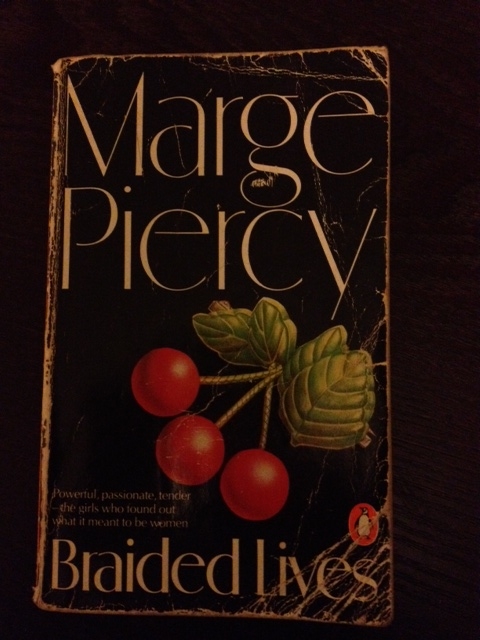
Braided Lives by Marge Piercy

(published 1982)

From Amazon:

Growing up in Detroit in the 1950s, and going to college when the first seeds of sexual freedom are being sown, Jill and Donna are coming of age in an exciting, turbulent time. Wry, independent Jill thrives in the new free-spirited world, while her beautiful cousin Donna desperately searches for a man to make her life whole. As each cousin is driven by different demons and desires, they eventually realize that they cannot overcome fundamental differences in each others’ lives. Still, as their futures assume contrary paths, Jill and Donna realize that they may be separated, but they’ll never be truly divided from one another.

It’s not too much of an exaggeration to call Braided Lives a life-changing book. I read it, way back when, when I was still a college student. (Yes, that’s a picture of my very own copy, which definitely looks its age.) I happened upon this book in a used-book store, at a time when I was first exploring issues around empowerment and feminism. Marge Piercy’s books were eye-opening, teaching me so much about female friendship, societal pressure in regard to gender roles, and the ongoing struggle for independence and equality. Braided Lives is a book with a message, but at the same time, it is a lovely, moving, at times heart-breaking portrait of love and friendship, and is a powerfully written piece of fiction.

I’d always wondered whether this book would hold up and still be relevant so many years later. My daughter, a recent college graduate, just read Braided Lives this past year, and was blown away by this tale of two young women’s friendship, the hard choices they have to make, and the different paths ahead of them. So that would be a resounding YES — Braided Lives is a book that still has a message for young women today, as well as anyone else who enjoys a good, sensitive, and touching story.

So, what’s your favorite blast from the past? Leave a tip for your fellow booklovers, and share the wealth. It’s time to dust off our old favorites and get them back into circulation! 

Note from your friendly Bookshelf Fantasies host: This is my baby-steps attempt at a blog hop! Join in, post a Friday Flashback on your blog, and share your link below. Don’t have a blog post to share? Then share your favorite oldie-but-goodie in the comments section. Let’s get this party started!


Wishlist Wednesday

And now, for this week’s Wishlist Wednesday…

The concept is to post about one book from our wish lists that we can’t wait to read. Want to play? Here’s how:

  • Follow Pen to Paper as host of the meme.
  • Please consider adding the blog hop button to your blog somewhere, so others can find it easily and join in too! Help spread the word! The code will be at the bottom of the post under the linky.
  • Pick a book from your wishlist that you are dying to get to put on your shelves.
  • Do a post telling your readers about the book and why it’s on your wishlist.
  • Add your blog to the linky at the bottom of the post at Pen to Paper.
  • Put a link back to pen to paper (http://vogue-pentopaper.blogspot.com) somewhere in your post.
  • Visit the other blogs and enjoy!

My Wishlist Wednesday book is:

Tempest Reborn by Nicole Peeler
(to be published May 2013)

Tempest Reborn is the sixth and final book in Nicole Peeler’s Jane True series… and if you’ve never encountered Jane True, you’re missing out on some sassy, sexy, supernatural fun. Because I’m a big believer in not spoiling anything if I can help it, rather than quote the blurb for Tempest Reborn, I’m quoting instead from the blurb about the first book in the series, Tempest Rising:

From the author’s website:

In the tiny village of Rockabill, Maine, Jane True—26-year-old bookstore clerk and secret night swimmer—has no idea that her absent mother’s legacy is entry into a world populated by the origins of human myths and legends.  It is a world where nothing can be taken for granted: vampires are not quite what we think; dogs sometimes surprise us; and whatever you do, never—ever—rub the genie’s lamp.   For Jane, everything kicks off when she comes across a murder victim during her nightly clandestine swim in the freezing winter ocean.  This grisly discovery leads to the revelation of why she has such freakish abilities in the water: her mother was a Selkie and Jane is only half human. With this knowledge, Jane soon finds herself mingling with supernatural creatures alternately terrifying, beautiful, and deadly—all adjectives that quite handily describe her new friend Ryu.  When Ryu is sent to Rockabill to investigate the murder, he and Jane fall hard for each other even as they plummet into a world of intrigue threatening to engulf both supernatural and human societies.  For someone is killing half-humans like Jane.   The question is, are the murders the work of one rogue individual or part of a greater plot to purge the world of Halflings?

I just love this series. Jane True is a bookworm (hurray!), who at the start of the series is somewhat of a town outcast and who has a past that she can’t quite make sense of. Over the course of the series, we see her come into her own as she learns about her magical heritage, develops her seriously strong powers, is welcomed into a society of supernatural beings that were there all along, and finds both love and purpose in her life.

But it’s not all action and adventure. The Jane True books are hysterically funny, while at the same time include elements touching, scary, and downright tragic. Bad things can and do happen to Jane and her friends. And yet, I find myself laughing out loud when I read these books. Nicole Peeler drops pop culture references galore, has a ready supply of snappy one-liners, and doesn’t skimp on the sexy times. Another reason to love Jane? This is a heroine who appreciates good food as much as she appreciates good sex — and believe me, both are very important to her! Jane is smart and funny, and it’s easy to root for her throughout these engaging, entertaining books.

The only negative about wishing for Tempest Reborn? Once I read it, I’ll be done with the series… and the Jane True books are just too much fun to come to an end.

Quick note to Wishlist Wednesday bloggers: Come on back to Bookshelf Fantasies for Flashback Friday! Join me in celebrating the older gems hidden away on our bookshelves. See the introductory post for more details, and come back this Friday to add your flashback favorites!

The Monday agenda

Not a lofty, ambitious to-be-read list consisting of 100+ book titles. Just a simple plan for the upcoming week — what I’m reading now, what I plan to read next, and what I’m hoping to squeeze in among the nooks and crannies.

Busy week ahead, so let’s dive right in. What’s on the agenda for this week?

From last week:

Quality over quantity, for sure! Real life (and by that, I mean the portion of my life that does not revolve around books) got in the way, big time, and it seemed that reading was relegated to the back burner — a most painful and frustrating situation for me. Here’s hoping that the coming week is a little less crazy. So, last week’s progress:

The Diviners by Libba Bray: Done! Loved it. My review is here.

And that’s really it. I caught up on a few weeks’ worth of the New York Times book review sections, but made no progress on any other books.

Drums of Autumn by Diana Gabaldon (group re-read): Moving forward, getting closer to the end.

And this week’s new agenda:

Due to a weird confluence of coincidences (did I just make that up? sounds weird), The Sparrow by Mary Doria Russell has been on my mind. My daughter just finished reading The Sparrow this past week, and was blown away. My husband, who relies on me for his book recommendations, is ready for something new, and I’m pushing The Sparrow on him. In addition, I’m going to hear Mary Doria Russell speak this week about The Sparrow! As a consequence of all this, I’ve decided to ignore my library stack and re-read The Sparrow myself. This is one of my very favorite books, which I’ve read once on my own and once as part of a book group. It’s been about five years, and I believe it’s time to treat myself to a re-read. I can’t say it enough times — if you’ve never read this book, what are you waiting for?

Assuming I finish up by mid-week, next on the agenda will be Breed by Chase Novak and then Gone Girl by Gillian Flynn. Sadly, I’ll be returning some books unread to the library this week, as there simply isn’t enough time for me to read them all before their due dates. Back on the request list they go!

My son and I finished up the book we were reading together (his review is here; my review is here) — looking forward to picking out some new bedtime reading material.

Drums of Autumn by Diana Gabaldon: Our online re-read is up to chapters 58 and 59 this week, and they’re good ones. My turn to write chapter summaries is next week. Gulp.

So many book, so little time…

That’s my agenda. What’s yours? Add your comments to share your bookish agenda for the week.

Book Review: Merits of Mischief by T. R. Burns

And now, for the mom’s perspective…

Book Review: Merits of Mischief: The Bad Apple by T. R. Burns

From Amazon:

The start of a mischievous new middle-grade series has trouble written all over it.Twelve-year-old Seamus Hinkle is a good kid with a perfect school record—until the day he accidentally kills his substitute teacher with an apple.

Seamus is immediately shipped off to a detention facility—only to discover that Kilter Academy is actually a school to mold future Troublemakers, where demerits are awarded as a prize for bad behavior and each student is tasked to pull various pranks on their teachers in order to excel. Initially determined to avoid any more mishaps, Seamus nonetheless inadvertently emerges as a uniquely skilled troublemaker. Together with new friends Lemon and Elinor, he rises to the top of his class while beginning to discover that Kilter Academy has some major secrets and surprises in store….

When reviewing kids’ books, I usually prefer to let my son do the talking. After all, what matters is whether he liked it, right? In the case of Merits of Mischief: The Bad Apple, I find that I have a thing or two to say myself. Consider this the point/counterpoint version of Q&A with the Kiddo, if you will. And now for my rebuttal:

SPOILER ALERT! While I usually make it my policy to avoid spoilers in my book reviews, I’m breaking my own rules for Merits of Mischief. I’m assuming that anyone reading this is an adult and won’t be bothered by learning how the book ends. If this isn’t true for you — look away now! You have been warned: I will be disclosing the ending of this book. END OF SPOILER ALERT.

I’ll be blunt. I did not like this book. I knew early on that I was going to have a problem with it, but my son was hooked and didn’t seem to be bothered by the moral issues that bothered me, so onward we went.

The main character, Seamus, is a well-behaved 12-year-old who attempts to break up a lunchroom fight by throwing an apple across the room. Unfortunately, the apple hits brand-new substitute teacher Ms. Parsippany in the head AND SHE DIES. Yup, chapter one ends with a dead teacher, killed by the book’s hero.

Seamus isn’t proud of himself:

I killed her.

Some people say it was an accident. They say I didn’t mean to do it, that I was just scared and tried to help. That may be true. But what’s also true is that Miss Parsippany, who’d been a substitute teacher for all of four hours and thirteen minutes, was alive in homeroom and dead by lunch.

Because of me.

A week later, Seamus’s parents are dropping him off at Kilter Academy, reputedly a severe scared-straight type of reform school for seriously troubled kids. The building is gray and imposing, ringed by barbed wire, and with a very menacing armed guard waiting to greet Seamus. But the second that his parents drive away, the guard reveals that her gun is a water pistol, sheds the ugly uniform to reveal stylish clothing, and shakes out her long, pretty hair. It’s Annika Kilter, sparkly director of the Kilter Academy, and nothing is as it seems.

Kilter, it turns out, is a school dedicated to encouraging promising young troublemakers to live up to their potential. The grey walls are merely a facade; behind the prison-like walls are high-tech dorms filled with endless sorts of entertainment, a cafeteria serving unlimited treats, beautiful gardens, and all sorts of trouble-making gadgets. The school store (the Kommissary) sells a variety of gear, including bows and arrows, a tar-and-feather kit, Hydra Bombs, and flame starters and extinguishers. Students earn Kommissary credits through a complicated system of points: misdeeds are rewarded with demerits, good deed earn you gold stars. The trick is, it’s the demerits that are desirable, and the bigger the difference between your number of demerits and gold stars, the more credits you get toward stocking up on the weaponry of your choice.

Seamus is naturally baffled at first, particularly when Annika greets him enthusiastically and proclaims herself delighted to welcome Kilter’s first murderer. Seamus is assigned to room with Lemon, an arsonist who starts fires in his sleep. Seamus and Lemon begin to bond after Seamus sticks by Lemon despite a series of middle-of-the-night dorm room fires, and eventually they form an alliance with other students as well. Despite making friends, Seamus feels that he must hide the reason for his entry into Kilter from all others, believing (rightly, as it turns out) that his friends would turn against him if they knew what he’d done.

Students are referred to as Troublemakers, and the goal is to advance in trouble-making skills. As part of their studies, students are expected to “get” each of their teachers by pranking them in a way that demonstrates knowledge of that teacher’s field of expertise. Pranks include sniper-like attacks with paint ball guns, stealing items without being caught, staging fake fires, and unfortunate incidents involving bodily functions. First year students are assigned trouble-making specialties based on their perceived talents in a ritual quite reminiscent of a sorting at Hogwarts — minus the magical talking hat, of course.

Seamus is assigned into the Sniper Squad, and is soon in training with his tutor Ike on the advanced usage of arrows, metallic boomerangs, rifles, and anything else that can be aimed and thrown or fired. Seamus is determined not to harm anyone else, but finds himself at the top of his class as his skills cause him to successfully “get” more teachers than any other students.

Exhausted yet? I am. Now is probably a good time to recount all the little things that bothered me so much about this book:

1) It makes no sense. Not that I’m a stickler for reality — I appreciate a zany approach to kids’ books as much as the next fun-loving reader. Take, for example, the Wayside School books — clearly, a set of rules apply that don’t exist in real life, wacky things happen, and it’s all for fun. Here, in Merits of Mischief, the story is presented as taking place in an ordinary boy’s life, but the pieces don’t hold together. So Seamus is sent off to reform school one week after killing a teacher? What happened to the legal system? Was there a trial? Weren’t there any witnesses? Doesn’t the accidental nature of the incident come into play? And what about this reform school that the parents send Seamus to — didn’t they check it out at all?

2) Hold on, Seamus is assigned to share a dorm room with a kid WHO STARTS FIRES IN HIS SLEEP! Lemon has had something like 12 different roommates assigned to him, none of whom last more than a day (and a fire) before moving out. Somehow, it’s supposed to be a sign of Seamus’s loyalty that he sticks by Lemon, despite the fact that he almost chokes to death one night from smoke inhalation. Um, no. I don’t care how zany a school this is supposed to be — leaving a kid to burn to death isn’t a good idea.

3) The kids are rewarded for their bad behavior — but the behavior isn’t about solving mysteries or figuring out physical conundrums, a la Mysterious Benedict Society. Nope, Lemon the arsonist is assigned a tutor to teach him even more fire-starting skills. Seamus, the alleged killer, is assigned to become an even better sniper. No ultimate purpose is ever defined, other then teaching the students to become better troublemakers. What will they do with these skills? Are they being trained to join some sort of secret agent force? We don’t know.

4) The teachers show a remarkable lack of awareness or concern. When a girl is injured at the end of the book during a major trouble-making assignment, the teaching staff continue celebrating the success of the trouble-making and refuse to assist the girl, leaving it up to her friends to get her medical treatment.

5) Finally… the book is about a kid who KILLED A TEACHER! Although as an adult reading this book, I was pretty sure it would turn out that she wasn’t really dead, my son had no idea and spent the entire book rooting for a kid who KILLED A TEACHER. Sure, Seamus feels bad about what happened and writes unsendable emails to Ms. Parsippany expressing his regret — but in point of fact this is a kid who caused someone’s death and who then gets to attend a super-fun high tech academy where he’s expected to make trouble. It makes no sense.

We do find out – on the very last page — that Ms. Parsippany is in fact alive and well. Seamus receives an email from her (which, as my son pointed out, shouldn’t have been able to happen, as the book very clearly states that the email system only works within the Academy itself). Her email simply says that she just returned from vacation and received his emails (huh?), that she appreciates how he feels, and that she’d be happy to keep corresponding with him. And that’s it. No explanation. The end.

The Bad Apple is the first book in a projected Merits of Mischief series, and I assume that someone who keeps reading will eventually find out more about why the Academy exists, how parents can send their children to a school with no knowledge of what happens there, and how Seamus ends up punished (if you’d call it punishment) for a crime that never happened. As is, The Bad Apple answers none of these questions… and it’s not mysterious, it just feels like poor planning.

I found Merits of Mischief: The Bad Apple to be a poorly executed but presumably well-intentioned book for kids. It seems to aim for fun and adventure, in the spirit of The Mysterious Benedict Society, mixed in with the excitement of a boarding school for specially gifted children, perhaps akin to a Muggle Hogwarts — but it misses its mark by a mile.

I like to let my children find their own way through book likes and dislikes, and so I didn’t drop this book in the middle. However, I found the moral fuzziness at the heart of Merits of Mischief quite disturbing, and would be perfectly happy to not read any further in the series. Fortunately, book 2 doesn’t come out until sometime in 2013, and I’m assuming my kid will have moved onto other things by then.

All in all, while my son enjoyed the story, I’d mark Merits of Mischief with a big red “not recommended” sign. On to bigger and better, I hope!